Do you want to become an innovator? Do you want to jumpstart your hidden creativity? Do you want to learn how top innovators create new game-changing innovations? What are their best practices? We have something special for you.
Business Innovation Monthly Report of the Top Innovators
Creativity And Innovation Driving Business publishes an insightful monthly report on the top innovators of the Innovation Index, innovations activity, best practices, stock performance, business performance and future outlook. We invite you to subscribe to this detailed monthly report. First month free.
We also offer the Ultimate Business Innovation eBook, a ready and pertinent resource of the best practices, success stories, and insights at the top innovative companies:
185-page collection of 48 best practices, case studies, and insights on the current state of Creativity and Innovation in Business at Top Innovators including Apple, Google, Netflix, 3M, Frito Lay, Johnson & Johnson, Proctor & Gamble, Toyota, GE, BMW, Deloitte, Southwest, Nike, IBM, Dell and more...Find out more
Can't wait for the monthy reports? We have created one-of-a-kind online bootcamp that will jumpstart innovation at your business. If you have always wanted to become an entrepreneur and innovator, this live workshop is for you!
The Innovation Bootcamp
Creativity And Innovation Driving Business is hosting engaging online business innovation workshops. Jumpstart innovation at your business, unblock your creativity, become an innovator and create game-changing innovations. Bootcamps scheduled in December 08, January, February, March 09. Find out more
About Creativity And Innovation Driving Business
The mission of Creativity and Innovation Driving Business is to provide no-nonsense insights, strategy and solutions with proven processes that drive Creativity and Innovation at your business, create real market growth and success for your products and services, and achieve market leadership. We have considerable experience and expertise in working with small, growing and established companies, various departments and distributed teams.
Learn more
Showing posts with label google innovation. Show all posts
Showing posts with label google innovation. Show all posts
Tuesday, December 16, 2008
Friday, April 18, 2008
Google Rises To Dizzying Heights

Google Inc. (NASDAQ: GOOG) announced the quarterly earnings yesterday after market close. Google blew away the earnings, topped the analyst estimates, and importantly, shook off the investor worries about Google's revenue and earnings growth. There were many doubts going into Google's earnings announcement - whether Google can sustain the market share, whether AdWords is producing enough clicks, whether Google can continue the torrid growth. Google erased these doubts in one swift announcement, and investors who were on the sidelines rejoined Google's party.
Google Inc. (NASDAQ: GOOG) is one of the Top 20 Innovators of The Innovation Index. Innovation Index Group has a BUY recommendation for Google with Q4, 2008 price target between $675 to $745.
Google shares are up 21.40% in one day at $545.90 currently. Google shares are still down 22% for the year after today's run up.
What were the earnings specifics?
"Google reported revenues of $5.19 billion for the quarter ended March 31, 2008, an increase of 42% compared to the first quarter of 2007 and an increase of 7% compared to the fourth quarter of 2007.
GAAP operating income for the first quarter of 2008 was $1.55 billion, or 30% of revenues. This compares to GAAP operating income of $1.44 billion, or 30% of revenues, in the fourth quarter of 2007.
GAAP net income for the first quarter of 2008 was $1.31 billion as compared to $1.21 billion in the fourth quarter of 2007.
Non-GAAP EPS in the first quarter of 2008 was $4.84, compared to $4.43 in the fourth quarter of 2007."
Which Google properties showed strength?
Google Sites Revenues - Google-owned sites generated revenues of $3.40 billion, or 66% of total revenues, in the first quarter of 2008. This represents a 49% increase over first quarter 2007 revenues of $2.28 billion and a 9% increase over fourth quarter 2007 revenues of $3.12 billion.
Google Network Revenues - Google’s partner sites generated revenues, through AdSense programs, of $1.69 billion, or 33% of total revenues, in the first quarter of 2008.
International Revenues - Revenues from outside of the United States totaled $2.65 billion, representing 51% of total revenues in the first quarter of 2008, compared to 47% in the first quarter of 2007 and 48% in the fourth quarter of 2007.
Paid Clicks – Aggregate paid clicks, which include clicks related to ads served on Google sites and the sites of our AdSense partners, increased approximately 20% over the first quarter of 2007 and approximately 4% over the fourth quarter of 2007.
Google performed rather well globally, and the all important Paid Clicks continued the upward growth with a 4% increase from the last quarter of 2007. This was perhaps the measure that most investors were worried about. Ultimately, a growth in search market share should translate into an equitable growth in Paid Clicks. The Paid Clicks growth does represent a 56% drop from previous quarter's growth of 9% (Google Paid Clicks had grown 9% in last quarter of 2007 from the third quarter of 2007). Is the Google Paid Clicks growth slowing? Would Google Paid Clicks go back to greater than 5% growth quarter over quarter once Google begins growing Search market share and make the Paid Clicks engine even more efficient?
Bottomline:
Google delivered. Google also consummated the DoubleClick acquisition in March 2008. The Top 20 Innovators of the The Innovation Index have been delivering on their earnings - IBM, eBay, Intel, Research In Motion, Nike, Best Buy have all met or beat their quarterly earnings. Whereas the market was upbeat after their earnings announcements, the market is exuberant today. The major U.S. indices are up about 2% today. Google has quenched the investor sentiments today, and if the overall U.S. economy improves in the 2nd half of 2008, watch out! Can Google be a $1,000 stock in 2009? If Google continues this growth trajectory, why not? Only time will tell.
About Innovation Index Group:
Innovation Index Group, Inc. is a new investment management company focused on systematically identifying, tracking and investing in the most innovative publicly traded companies in North America – collectively called the Innovation Index. We have developed the Innovation Index Fund, LLC as our first vehicle to invest in the Innovation Index. Over the past six years, the Innovation Index has generated a gross average annual return of 40%.
Innovation Index Group, Inc. and Innovation Index Fund LLC are registered California Corporations, and member of the Irvine Chamber of Commerce in Orange County. Further, Innovation Index Fund LLC is a private placement investment partnership organized under the California state regulations.
The Innovation Index Reports:
Invest in The Innovation Index - Innovation Index Fund tracks The Innovation Index
The Innovation Index closes 2007 at 66% - 2007 Annual Report on the Innovation Index
Top 50 Innovative Companies in the world - 2007 Report on Top 50 Innovative Companies
Annual Report - Chapter One - Total Innovation Activity - 2006 Annual Report One
Annual Report - Chapter Two - The Top Innovator - 2006 Annual Report Two
Annual Report - Chapter Three - The Innovation Insights - 2006 Annual Report Insights
Innovation and Stock Performance Correlation - The Innovation Index and Stock Performance
About The Innovation Index
The Innovation Index introduced in December 2006 is a weighted stock price index of the top 20 Innovators in
The Innovation Index returned 66% in 2007, and returned 174% over the previous five years (2002-2006). This assumes equal investment in each stock of The Innovation Index as of December 31, 2001. An average of $100 invested in The Innovation Index on December 31, 2001 returned $454 as of December 31, 2007. By comparison, $100 invested in S & P 500 returned 28% or $129, $100 invested in NASDAQ returned 34% or $136, and $100 invested in the Dow Jones Index returned 30% or $131 through December 31, 2007. The Innovation Index beats the S & P 500, NASDAQ and Dow Jones Index by more than seven times over the past six years.*
Alphabetical list of the Top 20 Innovators of The Innovation Index for 2008 and their stock ticker symbols:
3M Company - (NYSE: MMM)
Amazon.com, Inc. - (NASDAQ: AMZN)
America Movil - (NYSE: AMX)
Apple Inc. - (NASDAQ: AAPL)
AT&T Inc. - (NYSE: T)
Best Buy Co., Inc. - (NYSE: BBY)
Cisco Systems, Inc. - (NASDAQ: CSCO)
Costco Wholesale Corporation - (NASDAQ: COST)
eBay Inc. - (NASDAQ: EBAY)
General Electric Co. - (NYSE: GE)
Google Inc. - (NASDAQ: GOOG)
Hewlett-Packard Co. - (NYSE: HPQ)
Intel Corporation - (NYSE: INTC)
International Business Machines Corp. - (NYSE: IBM)
Merck & Co., Inc. - (NYSE: MRK)
McDonald's Corporation (NYSE: MCD)
Microsoft Corporation - (NASDAQ: MSFT)
NIKE, Inc. - (NYSE: NKE)
Research In Motion Limited - (NASDAQ: RIMM)
The Proctor & Gamble Company - (NYSE: PG)
The Innovation Index will analyze the positions and standings of the Top 20 Innovators at the end of each year. For 2008, there will be no further changes in The Innovation Index.
Disclaimer: The Innovation Index Group, Inc. invests in the stocks comprising The Innovation Index.*Past Performance Does Not Guarantee Future Results
References:
Google Press Release
Friday, February 8, 2008
Google (NASDAQ: GOOG) innovates with Google Apps Team Edition
Google Inc. (NASDAQ: GOOG) is one of the Top 20 Innovators of The Innovation Index. Google today announced new edition of the growing Google Apps family - Google Apps Team Edition. According to Google, this is the "the simplest and fastest way for groups of employees and students to collaborate within an organization".
“More than half a million businesses have already chosen Google Apps to collaborate and share information across the organization,” said Dave Girouard, vice president and general manager of enterprise, Google in the press release. “With Team Edition, groups of individuals at school or work can just as easily get the benefits of Google Apps by simply signing up online.”
Google Apps Team Edition allows teams to:
Google Apps Team Edition can become a useful alternative to Microsoft Office for small businesses, students, schools, small teams, non-profits and as such individuals looking to create and share basic documents, spreadsheets and presentations. It does not carry the price tag of Microsoft Office, and provides basic collaboration leveraging Docs, Calendar and Talk. Microsoft Office Live services do compete with Google Apps, however require some of the desktop applications. When you combine Google Apps Team Edition with Google Gmail, a team has most of the communication tools to get started. This suite can be quite efficient and reasonable for the businesses to begin their collaboration, and get a jump start. For the longer term, Google Apps may require standalone enhanced desktop editions of Docs and Calendar, so that more users can use Apps without a need for Internet connectivity. Perhaps, the standalone apps are already on Google Apps roadmap and will get launched in 2008. How much new business will Google Apps Team Edition create for Google? Not much in 2008. However, it will create many loyal users and would-be customers of Google Apps Premier Edition.
Microsoft Corporation (NASDAQ: MSFT) is also a Top 20 Innovator of The Innovation Index.
The Innovation Index introduced in December 2006 is a weighted stock price index of the top 20 Innovators inNorth America .
The Innovation Index returned 66% in 2007, and returned 174% over the previous five years (2002-2006). This assumes equal investment in each stock of The Innovation Index as of December 31, 2001. An average of $100 invested in The Innovation Index on December 31, 2001 returned $454 as of December 31, 2007. By comparison, $100 invested in S & P 500 returned 28% or $129, $100 invested in NASDAQ returned 34% or $136, and $100 invested in the Dow Jones Index returned 30% or $131 through December 31, 2007. The Innovation Index beats the S & P 500, NASDAQ and Dow Jones Index by more than seven times over the past six years.
Alphabetical list of the Top 20 Innovators of The Innovation Index for 2008 and their stock ticker symbols:
3M Company - (NYSE: MMM)
Amazon.com, Inc. - (NASDAQ: AMZN)
America Movil - (NYSE: AMX)
Apple Inc. - (NASDAQ: AAPL)
AT&T Inc. - (NYSE: T)
Best Buy Co., Inc. - (NYSE: BBY)
Cisco Systems, Inc. - (NASDAQ: CSCO)
Costco Wholesale Corporation - (NASDAQ: COST)
eBay Inc. - (NASDAQ: EBAY)
General Electric Co. - (NYSE: GE)
Google Inc. - (NASDAQ: GOOG)
Hewlett-Packard Co. - (NYSE: HPQ)
Intel Corporation - (NYSE: INTC)
International Business Machines Corp. - (NYSE: IBM)
Merck & Co., Inc. - (NYSE: MRK)
McDonald's Corporation (NYSE: MCD)
Microsoft Corporation - (NASDAQ: MSFT)
NIKE, Inc. - (NYSE: NKE)
Research In Motion Limited - (NASDAQ: RIMM)
The Proctor & Gamble Company - (NYSE: PG)
“More than half a million businesses have already chosen Google Apps to collaborate and share information across the organization,” said Dave Girouard, vice president and general manager of enterprise, Google in the press release. “With Team Edition, groups of individuals at school or work can just as easily get the benefits of Google Apps by simply signing up online.”
Google Apps Team Edition allows teams to:
- Work on the same document, spreadsheet or presentation (instead of emailing changes in multiple copies of the same attachment)
- Publish documents and calendars for the team to view and update
- Access information from any computer, even mobile phones
- Google Docs™ to create and share documents, spreadsheets and presentations
- Google Calendar™ to arrange meetings, set schedules, and publish event information
- Google Talk™ for instant messaging and free PC-to-PC voice calls
- Start Page where users can access their Google Apps services and customized content
Google Apps Team Edition can become a useful alternative to Microsoft Office for small businesses, students, schools, small teams, non-profits and as such individuals looking to create and share basic documents, spreadsheets and presentations. It does not carry the price tag of Microsoft Office, and provides basic collaboration leveraging Docs, Calendar and Talk. Microsoft Office Live services do compete with Google Apps, however require some of the desktop applications. When you combine Google Apps Team Edition with Google Gmail, a team has most of the communication tools to get started. This suite can be quite efficient and reasonable for the businesses to begin their collaboration, and get a jump start. For the longer term, Google Apps may require standalone enhanced desktop editions of Docs and Calendar, so that more users can use Apps without a need for Internet connectivity. Perhaps, the standalone apps are already on Google Apps roadmap and will get launched in 2008. How much new business will Google Apps Team Edition create for Google? Not much in 2008. However, it will create many loyal users and would-be customers of Google Apps Premier Edition.
Microsoft Corporation (NASDAQ: MSFT) is also a Top 20 Innovator of The Innovation Index.
Invest in the Innovation Index Fund
We launched the new Innovation Index Fund in December, 2007 that invests in Google and the Innovation Index and returned 66% in 2007, and 174% in the previous five years. If you want to learn more about the Innovation Index Fund, fill out your contact information at the bottom of this form: http://www.innovationindexgroup.com/invest.html
The Innovation Index Reports:
Invest in The Innovation Index - Invest in the brand new Innovation Index Fund
Introducing The Innovation Index Fund - Invest into The Innovation Index
Top 50 Innovative Companies in the world - 2007 Report on Top 50 Companies
Annual Report - Chapter One - Total Innovation Activity - 2006 Annual Report One
Annual Report - Chapter Two - The Top Innovator - 2006 Annual Report Two
Annual Report - Chapter Three - The Innovation Insights - 2006 Annual Report Insights
Innovation and Stock Performance Correlation - The Innovation Index and Stock Performance
The Innovation Index introduced in December 2006 is a weighted stock price index of the top 20 Innovators in
The Innovation Index returned 66% in 2007, and returned 174% over the previous five years (2002-2006). This assumes equal investment in each stock of The Innovation Index as of December 31, 2001. An average of $100 invested in The Innovation Index on December 31, 2001 returned $454 as of December 31, 2007. By comparison, $100 invested in S & P 500 returned 28% or $129, $100 invested in NASDAQ returned 34% or $136, and $100 invested in the Dow Jones Index returned 30% or $131 through December 31, 2007. The Innovation Index beats the S & P 500, NASDAQ and Dow Jones Index by more than seven times over the past six years.
Alphabetical list of the Top 20 Innovators of The Innovation Index for 2008 and their stock ticker symbols:
3M Company - (NYSE: MMM)
Amazon.com, Inc. - (NASDAQ: AMZN)
America Movil - (NYSE: AMX)
Apple Inc. - (NASDAQ: AAPL)
AT&T Inc. - (NYSE: T)
Best Buy Co., Inc. - (NYSE: BBY)
Cisco Systems, Inc. - (NASDAQ: CSCO)
Costco Wholesale Corporation - (NASDAQ: COST)
eBay Inc. - (NASDAQ: EBAY)
General Electric Co. - (NYSE: GE)
Google Inc. - (NASDAQ: GOOG)
Hewlett-Packard Co. - (NYSE: HPQ)
Intel Corporation - (NYSE: INTC)
International Business Machines Corp. - (NYSE: IBM)
Merck & Co., Inc. - (NYSE: MRK)
McDonald's Corporation (NYSE: MCD)
Microsoft Corporation - (NASDAQ: MSFT)
NIKE, Inc. - (NYSE: NKE)
Research In Motion Limited - (NASDAQ: RIMM)
The Proctor & Gamble Company - (NYSE: PG)
The Innovation Index will analyze the positions and standings of the Top 20 Innovators at the end of each year. For 2008, there will be no further changes in The Innovation Index.
Disclaimer: The Innovation Index Group, Inc. invests in the stocks comprising The Innovation Index.
Wednesday, May 16, 2007
Google's New Search - Step in the right direction - Still some ways to go
Google today announced it's new search technology aka Universal Search:
Here were some results for various queries starting with "baseball":

In this particular query for "baseball", Google Search is confusing, since the user is inundated with two sets of navigation links: the always present static links at the top, and the dynamically generated links below the search. As an end user, which link should I click on if I want more information? Images link in the top static bar? or Images link shown under the dynamic bar? News link in the top static bar? or News link in the dynamic bar? I think Google needs to fix this or represent the dynamic bar links in a different manner so as to indicate that there is interesting information available. For now, whether you click on the Images link in the static bar or in the dynamic bar, the results are the same. Also, the overall query results for "baseball" did not show anything more interesting than what was shown before in the query results (old Search).

The query for "baseball bat" produced better results. It not only showed me the text search results for baseball bat, but also showed me image results for baseball bat which made the results "interesting". In the case of "baseball bat" query, the dynamic links were different: only three links were shown - Web, Images and Products. Again, the Images dynamic link yields the same results as the Images static link. Hence, it is a bit confusing. Another confusing static link at the top was "Gmail" - clicking on Gmail yielded nothing except asking me to sign-up for Gmail. I am thinking that if you are logged in to Gmail, it may perhaps show something different. Either way, the static link for "Gmail" at the top did not provide anything meaningful. The Products dynamic link for "baseball bat" was definitely a plus, since clicking on the Products link yielded the following result:

Now, I was able to find baseball bats available for sale. This made sense. I think Google needs to visually present this better - perhaps embed a couple of Products snapshot on the main page.

Bottomline:
Google's new search technology is an early effort towards making searching for information better. Google has the right vision of integrating the search across various dimensions of Web, Images, Video, Products, etc. and providing comprehensive results. However, implementing this algorithm for new search, producing the results in parallel, and showing the results in a visually appealing and contextually easy-to-understand manner is going to be key as Google moves forward. Google may also be faced with the problem of what a majority of the user population may be seeking: a simpler answer to their search query. The more sophisticated users may appreciate the comprehensive answer that Google will provide. How would Google know whether the user is a layman user or a sophisticated user? One thing is certain though: Google has the ability to mine the world's information and present it in a contextual setting that is relevant to the user. Google just needs to make sure that in creating a new search, it does not make it confusing for the end user, as this would be huge step backward.
References:
Google is one of the top 20 innovators of The Innovation Index.
Google Begins Move to Universal Search
Google Introduces New Search Features and Unveils New Homepage Design
MOUNTAIN VIEW, Calif. (May 16, 2007) – Google Inc. (NASDAQ: GOOG) today announced its critical first steps toward a universal search model that will offer users a more integrated and comprehensive way to search for and view information online...
"Our focus has always been making our users' search experience as simple and straightforward as possible," said Marissa Mayer, vice president of search products and user experience at Google. "The ultimate goal of universal search is to break down the silos of information that exist on the web and provide the very best answer every time a user enters a query. While we still have a long way to go, today's announcements are a big step in that direction."
....
"Google has continued to concentrate on improving the quality of search," said Udi Manber, vice president of engineering at Google. "The level and speed of search innovation at Google has increased. Most of this innovation addresses basic ranking algorithms and is often not obvious to users. Users just see more accurate results, more often, in more languages, which is our primary goal."
New Navigation FeaturesNew dynamically generated navigation links have been added above the search results to suggest additional information that is relevant to a user's query. .....
I tried out Google Search today on various queries regarding "baseball" to understand the differences and whether it yields better, "integrated and comprehensive" results.
Here were some results for various queries starting with "baseball":

In this particular query for "baseball", Google Search is confusing, since the user is inundated with two sets of navigation links: the always present static links at the top, and the dynamically generated links below the search. As an end user, which link should I click on if I want more information? Images link in the top static bar? or Images link shown under the dynamic bar? News link in the top static bar? or News link in the dynamic bar? I think Google needs to fix this or represent the dynamic bar links in a different manner so as to indicate that there is interesting information available. For now, whether you click on the Images link in the static bar or in the dynamic bar, the results are the same. Also, the overall query results for "baseball" did not show anything more interesting than what was shown before in the query results (old Search).

The query for "baseball bat" produced better results. It not only showed me the text search results for baseball bat, but also showed me image results for baseball bat which made the results "interesting". In the case of "baseball bat" query, the dynamic links were different: only three links were shown - Web, Images and Products. Again, the Images dynamic link yields the same results as the Images static link. Hence, it is a bit confusing. Another confusing static link at the top was "Gmail" - clicking on Gmail yielded nothing except asking me to sign-up for Gmail. I am thinking that if you are logged in to Gmail, it may perhaps show something different. Either way, the static link for "Gmail" at the top did not provide anything meaningful. The Products dynamic link for "baseball bat" was definitely a plus, since clicking on the Products link yielded the following result:

Now, I was able to find baseball bats available for sale. This made sense. I think Google needs to visually present this better - perhaps embed a couple of Products snapshot on the main page.
I tried one more search: "baseball cap" since I wanted to buy a new baseball cap for my favorite baseball team. However, the results were disappointing: in this instance, the dynamic links shown were only for the Web and Images. And clicking on Images link produced the same results as would have appeared were you to click on the Static Images link. I was hoping to have found the Products dynamic link to find the baseball cap of my favorite team. However, this was not to be. Having said that, the usual Web search does provide links to product sites.

Bottomline:
Google's new search technology is an early effort towards making searching for information better. Google has the right vision of integrating the search across various dimensions of Web, Images, Video, Products, etc. and providing comprehensive results. However, implementing this algorithm for new search, producing the results in parallel, and showing the results in a visually appealing and contextually easy-to-understand manner is going to be key as Google moves forward. Google may also be faced with the problem of what a majority of the user population may be seeking: a simpler answer to their search query. The more sophisticated users may appreciate the comprehensive answer that Google will provide. How would Google know whether the user is a layman user or a sophisticated user? One thing is certain though: Google has the ability to mine the world's information and present it in a contextual setting that is relevant to the user. Google just needs to make sure that in creating a new search, it does not make it confusing for the end user, as this would be huge step backward.
References:
Google is one of the top 20 innovators of The Innovation Index.
Sunday, April 29, 2007
Google versus Yahoo - A tale of two cities
Google Inc. (NASDAQ: GOOG) and Yahoo Inc. (NASDAQ: YHOO) are two of the 20 innovators of The Innovation Index.

“Google's sites had 528 million visitors worldwide in March 2007, a 13 percent gain from the same month a year ago, according to ComScore Inc.. Microsoft had 527 million, while Yahoo had 476.3 million, the researcher said.
The popularity of searching the Web and new sites such as YouTube helped Google grow faster than both its biggest rivals. Products such as the Gmail e-mail service, an online calendar and an online payments system are drawing users even though they aren't nearly as popular as Google's search engine.”
Google already is the most-popular Internet search engine, drawing 48 percent of U.S. queries in March 2007, according to ComScore. Sunnyvale, California-based Yahoo was the most-visited U.S. Web site in February and also had the most repeat visits of any Web site.
In March 2007 I wrote a report on Can Yahoo Catch Google? after Yahoo had recently launched Project Panama, Yahoo's answer to Google AdWords and the making of a better search mechanism.
In the last two weeks both Yahoo and Google announced their earnings for the latest quarter. Project Panama had not yet impacted Yahoo's topline revenue; however, Yahoo officials are hopeful that Panama will have some impact in 2007. The question from the investors and analysts looms is how much impact Project Panama will have when the dust settles.
When one examines the growing gap between Yahoo and Google in terms of quarterly revenue, quarter over quarter revenue growth, quarterly net income, quarterly net profit margin, yearly innovations and stock performance gains, the picture becomes increasingly clear. Google is unstoppable at this juncture! And as of recent quarter's earnings announcement, Google has achieved another historical milestone vis-a-vis Yahoo, a first in its storied existence -- The Quarterly Revenue Gap between Google and Yahoo doubled -- Or to put in simpler terms: Google's quarterly revenues are now more than double Yahoo's quarterly revenue. 2007 will mark the first year when Google's revenue and profits will more than double Yahoo's. It's not just revenues. Google has widened the gap in Quarter over Quarter Revenue Growth, Net Income, Net Profit Margin and Stock Performance. Only the volume of Innovations or Gross Innovations is an area where Google and Yahoo seem to have some parity. Which brings me to the central point: Are sheer number of Innovations (total innovations) a leading indicator on how well a company is growing, or poised to grow? Alternatively, one has to really examine under the hood and look at not only the actual number and type of new products introduced, new collaborations and acquisitions, but also current market leadership and execution to understand how well the company is growing.
Google versus Yahoo Total Revenue Comparison

In the latest quarter ending March 31, 2007, Google had revenue of $3.66 billion; Yahoo had revenue of $1.67 billion. The Revenue Gap (Google’s revenue minus Yahoo’s revenue) between Google's and Yahoo's revenue: a whopping $1.99 billion. The Revenue Gap between Google's revenue and Yahoo's revenue is now more than all of Yahoo's revenue. This is significant! Compare this to the quarter ending March 31, 2006, or a year ago, where Google's revenue was $2.25 billion to Yahoo's revenue of $1.57 billion, or a Revenue Gap of $687 million. Importantly, the Revenue Gap a year ago was only 40% of Yahoo's revenue. Google is widening its lead by leaps and bounds over Yahoo, and at current average growth rates for both companies, Google revenue will be at least three times Yahoo revenue for March quarter in 2008. Sobering indeed.
Google is growing strong not just within the U.S. but also internationally. Google Revenues from outside of the United States totaled $1.71 billion, representing 47% of total revenues in the first quarter of 2007. Finally, Google’s partner sites generated revenues, through AdSense programs, of $1.35 billion, or 37% of total revenues, in the first quarter of 2007. This represents a 45% increase over network revenues of $928 million generated in the first quarter of 2006 and a 12% increase over fourth quarter 2006 revenues of $1.20 billion.
Google versus Yahoo Quarter over Quarter (Q/Q) Revenue Growth Comparison


About the only area where Google and Yahoo are somewhat equal are total innovations. In 2006, Google had a total of 75 innovations including 44 new products, 25 collaborations, and 6 acquisitions. Yahoo meanwhile had 77 innovations in 2006, including 38 new products, 37 collaborations, and 2 acquisitions. In 2007, Google has kept up the pace with 26 new innovations through April 27, 2007, including 14 new products, 10 collaborations, and 2 acquisitions; Yahoo on the other hand has 24 new innovations, made up of 12 new products, 12 collaborations and 0 acquisitions. On surface, both Google and Yahoo seem to have the same pace of innovations. Why then Google is doing so much better in all the metrics above? Three reasons: 1. Quality of innovations 2. Meaningful acquisitions 3. Execution on current strategy. For instance this year, Google was able to acquire DoubleClick in an all cash deal for a huge amount of money; for Yahoo, this would have been difficult to swallow. Google's AdWords and AdSense are head and shoulders above Yahoo's Text Search solutions - Panama has narrowed the gap somewhat, however, Google continues to introduce new elements such as the recently announced WebSite Optimizer. Yahoo is quite fond of collaborations as a way to create a larger ecosystem and grow the business, and consistently leads Google in new collaborations. However, as with all partnerships, so much is not under your control, and there is a high dependence on how well your partner will do for you. Google has done well with the AdSense partnership program, and has built a mass of content partners all around the world - Google's partner growth is viral now. Yahoo has taken an early lead on the mobile platform though, and is betting that mobile is where the games will be played in the future.
Google versus Yahoo Stock Performance Comparison

“Google's sites had 528 million visitors worldwide in March 2007, a 13 percent gain from the same month a year ago, according to ComScore Inc.. Microsoft had 527 million, while Yahoo had 476.3 million, the researcher said.
The popularity of searching the Web and new sites such as YouTube helped Google grow faster than both its biggest rivals. Products such as the Gmail e-mail service, an online calendar and an online payments system are drawing users even though they aren't nearly as popular as Google's search engine.”
Google already is the most-popular Internet search engine, drawing 48 percent of U.S. queries in March 2007, according to ComScore. Sunnyvale, California-based Yahoo was the most-visited U.S. Web site in February and also had the most repeat visits of any Web site.
In March 2007 I wrote a report on Can Yahoo Catch Google? after Yahoo had recently launched Project Panama, Yahoo's answer to Google AdWords and the making of a better search mechanism.
In the last two weeks both Yahoo and Google announced their earnings for the latest quarter. Project Panama had not yet impacted Yahoo's topline revenue; however, Yahoo officials are hopeful that Panama will have some impact in 2007. The question from the investors and analysts looms is how much impact Project Panama will have when the dust settles.
When one examines the growing gap between Yahoo and Google in terms of quarterly revenue, quarter over quarter revenue growth, quarterly net income, quarterly net profit margin, yearly innovations and stock performance gains, the picture becomes increasingly clear. Google is unstoppable at this juncture! And as of recent quarter's earnings announcement, Google has achieved another historical milestone vis-a-vis Yahoo, a first in its storied existence -- The Quarterly Revenue Gap between Google and Yahoo doubled -- Or to put in simpler terms: Google's quarterly revenues are now more than double Yahoo's quarterly revenue. 2007 will mark the first year when Google's revenue and profits will more than double Yahoo's. It's not just revenues. Google has widened the gap in Quarter over Quarter Revenue Growth, Net Income, Net Profit Margin and Stock Performance. Only the volume of Innovations or Gross Innovations is an area where Google and Yahoo seem to have some parity. Which brings me to the central point: Are sheer number of Innovations (total innovations) a leading indicator on how well a company is growing, or poised to grow? Alternatively, one has to really examine under the hood and look at not only the actual number and type of new products introduced, new collaborations and acquisitions, but also current market leadership and execution to understand how well the company is growing.
Google versus Yahoo Total Revenue Comparison

In the latest quarter ending March 31, 2007, Google had revenue of $3.66 billion; Yahoo had revenue of $1.67 billion. The Revenue Gap (Google’s revenue minus Yahoo’s revenue) between Google's and Yahoo's revenue: a whopping $1.99 billion. The Revenue Gap between Google's revenue and Yahoo's revenue is now more than all of Yahoo's revenue. This is significant! Compare this to the quarter ending March 31, 2006, or a year ago, where Google's revenue was $2.25 billion to Yahoo's revenue of $1.57 billion, or a Revenue Gap of $687 million. Importantly, the Revenue Gap a year ago was only 40% of Yahoo's revenue. Google is widening its lead by leaps and bounds over Yahoo, and at current average growth rates for both companies, Google revenue will be at least three times Yahoo revenue for March quarter in 2008. Sobering indeed.
Google is growing strong not just within the U.S. but also internationally. Google Revenues from outside of the United States totaled $1.71 billion, representing 47% of total revenues in the first quarter of 2007. Finally, Google’s partner sites generated revenues, through AdSense programs, of $1.35 billion, or 37% of total revenues, in the first quarter of 2007. This represents a 45% increase over network revenues of $928 million generated in the first quarter of 2006 and a 12% increase over fourth quarter 2006 revenues of $1.20 billion.
Google versus Yahoo Quarter over Quarter (Q/Q) Revenue Growth Comparison

The actual reason behind Google's insurmountable revenue position over Yahoo is owing to the quarterly revenue growth rate of Google. Google has averaged a quarter over quarter revenue growth of 12.99% over the last four quarters. This means, every quarter, Google's revenue grows over 12% from the previous quarter's revenue on an average. For instance, Google added $458 million in new revenue in the latest quarter from previous quarter's revenue. On the other hand, Yahoo has averaged a quarter over quarter revenue growth of only 1.7% over the last four quarters. Yahoo is growing, but growing quite slowly. Google is growing, growing quite rapidly. Hence the larger Revenue Gap. What is even greater is the Quarter over Quarter Revenue Gap growth between Google and Yahoo. Every quarter, the Revenue Gap between Google and Yahoo is growing 30% or higher. First, the current Revenue Gap is greater than Yahoo’s total revenue; now, the Revenue Gap is growing 30% plus each quarter; this means every three quarters, the Revenue Gap will double.
Google versus Yahoo Net Income Comparison

Google versus Yahoo Net Income Comparison

To many financial analysts and investors, total revenue or total sales alone are not a key metric. They look at net income, net profit margin, and earnings per share. Google has increased the lead over Yahoo in net income as well - the net income of Google is seven times that of Yahoo. Just a year ago, Google's net income was $592 million versus Yahoo's net income of $160 million, a difference of $432 million or less than four times. In the latest quarter, Google's net income is an astonishing $1.002 billion versus Yahoo's net income of $142 million, a difference of $860 million, more than seven times. Google was making more money than Yahoo a year ago; now, it is double that amount. Importantly, Google is adding a billion dollars in savings each quarter, which allows Google to create huge acquisitions such as YouTube in 2006 ($1.65 billion - although this included cash and stock) and DoubleClick in 2007 ($3.1 billion - all cash). Yahoo on the other hand has to be content with smaller or no acquisitions, and cannot invest heavily into new innovations. Yahoo just announced acquisition of Right Media, an online advertising auction site, for $688 million (cash and stock).
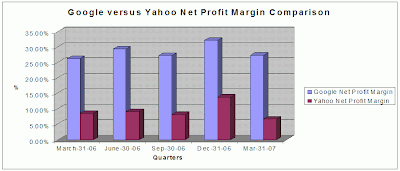
Google versus Yahoo Net Profit Margin Comparison
Google versus Yahoo Net Profit Margin Comparison

Another barometer of a company doing extremely well and putting more money in the bank is net profit margin, i.e. net income after paying income taxes as a percentage of total revenue. Google has averaged net profit margins of over 28% in the last five quarters; compare this to Yahoo's average net profit margin of just over 9%. Google's net profit margin is more than three times Yahoo's net profit margin. Yahoo has to work three times harder than Google to make the same amount of profits. Or Google has to work three times less than Yahoo. This means Google is running a highly efficient, operationally sound, profitable machine; Yahoo is doing good, but not as well as Google. Either Yahoo has to become more efficient (bottomline), or create a whole lot more revenue (topline) to really catch Google.
Google versus Yahoo Innovations Comparison
Google versus Yahoo Innovations Comparison

About the only area where Google and Yahoo are somewhat equal are total innovations. In 2006, Google had a total of 75 innovations including 44 new products, 25 collaborations, and 6 acquisitions. Yahoo meanwhile had 77 innovations in 2006, including 38 new products, 37 collaborations, and 2 acquisitions. In 2007, Google has kept up the pace with 26 new innovations through April 27, 2007, including 14 new products, 10 collaborations, and 2 acquisitions; Yahoo on the other hand has 24 new innovations, made up of 12 new products, 12 collaborations and 0 acquisitions. On surface, both Google and Yahoo seem to have the same pace of innovations. Why then Google is doing so much better in all the metrics above? Three reasons: 1. Quality of innovations 2. Meaningful acquisitions 3. Execution on current strategy. For instance this year, Google was able to acquire DoubleClick in an all cash deal for a huge amount of money; for Yahoo, this would have been difficult to swallow. Google's AdWords and AdSense are head and shoulders above Yahoo's Text Search solutions - Panama has narrowed the gap somewhat, however, Google continues to introduce new elements such as the recently announced WebSite Optimizer. Yahoo is quite fond of collaborations as a way to create a larger ecosystem and grow the business, and consistently leads Google in new collaborations. However, as with all partnerships, so much is not under your control, and there is a high dependence on how well your partner will do for you. Google has done well with the AdSense partnership program, and has built a mass of content partners all around the world - Google's partner growth is viral now. Yahoo has taken an early lead on the mobile platform though, and is betting that mobile is where the games will be played in the future.
Google versus Yahoo Stock Performance Comparison

Google stock has appreciated 16% since December 30, 2005; Yahoo stock is down 27% since December 30, 2005. However, Google stock has only gained over 4% this year (since December 29, 2006); on the other hand, Yahoo has gained over 11% this year. At one stage, Yahoo stock had gained over 25% in 2007; however, the latest quarterly results from Yahoo were received less favorably by the investors, and resulted in the drop. Google also had an early rally in the year, and was in the negative territory for a couple of weeks. Google's latest quarterly results eased the investor concerns about Google's torrid growth, and Google shares have gained ground since. Google stock has not appreciated in the same realm as the revenue growth. For a company whose revenue and net income has grown 63% and 69% respectively in one year, the stock performance gain has been only 16%. This has a lot to do with built-in expectation, and Google's already lofty valuation. Yahoo's revenue has only grown 7% in one year; and net income has dropped. Investors have rewarded Yahoo accordingly.
Bottomline
Google is firing on all cylinders, and has the making of a juggernaut. It appears that Google can only fall if Google makes huge missteps and places big bets on the wrong horse. Google has placed sizable bets with YouTube acquisition in 2006, and DoubleClick in 2007. YouTube acquisition led to some bad press owing to copyrights and a lawsuit by Viacom. Ultimately, Google will prevail, and YouTube in the meantime has seen nothing but huge growth in viewers each month. However, it has not come without some costs. DoubleClick will not have the same issues as YouTube; although it was valued astronomically high, hence the margin for error is small. In as much as Google can create timely innovations and execute well, it is poised to expand the market leadership further, and grow the revenue higher and faster. Yahoo has much catching up to do - both on topline and bottomline innovations; if Yahoo does not catch Google in the stride in 2007, it is possible that Yahoo could be relinquished even further in 2008. A time could come in 2008 and beyond wherein Google could outright grab Yahoo's market and begin winning away Yahoo's loyal base. The Disruptive Innovation Gap was created by Google, and now Google is running forward. How does Yahoo stop Google from doing this? It is a daunting task, and will take all of Yahoo’s Panama, Mobile and Content, and then some. Fundamentally though, Yahoo has to recreate that buzz and energy that used to be Yahoo, and get users to go to Yahoo in hordes as they used to go - before Google came knocking.
Bottomline
Google is firing on all cylinders, and has the making of a juggernaut. It appears that Google can only fall if Google makes huge missteps and places big bets on the wrong horse. Google has placed sizable bets with YouTube acquisition in 2006, and DoubleClick in 2007. YouTube acquisition led to some bad press owing to copyrights and a lawsuit by Viacom. Ultimately, Google will prevail, and YouTube in the meantime has seen nothing but huge growth in viewers each month. However, it has not come without some costs. DoubleClick will not have the same issues as YouTube; although it was valued astronomically high, hence the margin for error is small. In as much as Google can create timely innovations and execute well, it is poised to expand the market leadership further, and grow the revenue higher and faster. Yahoo has much catching up to do - both on topline and bottomline innovations; if Yahoo does not catch Google in the stride in 2007, it is possible that Yahoo could be relinquished even further in 2008. A time could come in 2008 and beyond wherein Google could outright grab Yahoo's market and begin winning away Yahoo's loyal base. The Disruptive Innovation Gap was created by Google, and now Google is running forward. How does Yahoo stop Google from doing this? It is a daunting task, and will take all of Yahoo’s Panama, Mobile and Content, and then some. Fundamentally though, Yahoo has to recreate that buzz and energy that used to be Yahoo, and get users to go to Yahoo in hordes as they used to go - before Google came knocking.
Monday, April 23, 2007
Why is Google shy about Marratech acquisition?
On the same evening of the record quarterly earnings announcement, preceding a week which included the huge acquisition of DoubleClick (was DoubleClick a Smart Buy?), Google Inc. (NASDAQ: GOOG) coyly announced the acquisition of Marratech's Video conferencing software on the Official Google Blog under the title: Collaborating with Marratech. No press release. No analyst call. No interviews. Just a simple announcement through a blog post by Google's VP of Engineering Douglas Merrill:
"As a company, we thrive on casual interactions and spontaneous collaboration. So we're excited about acquiring Marratech's video conferencing software, which will enable from-the-desktop participation for Googlers in videoconference meetings wherever there's an Internet connection.
We look forward to learning from the extraordinary ingenuity of Marratech's engineers as they focus on desktop conferencing research and development in Sweden, where they will continue to be located."
Why would Google do this? Why buy a company's video conferencing software when you are not going to go all out and talk about it? After all, Google is a key marketing innovator providing an advertising and search platform to tens of thousands of businessess worldwide. Why even put an update on the official blog afterwards that says: "To clarify some confusion, we acquired Marratech's software, not the company itself."
Contrast this particular Google acquisition with Cisco's acquisition of WebEx. Both Marratech and WebEx play in the same web collaboration and web conferencing market place. WebEx has over 2,000 employees; Marratech has 10, albeit a solid engineering team (as per Wikipedia). WebEx has industrial strength proven web conferencing and web collaboration technology used by thousands of corporations; Marratech has good technology that is used by tens of organizations.
For starters, Marratech has good software that include:
* High quality voice for groups with private audio feature
* Interactive group whiteboard including application and document sharing
* Multi party video
and provides support for:
* 256 bit Advanced Encryption Standard (AES) end-to-end encryption
* Support for Windows, Mac OS X and Linux on the client and server side.
* Support for bandwidth saving clusters
* Support for IP Unicast, IP Multicast or both
* Support for H.323 (dial in and out, E.164) and SIP
* H.264 video
Here are my top five reasons on why Google chose to acquire Marratech's video conferencing software and did not make a huge splash:
1. Google quite possibly entertained acquiring WebEx Communications Inc. (NASDAQ: WEBX), but did not go over the top as it did with DoubleClick, and essentially gave way to Cisco Systems, Inc. (NASDAQ: CSCO). WebEx would have been a smart play for Google in the enterprise market.
2. Google then decided to simply acquire video conferencing technology that it can essentially mold and embed it deeply within the Enterprise applications and Desktop. Google thus was looking at acquiring technology fast and for a small price.
3. Google will likely integrate Marratech into Google Talk, Chat, Google Apps, Google Desktop, and other Google collaboration products in the future. Marratech may even provide a superior audio solution than what Google has today. Google is only buying the software; it is not clear on whether Google will create a new team of engineers to work on the new solution, or outsource the development to Marratech.
4. Google may provide "Live Video Conferencing" powered by Marratech as an add-on to YouTube customers. This could be huge. YouTube has been a runaway hit with on-demand Video; combine this with live Video conferencing, and suddenly, Google can be powering the world's Video conferencing solution through the Google network.
5. Google will possibly use Marratech as a launchpad in Sweden and create a larger technology presence in the future.
"As a company, we thrive on casual interactions and spontaneous collaboration. So we're excited about acquiring Marratech's video conferencing software, which will enable from-the-desktop participation for Googlers in videoconference meetings wherever there's an Internet connection.
We look forward to learning from the extraordinary ingenuity of Marratech's engineers as they focus on desktop conferencing research and development in Sweden, where they will continue to be located."
Why would Google do this? Why buy a company's video conferencing software when you are not going to go all out and talk about it? After all, Google is a key marketing innovator providing an advertising and search platform to tens of thousands of businessess worldwide. Why even put an update on the official blog afterwards that says: "To clarify some confusion, we acquired Marratech's software, not the company itself."
Contrast this particular Google acquisition with Cisco's acquisition of WebEx. Both Marratech and WebEx play in the same web collaboration and web conferencing market place. WebEx has over 2,000 employees; Marratech has 10, albeit a solid engineering team (as per Wikipedia). WebEx has industrial strength proven web conferencing and web collaboration technology used by thousands of corporations; Marratech has good technology that is used by tens of organizations.
For starters, Marratech has good software that include:
* High quality voice for groups with private audio feature
* Interactive group whiteboard including application and document sharing
* Multi party video
and provides support for:
* 256 bit Advanced Encryption Standard (AES) end-to-end encryption
* Support for Windows, Mac OS X and Linux on the client and server side.
* Support for bandwidth saving clusters
* Support for IP Unicast, IP Multicast or both
* Support for H.323 (dial in and out, E.164) and SIP
* H.264 video
Here are my top five reasons on why Google chose to acquire Marratech's video conferencing software and did not make a huge splash:
1. Google quite possibly entertained acquiring WebEx Communications Inc. (NASDAQ: WEBX), but did not go over the top as it did with DoubleClick, and essentially gave way to Cisco Systems, Inc. (NASDAQ: CSCO). WebEx would have been a smart play for Google in the enterprise market.
2. Google then decided to simply acquire video conferencing technology that it can essentially mold and embed it deeply within the Enterprise applications and Desktop. Google thus was looking at acquiring technology fast and for a small price.
3. Google will likely integrate Marratech into Google Talk, Chat, Google Apps, Google Desktop, and other Google collaboration products in the future. Marratech may even provide a superior audio solution than what Google has today. Google is only buying the software; it is not clear on whether Google will create a new team of engineers to work on the new solution, or outsource the development to Marratech.
4. Google may provide "Live Video Conferencing" powered by Marratech as an add-on to YouTube customers. This could be huge. YouTube has been a runaway hit with on-demand Video; combine this with live Video conferencing, and suddenly, Google can be powering the world's Video conferencing solution through the Google network.
5. Google will possibly use Marratech as a launchpad in Sweden and create a larger technology presence in the future.
Saturday, April 14, 2007
Is DoubleClick a Smart Buy for Google?
Google Inc. (NASDAQ: GOOG) purchased DoubleClick for $3.1 billion in cash from San Francisco-based private equity firm Hellman & Friedman along with JMI Equity and management. Google is one of the Top 20 Innovators of The Innovation Index.
According to Google Press Release
"The combination of Google and DoubleClick will offer superior tools for targeting, serving and analyzing online ads of all types, significantly benefiting customers and consumers:
-For users, the combined company will deliver an improved experience on the web, by increasing the relevancy and the quality of the ads they see.
-For online publishers, the combination provides access to new advertisers, which creates a powerful opportunity to monetize their inventory more efficiently.
-For agencies and advertisers, Google and DoubleClick will provide an easy and efficient way to manage both search and display ads in one place. They will be able to optimize their ad spending across different online media using a common set of metrics."
According to Marketwatch story, "DoubleClick had been the subject of speculation about a possible acquisition. In late March, the Wall Street Journal reported that DoubleClick's owners were entertaining offers in the range of $2 billion from a handful of companies, including Microsoft."
Why would Google pay such a steep price for DoubleClick when DoubleClick was having revenue of only about $150 million in all of 2006 and was unprofitable as of April 2005? The acquisition puts DoubleClick's valuation at an astonishing and unheard of 20.66 times gross revenue. In comparison, Google's valuation is 13.7 times 2006 gross revenue. At 13.7 times gross revenue, DoubleClick would have been worth just over $2 billion. Compare this to recent acquisition of WebEx Communications (NASDAQ: WEBX) by Cisco Systems, Inc. (NASDAQ: CSCO) worth $3.2 billion, or 8.4 times 2006 gross revenue. The acquisition also puts tremendous pressure on Google's cash reserves that will deplete from $3.54 billion as of Dec. 31, 2006 to only $440 million. This means Google will not be able to invest freely in people and resources during all of 2007 and possibly 2008, until it rebuilds the cash reserve.
When Google CEO Eric Schmidt was asked about the large price being paid for DoubleClick in the conference call, Schmidt stated: "Google's board of directors felt after a detailed financial analysis (that) it's a very good deal for Google and our shareholders."
Bottomline:
Simply put, DoubleClick's innovative technology and ad platform provides Google an ability to provide display ads from agencies and advertisers. DoubleClick provides a ready-made platform, advertisers and agencies, publishers and relationships that have taken over ten years to build. However, some of these relationships could churn after Google completes the acquisition (case in point, YouTube acquisition and Viacom).
With Google's muscle power and market leading AdWords and AdSense platform though, DoubleClick business will see an incremental growth of possibly 50% to 100% year-over-year in the near future. At least this would be the expectation from Google Board.
This means, Google will see potential incremental revenue of $225 million to $300 million in 2008, $390 million to $520 million in 2009, and $675 million to $900 million in 2010 - so in essence, Google is paying about four times optimistic 2010 potential revenues through DoubleClick acquisition. Is Google being a bit carefree with the cash and money in the bank it has generated with the core business? Or is Google being bold and bullish by staking a key position in online display ad business? Should Yahoo! worry even more about Google? Why wouldn't Microsoft, AOL or Yahoo! pay $3.1 billion for DoubleClick, much less even $2 billion? It appears that a bidding war ensued between Microsoft and Google, and Google rolled the dice and placed a huge bet - perhaps Google did not want to come second in this particular bidding game. Microsoft could have benefited more from the acquisition. However, Microsoft must have found the price tag a bit too much to swallow, and decided to bow out.
On the other hand, DoubleClick acquisition is much closer to the core online Ad business that has made Google. It provides Google a real play against Yahoo!. And Google has the potential to further its marketshare in search advertising through inroads in display advertising. It also means that Google couldn't build out a display ad platform to rival Yahoo! within a given time and budget, and hence chose the acquisition route. Only time will tell on whether Google's lofty acquisition of DoubleClick for $3.1 billion is a Smart Buy. For now, the Google investors could be wary with all the questions, and may prefer a "wait-and-watch" mode until the dust settles. On the other hand, DoubleClick investors are having a big ball.
Friday, March 2, 2007
Can Yahoo! catch Google?
Before Google became Google, Yahoo! owned the search business. However, since Google search came onto its own, Yahoo! search was forgotten and relegated to the number two position. No one even considered the possibility that someday Yahoo! search can generate the type of revenue that Google generates, and possibly take on Google on the core search business that it owns a majority market share by a long shot. However, Yahoo! is coming back with Project Panama. It has a long road ahead, and significant catching up to do. And the question that was once forgotten is now being asked: Can Yahoo! catch Google? Mac Greer at Motley Fool interviewed Pulitzer prize-winning reporter David Vise, a senior commentator with breakingviews.com and the author of The Google Story on the question of the year: Can Yahoo! catch Google?
Yahoo! is one of the top 20 Innovators comprising the The Innovation Index, and is leading the top 20 Innovators in stock performance gain in 2007.
Here is Mac Greer's analysis on whether Yahoo! can catch Google, and his interview with David Vise:
--------Mac Greer analysis and interview-------->
According to preliminary reports, Yahoo Inc. (Nasdaq: YHOO) is recording some early success with its revamped search business, Project Panama. Online measurement company comScore Networks reports that since Yahoo! launched its new search business on Feb. 5, 2007, its click-through rate increased by 5% after its first week (ending Feb. 11) and another 9% after its second week (ending Feb. 18). But can a new and improved Yahoo! catch a tried-and-true Google (Nasdaq: GOOG)? I recently talked Yahoo! and other search-related business with Pulitzer prize-winning reporter David Vise, a senior commentator with breakingviews.com and the author of The Google Story.
Yahoo vs. Google
Yahoo! is one of the top 20 Innovators comprising the The Innovation Index, and is leading the top 20 Innovators in stock performance gain in 2007.
Here is Mac Greer's analysis on whether Yahoo! can catch Google, and his interview with David Vise:
--------Mac Greer analysis and interview-------->
According to preliminary reports, Yahoo Inc. (Nasdaq: YHOO) is recording some early success with its revamped search business, Project Panama. Online measurement company comScore Networks reports that since Yahoo! launched its new search business on Feb. 5, 2007, its click-through rate increased by 5% after its first week (ending Feb. 11) and another 9% after its second week (ending Feb. 18). But can a new and improved Yahoo! catch a tried-and-true Google (Nasdaq: GOOG)? I recently talked Yahoo! and other search-related business with Pulitzer prize-winning reporter David Vise, a senior commentator with breakingviews.com and the author of The Google Story.
Yahoo vs. Google
Mac Greer: David, Yahoo! recently launched what whey call their Project Panama, a new ad-ranking algorithm aimed at improving Yahoo's paid search. Do you think Yahoo! can compete with Google in paid search, or has the horse left the barn?
David Vise: I think that Yahoo! is a No. 2, but I think Google is a runaway No. 1. Google is synonymous with search. Look up "Google" in the dictionary, and it is the noun that has become a verb, "to Google." Yahoo! does have a space in search that is enviable to many people, but in reality, when you look at the numbers in terms of search, Yahoo! has less than 25% of the share. So Google is more than double its closest competitor, and that gap is growing.
Yahoo! has another problem with Project Panama that it is seeking to address. That is, Google is far better at converting searches and clicks into dollars than Yahoo! And Yahoo!'s ability to convert clicks and searches on Yahoo! into bottom-line profits has been very poor, and the company CEO, Terry Semel, has admitted as much. So it will be interesting to see how much Yahoo! can close the gap with Project Panama, and to the extent that it fails to do so, Google's lead will only widen. Remember, Google profits about 50% from searches done on Google.com, but it is the tremendous network that Google has created of literally hundreds of thousands of websites around the world that accept its ads and that it shares revenue with generously that give it a tremendous amount of market clout that goes well beyond its owned and operated sites.
MG: And David, I was stunned to see this stat from Piper Jaffray: Google earns two to three times as much on every user search than Yahoo!?
DV: That's right. It is a stunning figure, and you can bet that while Yahoo! is very publicly rolling out Project Panama, Google is very quietly also doing things to ramp up and improve its monetization of search. That kind of an edge between a No. 1 and a No. 2 in an industry increases the gap so widely that one could envision a time when you get to the point where Google essentially has little or no direct competition and where it really is in a monopoly position, as far as not only the information people are looking for, but also in terms of dominating Internet advertising.
MG: And if Project Panama doesn't take off, can we assume that Yahoo! CEO Terry Semel may not be Yahoo! CEO Terry Semel?
DV: Yes, I would say Terry Semel's future as the CEO of Yahoo! is tied directly to the success of Panama. If Panama succeeds, Semel is the CEO. If Panama goes down, Semel goes with it.
<--------Mac Greer Analysis and Interview--------
NY Times ran a story on the launch of Project Panama on Feb. 5. In this story, "Terry Semel acknowledges that Yahoo was late in starting the project (Panama). He said that happened partly because Yahoo's search advertising system, which the company acquired through its takeover of Overture Services for $1.6 billion in 2003, was performing well, and it took time for executives to realize just how much better Google's system was." ''Panama is a foundation for us to start sewing together all our advertising assets,'' said Tim Cadogan, vice president of Yahoo Search Marketing. Cadogan is also a realist. He believes the initial version of Panama will not get Yahoo! ahead, rather make Yahoo! compete more effectively versus Google.
Yahoo!, perhaps coincidentally after the launch of Project Panama, also began seeing more clicks directed at sponsored search ads, which generate more revenue than algorithmically generated ones. Sponsored clicks represented 10.6% and 11.1% of total click volume in the weeks ending February 11 and February 18, respectively, up from 10.1% during the week of February 4, according to comScore. Perhaps Project Panama is positively impacting the overall Yahoo! advertising business.In an unrelated story today, Yahoo Inc. (YHOO) Chief Financial Officer Susan Decker was appointed to the board of the venerable Berkshire Hathaway Inc. board. Berkshire Chairman Warren Buffett indicated that the board was looking for someone who was "owner-oriented, business-savvy, interested and truly independent."
Bottomline:
Yahoo!, beginning in late 2005 and 2006, has assembled an experienced team of managers, research fellows and economists to launch bold new initiatives, overhaul the search business beginning with Project Panama, and essentially take on Google in a twelve round boxing match. The first round was won by Yahoo!, the second and third round won decisively by Google; however, Yahoo! has shown that it has the staying power, and wants to now begin the next nine rounds of this long duel. This fight can easily take the next five or ten years. However, Yahoo! now wants to play this game on its own turf, and not get dictated by Google's rules. Case in point: Yahoo! Answers that won out against Google Answers. Yahoo! is also executing well on the mobile front with better, integrated solutions and key partnerships. Yahoo! perhaps has the senior management now that will methodically create the long term plan of attack versus Google. Then again, Google would make you believe that in the world of search, video, and Web 2.0, it is not the seniority that matters: rather unbridled passion and entrepreneurship. Managing and innovating through chaos is indeed the name of the game at Google.
If one takes a look at the financials, the discussion on whether Yahoo! can catch up with Google appears moot. In the quarter ending 12/31/2006, Google reported revenue of $3.2 billion; Yahoo! revenue in the same quarter was $1.7 billion. In the previous quarter ending 09/30/2006, Google revenue was $2.7 billion; Yahoo! revenue was $1.6 billion. Google quarter over quarter revenue growth is 19%. Yahoo! quarter over quarter revenue growth is 8%. A key measure is the widening quarterly revenue gap between Google and Yahoo!. The revenue gap for the 12/31/2006 quarter between Google and Yahoo! was $1.5 billion; for the previous quarter ending 09/30/2006, the revenue gap was $1.1 billion. The revenue gap quarter over quarter growth between Google and Yahoo! is a staggering 36%. If Yahoo! has to catch Google, not only Yahoo! has to increase its own quarterly revenue growth in the 25% to 45% range, but also grab market share and revenue from Google, and finally stall Google's revenue growth. Is this a lofty goal? Of course. Impossible? Nothing is. Unlikely? Only time will tell. Because it will take many years if Yahoo! is indeed going to catch up with Google.
Can Yahoo! catch Google? In ten years, would the headlines read: How Yahoo! toppled Google?
References:
Thursday, February 22, 2007
Google versus Microsoft - the enterprise battle heats up!
Google (NASDAQ: GOOG) today introduced new innovation with the Business version of Google Apps - Google Apps Premier Edition in direct competition to Microsoft's Enterprise applications.
Google is one of the top 20 Innovators of The Innovation Index.
Google Apps Premier Edition is available for a yearly subscription of $50 per user account per year.
Google Apps Premier Edition communication and collaboration suite includes the following Top Ten Features:
1. Google Gmail webmail services including Gmail for Blackberry
2. Google Calendar shared calendaring services
3. Google Talk instant messaging and voice-over-ip
4. Start Page branded and customized to company domain (e.g. companyname.googleapp.com)
5. Google Docs & Spreadsheets
6. 24 x 7 Phone support for critical issues - extended business hours support
7. 10 GB storage per user
8. New set of administration and business integration capabilities - Application-level control and APIs for business process adaptation, policies, data migration, user provisioning, single sign-on, and mail gateways
9. 99.9% uptime - SLAs (service level agreements) for monitoring and credits
10. French, Italian, German, Spanish, Chinese, Japanese and Korean language versions (possibly more)
Importantly, Google Apps Premier Edition builds on the success of 100,000 small businesses and universities using the free Google Apps Standard Edition and Google Apps Education Edition introduced in 2006.
Proctor & Gamble (NYSE: PG) and General Electric (NYSE: GE) are also two of the top 20 Innovators of The Innovation Index. Both P&G and GE applauded the new Google Apps Premier Edition.
P&G statement:
"Procter & Gamble Global Business Services (GBS) has enrolled as a charter enterprise customer of Google Apps, a successful consumer product suite now available to enterprises. P&G will work closely with Google in shaping enterprise characteristics and requirements for these popular tools," said Laurie Heltsley, director Procter & Gamble Global Business Services.
GE statement:
"So much of business now relies on people being able to communicate and collaborate effectively," said Gregory Simpson, CTO for General Electric Company. "GE is interested in evaluating Google Apps for the easy access it provides to a suite of web applications, and the way these applications can help people work together. Given its consumer experience, Google has a natural advantage in understanding how people interact together over the web."
Google also has the backing and adoption of smaller yet critical businesses such as San Francisco Bay Pediatrics.
San Francisco Bay Pediatrics:
"When it comes to our email systems, our doctors don’t have the time or the budgets to deal with managing technology or defending against spam," said Andrew Johnson, chief information officer, San Francisco Bay Pediatrics. "With Google Apps Premier Edition we don’t have to worry about downloading the latest spam filters or navigating unwieldy servers. This is where we let Google do what it does best, so we can do what we do best – help our patients."
Finally, Google made a very important announcement which was embedded towards the later paragraphs of the Press Release:
"other early adopters of Google Apps Premier Edition include Salesforce.com and Prudential Preferred Properties in the U.S., as well as Essilor and Mediametrie in France. "
Google is touting Salesforce.com as an early adopter.
Could this be the beginning of an early indicator that Google will go on to buy Salesforce.com?
Does Microsoft Live or Microsoft Business Services division have an answer for Google? Can Google find many distribution and enterprise partners such as Avaya and Postini to support, integrate and service Google Apps Premier Edition in the enterprise? For now, Google is knocking at the enterprise doors, and if Google is able to obtain early adopters such as GE and couple of other larger Fortune 500 corporations, Google will generate the kind of momentum where major enterprise customers will be compelled to take a look at Google Apps Premier Edition and evaluate at the price point of $50 per user account per year.
New Revenue Opportunity
With the introduction of Google Apps Premier Edition, Google has the opportunity to create new market share, and grab market share from Microsoft Office and Email applications. Google Apps Standard and Education Edition has 100,000 business customers today; at an average of 10 users per customer, this translates to 1 million end users potentially using Google Apps today. Google Apps was introduced in 2006. Thus, in about 1 year, Google Apps has an end user population of 1 million potential users. If Google Apps Premier Edition can attract 100,000 new businesses in one year, or 1 million end users, this will translate into new revenue opportunity of $50 million per year. However, knowing Google, and with the tremendous marketing muscle it exerts at Google.com, the goal is possibly much higher: 10 million end users or $500 million in annual revenue. Where will these customers come from? From new market growth and a sizable number from Microsoft. If Google goes on to buy Salesforce.com and introduces Google Apps integrated with Salesforce.com CRM applications, the vision of $500 million in annual revenue is within reach. In five years or less, Google has the potential to create a $1 billion business for Google Apps Premier Edition. Disruptive innovation in motion.
Google versus Microsoft - the enterprise battle heats up!
Google is one of the top 20 Innovators of The Innovation Index.
Google Apps Premier Edition is available for a yearly subscription of $50 per user account per year.
Google Apps Premier Edition communication and collaboration suite includes the following Top Ten Features:
1. Google Gmail webmail services including Gmail for Blackberry
2. Google Calendar shared calendaring services
3. Google Talk instant messaging and voice-over-ip
4. Start Page branded and customized to company domain (e.g. companyname.googleapp.com)
5. Google Docs & Spreadsheets
6. 24 x 7 Phone support for critical issues - extended business hours support
7. 10 GB storage per user
8. New set of administration and business integration capabilities - Application-level control and APIs for business process adaptation, policies, data migration, user provisioning, single sign-on, and mail gateways
9. 99.9% uptime - SLAs (service level agreements) for monitoring and credits
10. French, Italian, German, Spanish, Chinese, Japanese and Korean language versions (possibly more)
Importantly, Google Apps Premier Edition builds on the success of 100,000 small businesses and universities using the free Google Apps Standard Edition and Google Apps Education Edition introduced in 2006.
Proctor & Gamble (NYSE: PG) and General Electric (NYSE: GE) are also two of the top 20 Innovators of The Innovation Index. Both P&G and GE applauded the new Google Apps Premier Edition.
P&G statement:
"Procter & Gamble Global Business Services (GBS) has enrolled as a charter enterprise customer of Google Apps, a successful consumer product suite now available to enterprises. P&G will work closely with Google in shaping enterprise characteristics and requirements for these popular tools," said Laurie Heltsley, director Procter & Gamble Global Business Services.
GE statement:
"So much of business now relies on people being able to communicate and collaborate effectively," said Gregory Simpson, CTO for General Electric Company. "GE is interested in evaluating Google Apps for the easy access it provides to a suite of web applications, and the way these applications can help people work together. Given its consumer experience, Google has a natural advantage in understanding how people interact together over the web."
Google also has the backing and adoption of smaller yet critical businesses such as San Francisco Bay Pediatrics.
San Francisco Bay Pediatrics:
"When it comes to our email systems, our doctors don’t have the time or the budgets to deal with managing technology or defending against spam," said Andrew Johnson, chief information officer, San Francisco Bay Pediatrics. "With Google Apps Premier Edition we don’t have to worry about downloading the latest spam filters or navigating unwieldy servers. This is where we let Google do what it does best, so we can do what we do best – help our patients."
Finally, Google made a very important announcement which was embedded towards the later paragraphs of the Press Release:
"other early adopters of Google Apps Premier Edition include Salesforce.com and Prudential Preferred Properties in the U.S., as well as Essilor and Mediametrie in France. "
Google is touting Salesforce.com as an early adopter.
Could this be the beginning of an early indicator that Google will go on to buy Salesforce.com?
Does Microsoft Live or Microsoft Business Services division have an answer for Google? Can Google find many distribution and enterprise partners such as Avaya and Postini to support, integrate and service Google Apps Premier Edition in the enterprise? For now, Google is knocking at the enterprise doors, and if Google is able to obtain early adopters such as GE and couple of other larger Fortune 500 corporations, Google will generate the kind of momentum where major enterprise customers will be compelled to take a look at Google Apps Premier Edition and evaluate at the price point of $50 per user account per year.
New Revenue Opportunity
With the introduction of Google Apps Premier Edition, Google has the opportunity to create new market share, and grab market share from Microsoft Office and Email applications. Google Apps Standard and Education Edition has 100,000 business customers today; at an average of 10 users per customer, this translates to 1 million end users potentially using Google Apps today. Google Apps was introduced in 2006. Thus, in about 1 year, Google Apps has an end user population of 1 million potential users. If Google Apps Premier Edition can attract 100,000 new businesses in one year, or 1 million end users, this will translate into new revenue opportunity of $50 million per year. However, knowing Google, and with the tremendous marketing muscle it exerts at Google.com, the goal is possibly much higher: 10 million end users or $500 million in annual revenue. Where will these customers come from? From new market growth and a sizable number from Microsoft. If Google goes on to buy Salesforce.com and introduces Google Apps integrated with Salesforce.com CRM applications, the vision of $500 million in annual revenue is within reach. In five years or less, Google has the potential to create a $1 billion business for Google Apps Premier Edition. Disruptive innovation in motion.
Google versus Microsoft - the enterprise battle heats up!
Thursday, September 21, 2006
Can Ambiguity and Chaos create Innovation? You Bet....
In the latest issue in Fortune, Adam Lashinsky, Fortune senior writer, writes about "Chaos By Design" at Google.
He talks about how "disorder, disarray and uncertainty" are all "part of the plan" at Google.
This raises the question: Can Ambiguity and Chaos create Innovation?
Google, with over 8,000 employees, and over $10 Billion in annual revenue, is producing new innovation faster than your eyes can blink.
Selected references:
Leading eBook on Creativity and Innovation in Business
Creativity and Innovation Best Practices
Creativity and Innovation Case Studies
The Innovation Index
Top 50 innovative companies in the world
 Download market leading Creativity and Innovation in Business eBook. 212-page collection of over 55 best practices, case studies, and insights on the current state of Creativity and Innovation in Business at Top Innovators including Apple, Google, Netflix, 3M, Frito Lay, Johnson & Johnson, Proctor & Gamble, Toyota, GE, BMW, Deloitte, Southwest, Nike, IBM, Dell and more. "Your report from the eBook and definitive guide was the primary reference that we used." Used by over 500 leading organizations including HP, Pepsi, EDS, J&J, Nokia...Learn more
Download Now
Selected references:
Leading eBook on Creativity and Innovation in Business
Creativity and Innovation Best Practices
Creativity and Innovation Case Studies
The Innovation Index
Top 50 innovative companies in the world
For the complete article in Fortune magazine website, browse to:
Chaos By Design
He talks about how "disorder, disarray and uncertainty" are all "part of the plan" at Google.
This raises the question: Can Ambiguity and Chaos create Innovation?
Google, with over 8,000 employees, and over $10 Billion in annual revenue, is producing new innovation faster than your eyes can blink.
Selected references:
Leading eBook on Creativity and Innovation in Business
Creativity and Innovation Best Practices
Creativity and Innovation Case Studies
The Innovation Index
Top 50 innovative companies in the world
For instance, Google is the world's largest search engine and responds to more search queries than any other service online. Google.com is one of the 5 most popular sites on the Internet and is used around the world by millions of people. Google has released at least 83 full-fledged and test-stage products, including recent successes such as Gmail, Picasa, Finance, Earth and Blog. And Google's AdWords and AdSense programs innovated the business of search and created a windfall.
How does Google do this?
According to Sheryl Sandberg, vice president of Automated Advertising Systems: "We don't always have an answer. We're willing to tolerate that ambiguity and chaos because that's where the room is for innovation."
Google's senior vice president for business operations, Shona Brown, who is also the author of book that talks about "structured chaos" sums it up: "The way to succeed in "fast-paced, ambiguous situations," is to avoid creating too much structure, but not to add too little either. The company's goal, is to determine precisely the amount of management it needs -- and then use a little bit less."
According to writer Lashinsky, "That (approach) sheds light on all kinds of blunders -- which Google likes to explain away as its Googley approach to business. The company is figuring things out as it goes, and not quite as effectively as you'd expect from its stellar financial results."
The key question that the article discusses is on whether Google can come up with a second act? Can they create something tangible and huge as "Google.com"? Can Google continue to innovate, and how?
What's amazing is Google continues to innovate using what is described as "spaghetti method of product development (toss against wall, see if sticks),", requiring all Engineers to spend at least 20% of their time on new ideas.
Perhaps Writer Lashinsky best sums up Google's grand plan: "It should come as no surprise that the plan is as irreverent, self-confident, and presumptuous as the company itself."
How does Google do this?
According to Sheryl Sandberg, vice president of Automated Advertising Systems: "We don't always have an answer. We're willing to tolerate that ambiguity and chaos because that's where the room is for innovation."
Google's senior vice president for business operations, Shona Brown, who is also the author of book that talks about "structured chaos" sums it up: "The way to succeed in "fast-paced, ambiguous situations," is to avoid creating too much structure, but not to add too little either. The company's goal, is to determine precisely the amount of management it needs -- and then use a little bit less."
According to writer Lashinsky, "That (approach) sheds light on all kinds of blunders -- which Google likes to explain away as its Googley approach to business. The company is figuring things out as it goes, and not quite as effectively as you'd expect from its stellar financial results."
The key question that the article discusses is on whether Google can come up with a second act? Can they create something tangible and huge as "Google.com"? Can Google continue to innovate, and how?
What's amazing is Google continues to innovate using what is described as "spaghetti method of product development (toss against wall, see if sticks),", requiring all Engineers to spend at least 20% of their time on new ideas.
Perhaps Writer Lashinsky best sums up Google's grand plan: "It should come as no surprise that the plan is as irreverent, self-confident, and presumptuous as the company itself."
Download market leading Creativity and Innovation in Business eBook. 212-page collection of over 55 best practices, case studies, and insights on the current state of Creativity and Innovation in Business at Top Innovators including Apple, Google, Netflix, 3M, Frito Lay, Johnson & Johnson, Proctor & Gamble, Toyota, GE, BMW, Deloitte, Southwest, Nike, IBM, Dell and more. "Your report from the eBook and definitive guide was the primary reference that we used." Used by over 500 leading organizations including HP, Pepsi, EDS, J&J, Nokia...Learn more Download Now
Selected references:
Leading eBook on Creativity and Innovation in Business
Creativity and Innovation Best Practices
Creativity and Innovation Case Studies
The Innovation Index
Top 50 innovative companies in the world
For the complete article in Fortune magazine website, browse to:
Chaos By Design
Subscribe to:
Posts (Atom)