When does a Business become a dominant business in its market, achieve outright market leadership, and continue the market growth onwards and upwards.
Answer: Innovation.
Innovation driven by creativity and excellence in products, operations, and distribution.
Christensen's HypothesisAccording to Clayton Christensen, author of "Innovator's Dilemma: When New Technologies Cause Great Firms to Fall", companies that become attached to "
Sustaining Innovation" eventually disappear or lose their market leadership position. "Sustaining Innovation" is innovation derived from evolving the current product, serving profitable customers' needs, and focusing on investments driven by profit margins. On the other hand, companies that drive "
Disruptive Innovation" create new markets with opportunistic and creative Innovation, take away market shares from existing players of "Sustaining Innovation", and eventually become market share leaders. "Disruptive Innovation" is derived from creating simple, easy to use products that appeal to the low-end of the market, or a new, untapped market. Frequently "Sustaining Innovation" companies are driven up-market in a response to the low-end "Disrupting Innovation" players thus relegating them to a smaller segment of the market.
Christensen observes that as the market need evolves from early market to market maturity, the performance requirement associated with use and adoption of products by the broader market changes, and companies that are only focused on "Sustaining Innovation" typically do not react to this change. These companies are serving the needs of their current customers (profits), and frequently, these customers are not representative of the broader market. Even though these companies know about this change in customer habits and needs, they are not in any position to re-define themselves to embrace this changing market environment. On the other hand, companies driving "Disruptive Innovation" frequently observe this change in customer adoption, and create innovative products for the low-end market or a particular untapped market that allow them to achieve leadership.
Further, Disruption and Commoditization happen in parallel - so for the companies attached to "Sustaining Innovation", it is a double whammy - lose market to Disruption and lose profits to Commoditization. What ends up happening is the "Sustaining Innovation" company creating a product that is too good for the broader market and hence cannot command the premium price any more. On the other hand, the Disruptor, who is not worried about price margins, provides a product that is initially focused on the low-end market need or a particular unserved market segment, and begins capturing market share.
Some Questions
What happens to the "Disruptive Innovator" as we travel in time and as the markets evolve?
When and how does the "Disruptive Innovator" overtake the "Sustaining Innovator" ?
How does the market share for the "Disruptive Innovator" grow beyond the market share of the "Sustaining Innovator"?
To understand this further, let us look at the chart below titled "The Innovation Gap". (This is a variation from the model discussed by Christensen; I have tried to piece together the underlying concept)
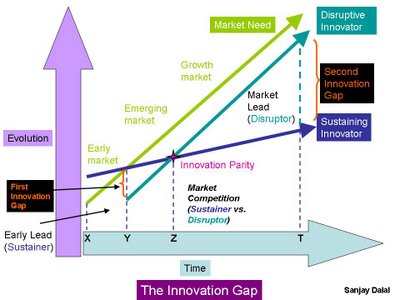
The X axis is the "Time" axis, the Y axis is the "Evolution" axis.
The chart showcases Market Need, Sustaining Innovator, and Disruptive Innovator. For chart simplicity, the Market Need and associated Market Growth is demonstrated on a straight line (a bell curve, or variable curve could be used instead).
Early Lead
The "Sustaining Innovator" or the Sustainer has the Early Lead in the Early Market. It has launched its product at point in time "X" as shown in the chart, a product that not only meets the current need of the customers in the Early Market, but also exceeds it. As a matter of fact, the Sustainer continues meeting this need of the Early Market customers, and some of the need of the Emerging Market customers as the market evolves.
The Disruptive Innovator or the Disruptor is not even present when the Sustainer began marketing its product to the Early Market customers at a point in time "X" on the chart. The Sustainer has this Early Lead on the Disruptor, both in terms of Market and Innovation, until the Disruptor launches its own product at point in time "Y" as shown in the chart.
First Innovation Gap
The Gap exists wherein the Sustainer has simply better Innovation than the Disruptor at the "Y" point of time in the Market evolution, has better understanding of the customer and has greater market share. We call this Gap, the "First Innovation Gap". The Sustainer has the lead on the Disruptor. It is precisely this Gap that drives the Disruptor to create new Innovation that is simple, easy to use and at relatively better price points. The Disruptor targets the low-end of the market or an untapped market. The Disruptor remains "under the radar" for some time as it starts building up this market that the Sustainer largely ignores (for the Sustainer is focused elsewhere, on the larger profitable customers, and meeting their needs).
Of course, this type of "First Innovation Gap" is not simply associated in the Early Market. It could happen at any stage of the Market. The Sustainer will have this Early Lead on the Disruptor always at some point in time.
While the Sustainer is Innovating at a different pace and trajectory serving the needs of its profitable and larger customers, and focused on profitable investments, the Disrupter is Innovating at a faster pace and trajectory serving the needs of the broader market, and creating new market share. The Disruptor has created Innovation that has a broader market appeal, owing to the simplicity and ease of use, and relatively better price points.
Innovation Parity
At point in time "Z" of the market evolution, the Disruptor has caught up with the Sustainer in Innovation, albeit on separate trajectories. We call this intersection as the "Innovation Parity". As is evident, it took the Disruptor less time to get to "Innovation Parity". The "Innovation Parity" is a significant milestone for both the Disruptor and the Sustainer - for the Sustainer has larger market share and profits at this point in time of the market evolution. The Disruptor has a growing share of the market and is also seeing some profits. And both the Disruptor and Sustainer are now matched up in terms of Innovation. The Sustainer's Innovation and market growth is tapered as it crosses the "Innovation Parity". The Sustainer has lost its market pulse and eye on the market, and is now losing head to head versus the Disruptor in its current market and customer base. The Sustainer has seen the growth of the Disruptor and growth of the broader market. However, the Sustainer has not changed with the changing environment and changing customer need. On the other hand, the Disruptor's Innovation and market growth is aligned and even faster than the pace of the market as it crosses the "Innovation Parity". The Disruptor is gaining significant market share, competing and winning head-on versus the Sustainer, and is beginning to create a Market Lead over the Sustainer.
Second Innovation Gap
What begins to emerge after the "Innovation Parity" is the "Second Innovation Gap". The Disruptor continues its Innovation momentum, is in tune with the market need, is winning consistently against the Sustainer, and has increased the market share. The Disruptor becomes the new market share leader at point in time "T" as shown in the chart. The Sustainer has fallen behind in Innovation, lost the momentum, is losing consistently against the Disruptor and lost the market leadership. The "Second Innovation Gap" is much wider than the "First Innovation Gap". For most Sustainers, the "Second Innovation Gap" is Game, Set, Match for the Disruptor that caused the Second Gap in the first place. The Disruptor is the newly crowned market leader and will remain the market leader for the longest time. This is not to say that the Sustainer cannot turn its Innovation and Growth trajectory and has the potential to itself become the Disruptor. However, as with the laws of probability, the probability for the same Sustainer to turn around and become a Disruptor again is minimal at best. Rather it is likely that the newly crowned Disruptor and market leader will at some point in time become complacent, become a Sustainer and leave the door open for a new Disruptor to come from behind. This could happen with a shift in the market, shift in customer need, significant market events, and significant new Innovation. And the Innovation Cycle continues.
How easy is it to cause Disruptive Innovation?
According to Christensen, Disruptive Innovation necessitates a disparate strategy process - not on what is already known to work, and incremental improvements. The process is driven by Creativity, unconventional and out-of-the-box thought, and without any anticipation. Further, the process design does not begin with addressing the needs of current customers (this is what the Sustainer does); rather the process design targets what's underneath the need. What drives customers to do what they do. Where is the unanticipated need? And finally, Disruptive Innovators are not profit driven - at least not initially. Their focus is on creating something of intrinsic value that will apppeal to a much larger market, yet is intuitive, easy to use and simple.
Selected references:
Leading eBook on Creativity and Innovation in Business
Creativity and Innovation Best Practices
Creativity and Innovation Case Studies
The Innovation Index
Top 50 innovative companies in the world
If you enjoyed reading this Creativity best practice, I recommend the complete list of Creativity Innovation Best Practices.
Acknowledgements
Clayton M. Christensen - The Innovator's Dilemma, The Innovator's Solution, Seeing What's Next


 Download my Creativity and Innovation eBook. 212-page collection of over 55 best practices, case studies, and insights on the current state of Creativity and Innovation in Business at Top Innovators including Apple, Google, Netflix, 3M, Frito Lay, Johnson & Johnson, Proctor & Gamble, Toyota, GE, BMW, Deloitte, Southwest, Nike, IBM, Dell and more. "Your report from the eBook and definitive guide was the primary reference that we used." Used by over 500 leading organizations including HP, Pepsi, EDS, J&J, Nokia...Learn more
 It weighs only 2.5 oz (about the weight of a "C" battery), and is 35% smaller in size than a credit card. It is the world's smallest flip phone. And then the obvious question comes to mind? Does it pack a punch? Does it have the cool features? The answer is Yes. It has all the standard features of a cell phone and then some. How about a VGA camera with flash, multimedia messaging, tri-bands, instant messaging, speakerphone, MP3 and Music tone ringtones and more. And 35% smaller in size than a credit card. A very small Innovation that consumers are racing to buy, use and enjoy.
