Showing posts with label tripadvisor. Show all posts

Monday, February 1, 2010

Tnooz: The blurring lines between transactional and non-transactional sites

My latest post for Tnooz has is live. Title of the post is "Non-transactional travel sites are chasing the online agents on unique product hunting – but can it work?". I write about how content sites are starting to negotiate directly with suppliers for unique product offerings, trying to directly challenge the major online travel agents. Mentioned in the post are Kayak Private Sale, TripAdvisor Business Listings, Voyageprive, Jetsetter, Dealbase and Totaltravel.

You can read the full post here.

Wednesday, November 11, 2009

3 rules for what is needed to start a consumer information or UGC based online travel start-up

User/crowd generated content available through the mega review site TripAdvisor has done a lot of things to the industry. On the consumer side they arguably changed the purchase patterns by putting user generated content at the heart of the decision making process. On the hotel marketing side they generated a whole industry of review gaming and UGC manufacture. And...on the start-up side they have convince online travel entrepreneurs that there is a business model based solely on attracting customer because of users contributing their experiences, ideas, content and more is unbeatable.

I had one such company write to me recently called cost4travel. Their plan is for consumers to share with each other their experiences on the costs of travelling to various destinations and for various activities. The idea is that consumers will share the prices they have paid for the greater good of allowing other consumers to get user supported price estimates. Allowing users to search by cost as a first point of reference rather than by destination. Interesting idea and reminiscent of Joobili's idea of coming to the search process on a time/date basis rather than destination. The challenge for cost4travel and any business that needs a scale of user content or data is how to get that scale. In the perfect world consumers add all of the data you need. That, like TripAdvsor, thousands, then tens of thousands and eventually millions of consumers will add the content for you. The challenge is how to get the consumers to volunteer information when the initial content collection is sub-scale - when a contribution by the earlier users is not going to be responded to on mass by the contribution of other consumers. Finding a way to build a business model that depends on consumers contributing the answers and information before...well...consumers have contributed the answers and information. You can call this the UGC paradox.

I have been trying to think back on the early days of TripAdvisor as surely they had this issue but I cannot recall how they managed it. Can you? Therefore I moved to looking to two non-travel examples for inspiration. From these 2 I suggest 3 rules for starting a consumer information (UGC) dependent business in online travel. First the rules and then the inspiration.

My 3 rules on things you must have to start a consumer information or UGC based online travel start-up

1. You need a source of data to kick things off. Look for and index available data first. There will be little incentive for consumers to search or contribute without a baseline of data. When looking for this data do not be afraid to use expert or professional data. In fact seek out great quality existing content and add value to it by being the best index and distribution mechanism for it;

2. Reward consumers for entering data and content. Altruism is not enough to get consumers to give you data. You need to give them an reward. For example make data contribution a "cost of entry" for consumers. You have to give something to get something. Make it so that if a consumer contributes data, then they get a better result; and

3. Syndicate, distribute and get it out there. Make it easy, very easy for consumers to send the information around, blog it, share it, tweet it, swap it....get it out there.

Inspiration number 1 - Payscale

Payscale is a Seattle based salary and compensation site. Anyone can open a profile, enter in their skills, experience, location and job title. Payscale then matches you against everyone else in the Payscale universe of contributors and returns salary and compensation comparison information. Another UGC play that requires scale. It can only provide an information seeker with a valuable experience if there are millions of consumers contributing their skills, job descriptions and salary information. Scale they have. In Oct 2008 they reported 15 million profiles. But at the time of launch they probably only had a few hundred profiles (assuming they beta-launched with info input by friends, family and founders). Thus they kicked off the business and populated their database with statistical data from a variety of external (read non user generated) sources including government sources. Plus before you could access the data they had collected from others, you had to submit your own data. Means there was enough initial data to provide a answers to early customers and those customers had to submit more data. We learn from this that you need to collect some starting point data to kick of the business and will be more success if you reward consumers for entering data (in this case by making it a cost of getting a response).

Inspiration number 2 - YouTube

YouTube is the biggest UGC site on the web. Without user generated videos YouTube is dead. The purist YouTube UGC argument is that YouTube over came the UGC paradox through timing in technology and social desire. That is launched itself at exactly the right time - when the desire for consumer sharing of videos matched the technology capability to shoot and upload in moments. However the real truth (OK arguable truth) is that what made YouTube popular enough to attract scale in UGC videos was not UGC videos. Rather it was copyrighted material. In particular consumers uploading and then sending to each other copyrighted material from Viacom (Daily Show, Colbert Report, MTV videos) and NBC Universal (Saturday Night Live). Before videos like Dancing Matt and LonelyGirl15, the huge YouTube hits were videos like SNL's Cronic of Narnia (no longer avail on YouTube). YouTube was built on the back of sharing professionally produced copyright material not UGC. Don't believe me? Then think back to the first time you were sent a YouTube video. I'm betting it was a clip from a TV or a music video. Still don't believe me? Then look at the list of top watch videos of all time. Seven of the top eleven are music videos or clips. YouTube's early value was in being a repository and distribution means for non-UGC. The learning from this is don't discount "expert" or professional data. If fact you may want to encourage it. Secondly we learn - make it easy, very easy - for consumers to send it around, blog it, share it, tweet it, swap it....get it out there.

So from YouTube and Payscale I have developed my three rules for launching UGC based start-ups. There will be more rules for making it a success but these are my view on what you need to get started.

Anyone one out there remember the early days of TripAdvisor well enough to add to the list of rules? More ideas in the comments.

thanks to richbeechina for the crow shot

Sunday, November 1, 2009

Kuxun acquisition takes TripAdvisor further into China

Expedia's TripAdvisor is to buy Chinese meta-search company Kuxun (at least I think it is a meta-search company) (according to Dow Jones via Hotelmarketing.com). TripAdvior CEO Steve Kaufer would not give away how much was paid but is quoted in the article as saying he has US$50mm to invest in China in 2010 and 2011 but this includes setting up the local version of TripAdvisor Daodao.com. Also said he plans to double the number of staff in China from 80 to 160. My guess (no basis just a hunch) is Kuxun will be used as the tech behind Daodao with Kuxun's brand to disappear soon after the deal.

In case you are wondering about meanings. I am reliably informed that Kuxun means Cool Information or Smart Information and Daodao means To Reach, To Arrive.

Her is my updated list of TripAdvisor Acquisitions in the last few years:
I always close these stories with the reminder that Expedia owns TripAdvisor as you'd be surprised how much search traffic I get asking the question "who owns TripAdvisor"

Tuesday, August 18, 2009

801 not out

Another 100 posts are live on the InterTubes. Time again for my regular "not out series" recap where I go through the last 100 posts and remind you of the themes that have been dominating the blog. I started almost three years ago with 101 not out and continued with 201, 301, 401, 501. 601, and 701 not out. This comes at a time that the BOOT passed the 100k visitor mark.

Two new segments for the Blog
Meta search action a-plenty which I tried to summarise in my post "Meta-search vs Online Travel Agents: the three main differences and why they matter"
While also having time for Travel Discovery and Inspiration sites such as:
...and we found out how much Expedia paid for VirtualTourist and OneTime

BOOT interview mania with start ups and industry shakers
oh...and...a plane actually landed on water

Sunday, August 2, 2009

Still trying to convince offline travel media that Expedia own's TripAdvisor

Below is an extract of the TravelToday daily PDF published by the Australian version of TravelWeekly (owned by Reed Business).
Expedia coup
Expedia has partnered with SeatGuru to integrate user reviews of airplane seats [sic] into the seat maps for flights sold on Expedia.com.
In case you (like TravelWeekly) have missed the last 5 years of the online travel industry, Expedia owns TripAdvisor and in May 2007 TripAdvisor bought SeatGuru.

What next TravelWeekly? Amazing news that Qantas has extended its preferred supplier relationship with Qantas Holidays. Industry shaking news that W and Sheraton hotels have agreed to exchange loyalty club points. Hold the front page news that Avis and Budget are using the same fuel supplier.

Rather than using the headline "Expedia coup", it would be more appropriate to usethe phrase "People at Expedia are returning each other's calls". But that would hardly make for an interesting headline.

PS - can only find the article in PDF form, let me know if you see it online.

Tuesday, July 7, 2009

TripAdvisor needs to move to a "no stay, no say" approach to reviews to protect brand and online reviews generally

TripAdvisor - Hotel ReviewsExpedia's TripAdvisor is claiming more than 20 million reviews on their site. In addition they have been on a steady and apparently unstoppable campaign to buy niche review sites in areas such as Cruise, holidays, airline seats and vacation rental. You'll find the latest list of everything they have bought here. As a result (and as predicted here) they have morphed from a destination site to an online advertising network and meta-search company called (unsurprisingly) the TripAdvisor Media Network.

While that has been going on in the background, the front end of TripAdvisor looks like an Onlnie Travel Agency site with tabbed header, a search widget middle left, deals and promos in the the C column and content and search help below the fold. Clearly a move to compete directly with the OTAs in drawing in consumer loyalty and repeat business.

Despite all the changes, the heart of TripAdvisor is the reviews. The dedication of the user base to write detailed, descriptive, useful and Google friendly content to attract lookers and bookers. This all ties to the baseline of the TripAdvisor band and their tag line - "get advice from real travellers". Unfortunately stories are coming out about possible flaws in TripAdvisor's mechanism for ensuring that reviews are only written by "real travellers".

Just recently the Times in the UK ran a piece called "Who's really writing the reviews on TripAdvisor". The story quoted one hotelier as saying "the system is laughably easy to manipulate....I was even approached by PR first offering to write my reviews for me." Newsweek also covered the story in their article "TripAdvsor tries to respond to fake hotel reviews". In that story journalist Sean O'Neil noted that he did not understand why "TripAdvsor didn't duplicate Amazons "Real Name" feature, which offers third-party verification that a reviewer is the person he or she claims to be".

The question is not whether or not their are fake reviews on TripAdvisor - clearly there are. The question is how many are there and what influence do they have in hotel rankings, especially in smaller destinations. Consumer Travel uber Blogger Chris Elliott put the question best in his story "Does TripAdvisor hotel manipulation scandal render the site completely useless".

The official word from TripAdvisor (care of Elliott's post) is that they have a zero tolerance for fake reviews (they call it fraud) and a three methods for policing this policy. Quote -

"1. Every review is screened prior to posting and a team of quality assurance specialists investigate suspicious reviews

2. Proprietary automated tools help identify attempts to subvert the system

3. Our large and passionate community of more than 25 million monthly visitors help screen our content and report suspicious activity"

An example of this approach can be seen on the entertaining TripAdvisor We're Not Making This Up Blog (in the post called "Exactly") where an irate hotel DOS is complaining that all of the reviews he is writing for his own hotel are being pulled down.

What is missing is independent confirmation that the customer actually stayed in the hotel. My view is that these three steps are not enough. Technology and human review will simply not be enough to screen out the "gamers". The only way to be truly clear of fraud is for TripAdvisor to move to a "no stay, no say" rule. A means of verifying that the person writing the review has stayed at the hotel. This could be achieved though a combination of approaches such as a feature like the Amazon Real Name service, using the enormous amounts of transaction and searching data that the Expedia Inc empire collects, drawing on information from advertising partners and other verification mechanisms.

The counter view is that this would be too hard for TripAdvisor as they do not do any of the bookings, that is left to the advertiser. While there is some truth to that argument, between the data collected by TripAdvisor on click behaviour, information provided by advertisers and information from what must be a massive Expedia Inc privacy killing data warehouse, there is (I am sure) more than enough data available to TripAdvisor to verify. I would not be cheap or easy to do, but in my opinion necessary

What do you think - should TripAdvisor move to a "no stay, no say" rule or is the fraud so small that it doesn't need to?

If you are looking for more commentary on this story also check out
As always I close with confirmation that Expedia owns TripAdvisor. Other than searches for my name, Google searches for "who owns TripAdvisor" is my number one source of search traffic.

Sunday, May 31, 2009

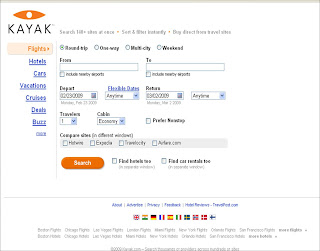
Kayak CEO Steve Hafner Interview: keep it simple, focus on search, stay out of Asia..oh...and get back into offline marketing

Enjoyed a chance to catch up with Kayak CEO Steve Hafner last week. I had planned the call to be about the challenges of a traffic arbitrage business model. I had hoped to draw out of Hafner that there was pressure in the Kayak model fuelled by rising paid search costs, being late to the review game with the Travelpost revamp and tremendous marketing and product pressure from the drop/elimination of booking fees by the big online travel agents (OTAs). Instead Hafner was relaxed, confident and ready to push ahead with millions of dollars in offline (yes offline) advertising planned.

We touched on two main areas. His focus and plans for the next twelve months (including plans for Travelpost and why the OTA fee cuts don't phase him) and his thoughts on expansion outside America (not in Asia and measured in Europe). On the former there is a lot to be worked on for Travelpost to catch TripAdvisor but there are plenty of flaws with the TripAdvisor product and an accompanying disquiet amongst users. On the latter, the potential risk I can see is that they may be under estimating the challenges of growing in Europe where they have more competitors and less compliant suppliers.

Here is our exchange in detail.

On plans for the next twelve months

Hafner says that Kayak is exclusively focused on three things:
  1. More focus on core search: The measures here are speed, accuracy and simplicity. Hafner is measuring his world in terms of milliseconds in response time. I asked if we was worried about price accuracy, database loads, hotel and switch look to book issues but none of these concerned him. For Kayak the true cost per query is falling to near zero through caching and the costs of bandwidth. This allows him to focus on the speed of search and the comprehensiveness of the results. His goals are big but simple - that the submit button results in a search in 15 milliseconds, that the results contain every bookable option and that the filtering and customer profiling gives the client the results they want. While this sounds obvious it was the simplicity and aggression in his focus that impressed me;
  2. Driving awareness: Hafner believes it is the perfect time to get back into offline marketing to take brand awareness to the next level and compete with the OTAs. He believes that Kayak is "fully penetrated online" and that the costs of offline has "come down by about a third". Critically he does not want to leave the offline channel as the exclusive domain of the big spending OTAs, especially because (as he puts it) "the fee cut [by the big OTAs] takes margin away from their P&L and out of their marketing budgets". New CMO Robert Birge has a $100mm to spend on marketing and a CEO keen to see the brand in lights on TV (example below of their "trip idea" commercials from back in 2006). Right now Hafner is claiming that 8% of online shoppers have heard of Kayak (cf he claims Orbtiz number is 60%). In two years he wants the number to be 20%. ; and
  3. Making Travelpost a viable competitor to TripAdvisor and Travelzoo: Kayak has followed the much smaller Uptake into the review meta-search model through a revamp of Travelpost. Prior to the revamp Travelpost (acquired by Sidestep) was a user generated hotel review site much like TripAdvisor. Now post revamp it aggregates reviews from around the web as well as allowing direct posting and commentating. He plans to go after both TripAdvisor and Travelzoo with this new product. He hopes within two years for Travelpost to be generating about half the revenue that Travelzoo is making from deals and to be 15% of the size of TripAdvisor's media revenue (up from 1% now).
On Expansion plans

An interview with Hafner is famously free from PR generated answer obfuscation. I asked a detailed question about the Asian market that started with a lead in on the challenges in the market, the earlier successes of Qunar in China and Wego in Singapore and Australia. Even made a reference to Sprice and Cheapflights. "So Steve," I concluded, "do you have your eyes on Asia too?". Two word answer - "absolutely not". In short he thinks the market is too small (in terms of search volume) and not mature enough (in terms of online advertising).

Europe is another matter. He admits that the change in MD "reflects a disconnect in aggressiveness" which I read to mean that the outgoing MD had a more aggressive plan than Hafner did (see the Travolution post on this for more details). This does not mean they are pulling out of Europe and he rejected any suggestion that Kayak had made a "false start" there. Instead they will keep on with the general three strategies above run by the two people in the London office. He conceded that there are product gaps in Europe (no Rayanair and some other low cost carriers) as well as higher costs from online marketing as Google is so much stronger but he is there for the long term even with no plans to replace the Managing Director role.

The competitors are coming fast at Kayak with big marketing budgets and constant model changes. Kayak's response is keep doing what we are doing only better and now on TV. What do you think. Good plan?

---------------------
Example of earlier offline advertising efforts by Kayak.

Sunday, May 10, 2009

Want to know how consumers search for Travel - well NY times has a few tips

Interesting piece here from the New York Times' "Frugal Traveler" called "Research: The Travller's Best Friend". Is an article where the Frugal Traveler gives their tips and tricks to NY Times readers on which sites to use to research, book and manage a trip. There will be no surprises for you the experienced online travel user/abuser but it does provider some useful insight into the advice the the mainstream media is giving the online consumer on where to look and book.

No blogs were mentioned. Sites getting a mention include:
Also some old school recommendations to check out books.

Thanks for Madame BOOT for sending through the link.

Thanks to Kristina B for the fantastic image

Wednesday, May 6, 2009

VirtualTourist and OneTime cost Expedia $85mm according to Venture Beat

Eric Eldon over at the Venture Beat is reporting from an interview with VirtualTourist and OneTime founder J.R.Johnson in his post "No free lunch: The story behind VirtualTourist’s big exit, and Lunch.com".

For those keeping a track of the large number companies bought by TripAdvisor recently, VirtualTourist and OneTime were acquisitions nine and ten in year of frenetic activity by the Expedia owned Tripadvisor (yes...Expedia owns TripAdvisor:)).

Not sure how he did it (and he does not credit Johnson with leaking it) but Eldon has discovered that Expedia/TripAdvisor paid $85mm for the two companies. More back story to the transaction over at the full VentureBeat post.

Hat tip to HotelMarketing where I first saw the story.

Friday, February 20, 2009

Expedia to launch meta-search. But... don't they already own OneTime

A Kevin May @travolution tweet pointed me to a Travolution story "Expedia mulls launch of meta search engine". Contains a quote from Expedia CEO Dara Khosrowshahi considering a move into the meta-search model. I found this a little odd as back in July last year Expedia subsidiary TripAdvisor (yes...Expedia owns TripAdvisor:)) bought meta-search company OneTime (my post on the story here). Couple of possibilities here. Maybe the OneTime engine is not good enough and Expedia needs to start again. Or maybe Khosrowshahi has signed off on so many acquisitions for TripAdvisor that he forgot about one. Most likely it is just a sign that of the long list of TripAdvisor subsidiaries one of them (OneTime) is going to be getting a lot more attention than the others.

Update - getting lots of feedback in comments, twitter and email saying the OneTime should not be considered a meta-search company. More a deal finder. Looks like Option 1 above is the right one (OneTime engine is not good enough).

Monday, January 5, 2009

The BOOT is back for 2009 with 5 predictions for the online travel industry

The BOOT is back for 2009. Tanned (a little burnt), rested (though could do with another big sleep in) and ready for action (kind of). Inspired by the Travolution article "Predictions for 2009" I am going to open up the 2009 edition of the BOOT with my predictions for the travel industry. Here are my five predictions for 2009:

  1. There are more airlines to go bust. In fact before the end of 2009 a big carrier will go bust or be taken over as a saving measure. Alitalia is a gimme so I wont count the impending Alitalia failure/restructure as a successful prediction. Another big carrier (or two) will fail or be bought in 2009. Update - if you want a list of all of the 21 airlines that died in 2008 check out this post over at cranky flyer;
  2. Domestic travel growth will surprise us all. I am a noted optimist when it comes to the travel industry surviving shocks and set backs. People will still travel in 2009 - they will just go short. Consumers will look for domestic deals and shorter trips to enable them to enjoy the travel and breaks they want without the long-haul price tag;
  3. Consolidation is not yet finished: In 2008 TripAdvisor bought everything in sight, Venere first bought Worldby then joined the extended TripAdvisor family by being acquired by Expedia, Microsoft bought Farecast, Priceline bought Agoda, Wotif bought AsiaWebDirect and Travel.com.au and more. The consolidation in the online travel industry will continue through 2009. There are too many bargains out there;
  4. 2009 will not be the year of mobile for the travel industry: Every year since 2000 we have been talking about the mobile revolution in online travel. This year I rejoined that chorus of mobile revolution fan boys while at PhoCusWright in LA. With the Global Financial Crisis (I am told there is even an acronym for this - GFC) in full swing I think the larger players will pull back from their mobile plans and focus on core products, costs control and customer loyalty. Mobile will have to wait until 2010; and
  5. The dinosaurs will screw up and come out of the GFC even weaker: The big offline players have been screwing up online for a long time now. The good ones have managed to avoid destruction due to the booming economy and the sale of complementary products (land, car, package and especially cruise). The boom is over and the pain is hitting. Just recently Flight Centre announced a likely 33% drop in profits for 2009. In the past I have given advice on how you would know that offline players like Flight Centre "get it" and are ready to execute online. The GFC actually provides a fantastic opportunity to "get it" and join the online travel revolution. Expectations for performance are low during a bust giving offline players time to shift focus and make investments in areas they have previously ignored online. But I think the offline players will miss this chance. Instead of emerging from the GFC with a stronger online focus they will dig even deeper into the offline hole and emerge even further behind the online industry leaders. As evidence of this see the recent interview from new Stella Travel (Australia's number 2 offline player) CEO Peter Lacaze where he confessed to being an online sceptic. [Disclosure - in the past I have consulted to Stella on their online strategy].
UPDATE - Prediction number 6 - the last minute model will come back. I called the last minute model as being on hiatus in May 2008. It will come back as hotels start to hurt during the GFC.

Stay tuned to see what I get wrong and right here. The BOOT is back for 2009.

thanks to Tokyo Boy on flickr for the photo

Friday, December 12, 2008

Expedia and Travelocity team up (in Asia at least): Zuji is carrying Tripadvisor reviews

Am sure you know by now that Travelocity is operating in Asia under a number of brands including Zuji in Australia, Hong Kong, Singapore, New Zealand and Taiwan. You definitely know that Expedia owns Tripadvisor (though I keep getting search engine travel from people that don't). But did you know that Zuji is now including Tripadvisor branded reviews in their hotel search results. In other words a content sharing deal between a Expedia company and a Travelocity company.

Wednesday, November 19, 2008

PhoCusWright: Model Blur - media and retail. Big deal for the industry but less for consumers

Center Stage at The PhoCusWright Conference
Philip Wolf is giving his opening monologue at the Centre Stage part of the PhoCusWright conference in LA. The second storm in the "Perfect Storm" is the merging of models in Travel between the media model and the retail model. The media model being eyeball focused, content companies that generate money from advertisers (think TripAdvisor and Away in the travel space, Yahoo!, MSN and online newspapers in the more general media space). The retail model is based on transactions direct with consumers (surely you don't need me to give you examples).

As part of the Philip's perfect storm analogy, these two models are coming together. Expedia has started doing Google Ad words, Partner Marketing is exploding on OTAs (TripAdvisor, Away, IgoUgo and the OTA sites themselves), companies like Hotel.de allow select/preferred hotels to bid for higher spots in the search results with increased margins (much like Google Ad words itself).

This is a big deal for the industry. Retailers embracing the media business is a signifcant and substantive business transformation (and one that I have said has to be executed cautiously and consciously). In a later session Jake Fuller of Thomas Weisel Partners said that while he expected much less consolidation in 2009 compared to 2008, if it does come it will come in OTAs/retailers expanding their media businesses.

But I think this shift is less of a big deal from the consumer point of view. The consumer is coming to online travel retailers and media companies with the same question and desire. Whether they come to a retailer or a media company they are still asking "where should I go and where can I get a good deal?".

My view - focus on answering the consumer question rather wondering which business model we are in or should be in. Answer the consumer need first and let that drive the product and business model needs.

Monday, August 25, 2008

TRAVELtech: TripAdvisor China "on its way"

Arthur Hoffman MD Expedia AU/NZ took time to talk through a lot of the non-retail activities of Expedia in Asia Pacific.

The stories have already broken around the launch of localised TripAdvisor products in India and Japan. Hoffman when on to say that TripAdvisor "on its way to build a more local model in China". Will call that a pre-announcement.

He is convinced you need to incorporate content and retail. Not in a community fashion but in a targeted fashion - personalised for the individual consumer. Gave an example of the integration of the SeatGuru airline seat information into the booking path of Egencia (new name for Expedia's corporate travel agency).

Thursday, August 21, 2008

TripAdvisor into Vacation rental through purchase of FlipKey

Another play by TripAdvisor. This time they have acquired vacation rental player FlipKey. Hotelmarking.com has the press release here. Even though FlipKey is an accommodation provider don't confuse them with an intermediary like the Expedia owned Hotels.com. If I understand the FlipKey model correctly they are a listing service. They charge either or both of a listing fee and per email referral fee. In other words it is an online version of a yellow pages or pay for listing directly. I don't mean that to be a negative or derogatory, rather to highlight that it is an advertising business (like the rest of the TripAdvisor Media Network) not a retail business (like the Expedia business).

I am continuing my updated list of their acquisitions.
I always close these stories with the reminder that Expedia owns TripAdvisor as you'd be surprised how much search traffic I get asking the question "who owns TripAdvisor"

Wednesday, July 23, 2008

Online Content and Advertising: Are the Eyeballs drying up?

Old school online travel was about selling travel to people. Consumers would search, put in a credit card and end the process with a done transaction. New school online travel is about content and eyeballs. I have talked before about the "zero percenters" - sites which control none of the content on their website, instead relying on user generated content. Even more recently I spoke of the significant ad network that is now the TripAdvisor Media Network. I have also come across a dedicated ad network for travel content sites called - in a very creative move - The Travel Ad Nework. All of these sites and networks depending on eyeballs and advertisers willing to pay for those eyeballs. There is trouble on the horizon for ad dependent players. ValueClick Media (the second biggest of the independent advertising networks) pre-anounced their results last week. They are predicting revenue of $163-$164 million versus expectations of $166-$170 million. This slight miss caused the ValueClick stock to plunge 18% in one day. A few days later and the stock is down almost a third. Are the dollars chasing eyeballs drying up???

thanks to sean dreilinger from flickr for the photo

Monday, July 7, 2008

Virtual Tourist and OneTime.com join the TripAdvisor Media Network

I have been off the grid so am late in commenting on TripAdvisor's acquisition of social network Virtual Tourist and meta-search company OneTime.com (deal press release here). alarm:clock is crediting the nine year old Virtual Tourist with 5 million uniques and 30 million page views a month. Hotelmarketing.com reported in April that Virtual Tourist had passed the million member mark. The release says that VirtualTourist General Manager Giampiero Ambrosi and OneTime General Manager Dena Yahy will stay with the company but no word on what will happen witth Virtual Tourist founders J.R. Johnson and Tilman Reissfelder.

I have been saying for a while now that TripAdvisor is an advertising network
. They are already calling themselves the TripAdvisor Media Network (see the bottom of this press release as an example).

The combined network is carrying some 32 million unique users per month. To put this in perspective I understand that ValueClick Media is the second biggest of the independent advertising networks (here is a list of the top ten from Dec 07). By independent I mean one not owned by a large publisher such as Advertising.com (AOL), BlueLithium (Yahoo!) and aQuantive (Microsoft). ValueClick claim 137mm uniques it their ad network. 32 Million for TripAdvisor is still well short of the ValueClick mark but still more that enough to be a top network. I predict that very soon TripAdvisor will start selling ads for sites they do not own.

I have been keeping a running list of the TripAdvisor acquisitions. Here it is
All of which is owned by TripAdvisor's parent Expedia (You would be amazed how much Google traffic I get based on the search "who owns TripAdvisor")

Guillaume over at hotel-blogs has generated a nice graphic to capture them all.

Update - report that Expedia/TripAdvisor paid $85mm for VirtualTourist and OneTime.

Sunday, April 6, 2008

Expedia / TripAdvisor keeps buying and the network keeps growing.

It is Expedia week here at the BOOT as they are filling the news funnel with story after story.

TripAdvisor is showing no signs of slowing in its quest to become an advertising network. Another acquisition has been added to the ever expanding list of niche travel content companies. Airfarewatchdog.com is the latest to the following list of TripAdvisor stable-mates:
With airfarewatchdog and Holidaywatchdog in the family, it looks like the TripAdvisor Owl is being voted off the island the animal logo battle that is the Expedia brand family.

If Google is interested in anything in the Expedia family it is this collection of assets - not the transaction parts.

Thanks to Kevin at Travolution is always first out with these stories.

Friday, February 15, 2008

501 not out

Time has passed and the posts keep flowing. Time for my "not out series" - a regular summary of the last 100 posts that I first started with 101 not out and continued with 201 , 301
and 401.

Just like the 401 update it has been deals, deals, deals that has dominated the last 100 BOOT rants:
Cash flowed into online travel:

I spent some interesting times on the phone doing start up interviews with:
In the weird world of quirky news:
Oh and Qantas turned from being the flying Kangaroo to the thieving Rat.

But I saved my most angriest post for number 400 - the last in this seasons. When the new Australian government said they were doing me a favour by continuing to allow Qantas to over charge me on flights to America.

If you're still reading then I'm still writing.

Sunday, February 10, 2008

TripAdvisor buys HolidayWatchdog.com - one step closer to being a full on ad network

More deals to report. Thanks to Kevin and Travolution for breaking that Expedia's TripAdvisor has continued its targeted content acquisition plans and bought HolidayWatchdog for an undisclosed sum. This adds TripAdvisors collection of targeted sites including smartertravel.com and bookingbuddy.com; TravelPod.com; Travel-Library.com; SeatGuru.com; and Cruisecritic.com.

So while the TripAdvisor site begins to look more and more like an OTA site than a content site they see more and more expansion opportunity from outside the TripAdvisor brand. This means that behind the scenes the revenue generators at TripAdvisor (ad sales guys and girls) begin to look more and more like members or a advertising network than product owners. That is not necessarily a bad thing but if taken too far goes away from the core of success - tight relationship with customers - and closer to the usually disinterested eyeball pushing that you associate with an ad network.

Oh.. and the for sake of my continued access to search engine traffic and to help all those who missed the memo let me once again confirm that since March 2004 Expedia Owns TripAdvisor...

UPDATE - Travolution are reporting the purchase price is rumoured at GBP9-10mm