Showing posts with label content. Show all posts

Wednesday, February 10, 2010

BOOT eyefortravel interview: search, mobile, social networking, innovation, Asia and more part 2

Part 2 of pre-conference interview with with Ritesh Guptaof eyefortravel in the lead up to the TDS conference in Singapore April 28 & 29. Part 1 here.

Question - Can you provide an insight into how does search differ for mobile phones vis-a-vis PC? What according to you are the striking differences?

BOOT - The easy answer is location. A phone knows so much more about your current location than a PC. This gives mobile a huge advantage over PC search in servicing an immediate requirement. But there are challenges here too. A mobile can assume too much about a location. Just because I am travelling in Tokyo does not mean that I want the answer to the question to be in Japanese. The other challenge for mobile is that the platforms are still not uniform in display. Thankfully we are down to a much smaller list of mobile browsers/operating systems that previously but still there are differences between iphone, windows mobile, blackberry, palm and symbian which call challenges in display. This is where apps come in as content providers are trying to get around the browser and device compatibility by using apps to control display and information management to consumers.

Question - The progression of technology and innovation in the travel industry continues at a quickening pace and Asian countries are closing the gap on their western counterparts. What according to have been the major developments in this context in Asia?

BOOT - Innovation is always driven by local requirements and demand patterns. Therefore there are examples across Asia of markets driving product development well ahead of the US or Europe. India leads the world in online bus ticket sales and low cost carrier and traditional carrier display integration. Japan leads the world in online hotel bookings via mobile phones. China leads the world in call centre same day hotel bookings. The mistake many make in planning for innovation is to look to the technology first rather than the business need. As I discussed in this post the secret to innovation is as much about timing, social readiness and execution as it is about a great technology idea. Therefore the major development in Asia that is driving innovation is not a technology one it is a attitudinal shift and market maturity. A display of confidence within the Asian travel industry that dedicated market specific solutions can be put together to target customer needs rather than simply copying what the global OTAs are doing in Europe and America.

Question - What are you most looking forward to at TDS Asia? Who are you most looking forward to meeting at the event?

BOOT - Conferences are always about people watching and meeting. That is what I am looking forward to. The best person you meet at a good conference is the person you weren't expecting to meet. Someone you did not know that you needed to know - if you know what I mean :).

Tuesday, February 9, 2010

BOOT eyefortravel interview: search, mobile, social networking, innovation, Asia and more part 1

I have just completed an email interview with Ritesh Guptaof eyefortravel in the lead up to the TDS conference in Singapore April 28 & 29. Here is part 1 of our exchange (part 2 here).

Question - Do you think predicting user preferences is the biggest unsolved problem in online travel? How do you assess the integration of social search into online travel?

BOOT - I am a strong believer that all companies in online travel should be focusing on understanding users and working on predictive and recommendation engines. But it is a mistake to come at this from just a user preference angle. The trap that companies are falling into is thinking that consumers are still asking "closed" questions. Questions that can be answered with an easy or direct response. Questions like "how much for a flight to new york?, "which hotel should I stay in in Rome?". These are the questions consumers asked for the first 15 years of online travel. Now consumers are also asking open ended questions like "where should I go next?, "what is a good place to go this weekend?". Questions that require a more detailed answer and therefore a very detailed understanding of not only the preferences of the user but also the relationship between those preferences and the destinations available and the different versions of the individual that is searching (my concept of EveryYou). Social networking's role in this is the role that word of mouth has always played in marketing and travel purchases. A force that can be instrumental in a consumer's purchase decision which can be influenced, prodded, supported but never controlled. The difference between Social Networking marketing and word of mouth marketing is just speed. Social network is word of mouth at the speed of light.

Question - Today Google's algorithms are still quite a bit of a black box for professional search marketers. The semantic web should make it more efficient to create and manage online campaigns, because there will be less left to algorithmic interpretation. How do you assess this viewpoint?

BOOT - Google has won search - game over. There are countries were they are weaker (Japan, Korea, China for example) and products where they are weaker (local search and business listings for example) but let's not kid ourselves about who has won search. That said, "old search" is about providing a single destination as an answer to a question. Regardless of the search term, Google only presents a list of single answer destinations. If an answer to the search request is found through information from a combination of different websites then Google (or any search site for that matter) do not have the answer. The other constraint on Google and old search is the limited scope for incorporating and merging the latest up to date with results with older more trusted results. Google has been experimenting with incorporating real time search in their results (example here) but they have not yet figured out how to establish authority in real time search or change the display to be more than an never ending stream of updated information. The Semantic web should be part of the solution here but I still feel we are a while away from implementation because we have not figured out new rules for authority and new methods for display. Maybe Google have but there are just not saying yet!

Question - Google, which last year had introduced a new experiment on Google Labs called Google Social Search, has added a social element to Google Images. With Social Search, Google finds relevant public content from your friends and contacts and highlights it for you at the bottom of your search results. What is going to be the next big thing or trend in social search engine marketing?

BOOT - If you agree with my comments about that marketing of social networking is just like marketing through word of mouth but at the speed of light then the next big things in social network marketing are finding ways to adjust word of mouth marketing to a faster/instantaneous medium. The basics of word of mouth market are trust, interest and relevance. For a consumer to be prepared to share a product, idea, story, service etc with a friend they have to trust the source, be interested in the item/thing and think that it is relevant to others in their circle. Social network marketers need to have these three human elements at the centre of each campaign. The mistake that I see so often is jumping to a technological solution to marketing on social networking rather than the human elements. We can see this in the constant screw ups at Facebook with privacy as they launch new privacy crushing rules and products to give marketers access to customer data. My advice is to turn to the technology second and the human elements first. Establish trust then make something relevant and interesting. If you do, consumers will follow. The final thing to remember as a marketer in social networks - and the 21st century for that matter - is to accept that you have limited control over what your customers will say about your brand. The response to that lack of control is communication and discussion (ie engagement) not defamation, litigation and IP laws (ie stupidity).

Question - This year, we have already seen a couple of significant moves from Apple and Google towards mobile advertising. How do you foresee the impact on search and social media via mobile phones on the travel industry?

BOOT- Up until recently I have been a mobile denier. Mainly because every year since 2000 has been THE year that mobile would take over PC as the place for online action. Google's purchase of AdMob is the turning point. Not because when Google does something it means we have to take a trend seriously but because it means we know have non-transactional revenue streams for mobile activity. The problem for mobile has been that people stop at the credit card entry point. For a variety of reasons people that are completely comfortable putting their cc number into a PC or giving it to a bartender covered in tats and piercing in the off-line world have hesitated when asked to give it to a mobile phone. With Google betting on mobile advertising we have a biz model outline. A means for content and transactional companies to make money in mobile. That is the step that has been needed - more that the continued roll out of smart phone technology and more than the expansion of social networks.

more in part 2

Monday, February 1, 2010

Tnooz: The blurring lines between transactional and non-transactional sites

My latest post for Tnooz has is live. Title of the post is "Non-transactional travel sites are chasing the online agents on unique product hunting – but can it work?". I write about how content sites are starting to negotiate directly with suppliers for unique product offerings, trying to directly challenge the major online travel agents. Mentioned in the post are Kayak Private Sale, TripAdvisor Business Listings, Voyageprive, Jetsetter, Dealbase and Totaltravel.

You can read the full post here.

Saturday, January 16, 2010

Bob Iger, President and CEO Walt Disney on Digital Business Models

Bob Iger, of Walt Disney, in an interesting interview with Fortune's Richard Siklos.


"When we think about monetization we look at advertising, micropayments, paid-for-content and subscription"

"We believe that anything that serves consumers better is a good thing so consumers who have subscribed to multi-channel services, being able to watch those programs and those channels online, we think is a good thing. We do believe though that it is something that should be charged for."

"You have to have one hand in the future and one hand in the present, if you have two in one place then you fail. If you have two in the future then you are not managing your business day to day and that's a big problem operationally, and if you are just managing today, you will miss out opportunities or you will completely ignore significant threats and not prepare yourself for that, so this notion of protecting the present is something that I talk about a lot at the company"

"The most important thing is what is the consumer doing and where the consumer is going"

"The record industry was propped up by a business model selling a 15 song CD for $15, that wasn't sustainable because the price to value relationship was not there, and the other thing that was really interesting was that consumers knew that they could access music in much more convenient ways online and they ended up getting angry that the retailers or the record industry wasn't providing that experience"

Related videos:

Sunday, January 3, 2010

2010 Predictions: The BOOT on what to expect for 2010 in the online travel industry

You think 2009 was full of surprises. Well fasten your safety belts, lock in the tray table and get ready for the turbulence, change and excitement that I expect 2010 to bring.

Here we go - I have five predictions for 2010 (two of them drawn from my contribution to the Tnooz post "Tnooz predictions for 2010"):
  1. The non-refundable not enough: 2009 was the year of the deal. Lastminute specials returned and ADR/Ave ticket price fell through the floor, past the basement and almost reached magma. But the main (maybe the only) weapon in the 2009 deal war was the non-refundable. I predict that to win round two of the deal smackdown will require suppliers and intermediaries to come up with something more creative that just non-refundables The non-refundable is successful in driving demand while protecting "normal" pricing (ie BAR). But it is a crude weapon - targeting only those with no scope for a change in plans. Driving demand in 2010 will mean finding additional market segments. Which in turn will require more creativity and subtlety in pricing and deal structures than afforded by the non-refundable. Jeremy Philips in a review on WSJ.com of the book "Priceless" by William Poundstone ran an interesting quote that summarises the prediction here. As Robert Crandall, a former CEO of American Airlines, has said: "If I have 2,000 customers on a given route and 400 different prices, I'm obviously short 1,600.";
  2. Year of the app: mobile may finally be here as a force in online travel but in 2010 the action will be in "apps" not phones. By app, I mean a piece of software designed to perform a function where the function is stand alone but can only exist as part of an operational eco-system. I am not thinking just iPhone here. Though the numbers are extraordinary. On March 27 2008 Apple launched its SDK to the public. Just eighteen months later (Nov 4) they announced more than 100,000 apps available for the iPhone and more than 2 billion downloads. But this is only part of the app story. On May 24 2007 Facebook opened up its platform for third party application development. On their stats page (checked 3 Jan 2010) they are claiming 500,000 apps. It does not stop at smart phones and social networks- HP have launched a printer with an interface and app store. The easy part of this prediction is to say that app numbers will grow again both in number (they will more than double in 2010) and in platform (more sites and more phones launching more of them). The real prediction is that I think the app trend equals a change in how web services are accessed. While not the death of the browser, the rise of the app is a sign that the browser is no longer an essential part of the Internet experience. Further proof that we have left the Web 1 era that defined web success through website stickiness and are well into the Web 2 world of syndication being the success measure. That confining your internet viewership plans to the computer and browser is a doomed strategy;
  3. New marketing measurement metrics will emerge: The very mature online media and advertising world has settled into a comfortable metric duopoly of clicks and page views. Measuring audience reach and advertiser value by either the number of clicks generated or pages views. I predict for 2010 that we will see a new metric emerge. Not sure what it will be but it is clear to me that the market is looking for a measure of engagement rather than traffic. A way of showing marketers that consumers have taken in a brand message not just clicked on a link or maybe glanced at a flashing 468x60. The portals have had behavioural targeting technology for more than two years (Yahoo! has Blue Lithium, AOL has Tacoda) and Google is looking for the Next Big Thing to be video advertising (read more in interview with Rob Torres of Google reported on Tnooz). These are clear indicators of the need for a new metric;
  4. Consolidation in the sector (surely!). This is a left over prediction from 2009. The conditions in the year of the GFC seemed perfect for consolidation. Stock prices were depressed, cost cutting acceptable and appetite for organically funded expansion low. But we saw virtually nothing that could be called a “big deal”. There was deal activity but at the lower end such as through regional tuck-ins (ie Travelocity buying Travelguru, and Ctrip buying EZtravel), small local deals (ie Wotif buying GoDo) and constant content site acquisition by TripAdvisor. With bankers chasing bonuses and companies chasing growth in 2010, I expect to see some consolidation in the big end of online travel town (from Tnooz post); and
  5. Recommendations as the future of online travel: Search – as a means for customers finding what they want in online travel – is no longer as effective in 2009 as it was in 2005. Two causes – the explosion of content through the UGC revolution and consumers desire to seek answers to open ended questions (ie where should I go next) that are not easily answered by a search model based on taking you to one site. 2010 will see even more investment by start ups and established companies on different ways of searching and on methodologies for recommending. The long term future is the ability to generate a recommendation of one based on the individuals unique combination of desires, needs and interests of an individual at a particular point in time (EveryYou). The 2010 future is increased profiling, increased data collection and even more start up activity around search and discovery (from Tnooz post).
Close the door, buckle up, it is time to push back and take off. It is 2010 and the BOOT is back.

If you are interested - check out my 2009 predictions

thanks to pfala for the photo via flickr

Wednesday, December 16, 2009

Geckogo: start up surprise #2 from PhoCusWright 2009

Travel Guides & Vacation Planning - GeckoGoThe " "PhoCusWright surprise" occurs when I meet an online travel start up(s) at PhoCusWright that I have never heard of but is (are) number one in their category by some reasonable measure. Yesterday's surprise was Localyte.

Surprise number 2 - Geckogo

Geckogo - is a travel planning and inspiration site that want to solve the "too much information" problem by allowing travellers to aggregate content from social networks, friends recommendations and use that information to build trip plans. They claim to sit in between the travel aggregation sites like UpTake / NileGuide / TravelMuse and travel social network sites like WhereIveBeen and TravBuddy. Though I am not sure I yet see the gap. That said, I see the value of content company with social media interaction. The challenge for a business targeting that space is how to collect information and establish an index.

Geckogo founders Pokin Yeung and Eric Mackinnon are coming at the challenge through building a Facebook application called travel brain. It allows consumers to load cities and destinations visited (like TripAdvisor's Cities I've visited). The difference with TA's app is that Geckogo gives users a chance to increase their "score" by adding information about a destination. This rewards consumers for generating more content and engaging further with Geckogo. The result was that the Facebook app is the main content acquisition tool and consumer point of interaction for Geckgo. In addition partnership with Bradt Travel guides has helped populated editorial content on the site.

With Facebook as a driver, Geckogo claims to have attracted a network of 700,000 users - with 8% of those contributing content regularly. Results in 250,000 articles mainly collected from Facebook users - parsed and classified through their information architecture. Eric described part of the architecture as a "synonym database" that prompts contributors to help flesh-out areas that need more information. For example a casino in a destination means gambling but gambling as an activity in a destination will prompt a question on whether or not their is a casino.

This is where the surprise factor came in. I have talked before about what content companies need to do to succeed. My definition of success has always been SEO raking and traffic. Yet in Geckogo we have a online travel content company where early success has come from the using Facebook as a distribution and content acquisition mechanism. They made me feel a little old and outdated in continuing to believe that search is the number one battleground for traffic.

Being Facebook dependent is beneficial for Geckogo as their competitive set is lower. But in my interview with Pokin and Eric at PhoCusWright they admitted that Facebook dependence comes with risks. Just like a change in the Google search algorithm can send SEO dependent companies from the top of the world to the bottom of page 5, so too a Facebook change has dramatic impacts on Geckogo. When Facebook moved from a profile based page structure to the more twitter like newsfeed structure, Pokin admitted that usage dropped dramatically. Geckogo had to rebuild the way the app interacted to support the new approach.

Still in the angel funding stage Geckogo knows they have more money to raise and work to do. Eric admitted they are looking or about four times as much content before they will be able to answer the level of questions they are targeting. In addition to more content they should also work on the query architecture to help drive more responses and customer interaction. But the surprise factor success is there - Geckogo claim to be the number one content contributor on Facebook (but not the biggest app). Update - see below

For a bit more information on Geckogo check out their presentation from the Facebook app targeted fbFund. Also a story on the same presentation from UpTake industry blog written by Elliot Ng.

Update. Geckogo founder Pokin comments below. Here is an extract

"I should also clarify our claim of being the number one travel content source on Facebook. As a blanket statement that was absolutely true when we posted it, but I can’t validate that now since our friends at Where I’ve Been have also started collecting content as well. I believe we continue to be the number #1 source on Facebook for travellers to gain meaningful travel insight and help one another in their travel plans."

Tuesday, December 15, 2009

Localyte: start up surprise #1 from PhoCusWright 2009

A PhoCusWright side effect that I look forward to is meeting online travel companies that I have never heard of but are number one in their category by some reasonable measure.

This year two companies had me turn to the blogger next to me and in shared geek awe (with a hint of punditry arrogance) say "how come we never heard of these guys before".

[update May 13 2010 - Localyte has been bought by Nile Guide. Tnooz story here]

Surprise number 1 - Localyte

Localyte is a online content company that allows travellers to ask direct questions of and search content produced by "local experts". Classic UGC and social networking stuff. The surprise factor with Localyte is the staggering the amount of content they claim to have amassed. At the PCW Innovation Summit Localyte head of Biz Dev Doug Renert claimed 40,000 individual contributors – self appointed local experts – providing content and direct response answers to questions on what to do in a location. This has generated an SEO content well with a depth of 700,000 reviews and a mind boggling 20 million words per month. This is extraordinary for a company founded just over two years ago (Aug 2007) and drowns out any question of whether or not they have met my 3 rules for a content start up.

In his blow by blow summary of each of the Travel Innovation Summit presenters Phil Caines of Tourism Tide has a great summary of Localyte's business and product.

"Grabs recommendations from a 40k strong army of local experts to provide travel advice. Can be used by travel agents to advertise their location. Growing to 700k reviews in 2 years. Travelers can pose questions to locals and they will respond accordingly. The program can be used using the Global Sherpa iPhone app. the locals get a system of points and rewards to motivate the contributors. They throttle questions so people don’t get inundated. Open API so that anyone can integrate this technology into their sites."
Impressive. Surprising.Now to the challenges.

There is an viable business model for this level of content though not a guaranteed one. Traffic and content is a great foundation for an online media business but monetisation will still take effort - if Facebook cannot be certain of its revenue streams then niche social media content sites need to work even harder for monetary success. In Localyte's favour there are potential B2B revenue streams through destination marketing organisations as well as the typical ad sales and transaction referral commissions.

The main question for Localyte is - what constitutes a local expert and how to verify. In a Tnooz post of mine that included them I said
"I have concerns about the accreditation of the local and how to be sure they are not a rep of a particular travel product and therefore biased"
Sean Keener of Bootsnall via a tweet put it even more bluntly
"What constitutes a local expert? - local tour provider often times equals spammer in my experience. "
For my local region (Bondi in Sydney) the number one expert on Localyte is a travel agent living in Sydney. As a Sydney based travel agent it is true that this Localyte member is going to know what to do and where to go. But there is also a commercial angle here. The challenge for Localyte will be how to balance the commercial interest of the expert with the brand pitch for providing unbiased local advice.

My Localyte Summary - a very impressive level of content and worthy of our surprise. But challenges in executing on monetisation and ensuring the independence of the experts.

If you would like to read more on them then the tweets around the Localyte PhoCuswright presentation that were hashtagged #pclocalyte can be seen here.

Here is the Localyte demo from PhoCusWright


Tomorrow will post surprise number 2 - Geckogo

Thursday, November 19, 2009

Secret to Innovation - technology and social movement together. Thoughts from PhoCusWright Innovation Summit

Another follow up from yesterday’s Travel Innovation Summit at the PhoCusWright. During the presentation I saw a lot screens and tech diagrams from innovators showing the latest in Web 2/3.0 technology. Lots of impressive looking technology touching on search, collaboration, analytics, content aggregation, mobile and more. Despite the impressive nature of the technology on display I came away reminded that technology is not enough for innovation. With innovation there is also critical need for an execution element and timing the product with social readiness for its adoption. For a new piece of technology to be capable of becoming an innovation it has to be timed to match the social movement and consumer readiness to use it (or be capable of holding on long enough for consumers to catch up).

This was particularly front of mind for me because only recently we learnt about Yahoo! finally shutting down GeoCities (TechCrunch story here). A business it bought for $2.87billion. At the height of GeoCities (wikipedia here) popularity it was the number one place for user generated content and destination information. It was the blogging platform before there were blogging platforms. Countless personal GeoCities pages were set up by individuals to talk about their lives, animals, home towns, travel experiences and more. Millions of words of local content were available through GeoCities years before TravelMuse, Nileguide, Geckogo, Tripsay, TripAdvisor, Uptake, etc were a glint in an angel funder’s eye. Yet it died. Clearly not for lack of user generated content. Sean Keener of BootsnAll said at breakfast yesterday that GeoCities died because Yahoo! blew it because they did not know what to do with it. There is something in this. But another reason why GeoCities died was that it came out too far ahead of the desire for consumers to share themselves with the InterTube world. When GeoCities was at its peak in 2000/2001 the traffic was high, the usage was ok but there was no revenue model (no AdSense or equiv) and no sharing and distribution mechanisms (twitter, facebook, URL shortening). The consumer trend for writing, sharing and engaging in social commentary was not there to support the business. The product/technology was launched too far ahead of the social desire and trend to use it.

Don’t believe in this need for technology and social change to be together? Let me give you another example. In 1996 – as a young lawyer- I was excited to load PointCast as my screen saver. Without me having to click a button or search a site, news and information was pushed to me. All the information I used to have to surf around to find was coming to me in a means that was more convenient, faster and “hands free”. Everybody in the firm followed suit and downloaded the product. Then in Jan 1997 (wikipedia story here) Murdoch offered $450mm for company. While PointCast was holding out for more money network admins across the corporate world were finding their network s crashing down under the load of constant information queries. Employees were banned from using PointCast. Without complaint we shrugged and uninstalled PointCast. The critical part was “without complaint”. We liked the feature but did not need it. It was not that big a deal to go back to reading the local paper, BBC and CNN online. Within moments Murdoch pulled the bid and PointCast was later sold for (a paltry) $7mm and shut down a year later. Fast forward to 2009 and each of us has a newsreader indexing hundreds of information and news site. If companies tried to block newsreaders there would be an employee revolution and drop in productivity. PointCast was the first prototype of a news reader but socially we did not need to fight for it and did not miss it much when it left because there wasn’t enough content out there to compel the need for an aggregation product. Technology came too early for the consumers.

My point from these two examples is that when trying to innovate it is critical to focus as much on timing and social readiness as it is to focus on the technology and product. Making sure consumers are available and ready to pick up what you are building.

I talk about this in my EveryYou concept. Our ability to develop a specific and targeted recommendation of one based on the unique combination of desires, needs and interests of each individual at any moment in time is only now becoming available because of the matching of technological capability (near unlimited processing power) and consumer desire to share information and data and receive targeted advice and replies.

What do you think? How important is timing in innovation?

thanks to Vermin Inc for the photo

Monday, November 16, 2009

Interview with Joobili boss Jared Salter - Part 2 - timed search, refinement and turnips

This is part 2 of my interview with Jared Salter, CEO of time based travel discovery and inspiration company Joobili (pictured here to the right of Joobili Co-founder Tamas Gabor). In Part 1 we discussed the founding of the company including raising money in Budapest with just a powerpoint presentation. In this part Jared and I talk functionality, discovery and inspiration online and turnips.

BOOT: Your site starts of with a time based search rather than destination based search. You need a lot of data to provide consumers with information on every event and activity around the world. Where do you get the data from and how do you plan to get more?

Jared from Joobili: We started off by creating it in house with a team of writers scouring the web, collecting events and writing up. We needed to do this to get us started, however clearly there is a scalability issue with approach. Now we are partnering with local tourism offices to access their content. In this area there is a big advantage is being in Europe. We now have deals with 12 or13 European national tourist offices, 25 regional tourism boards and 75 plus local promoters. They have joined us Joobili pro members. We give them a back end to upload and manage events.

BOOT: Where are you in the evolution of the product?

Jared from Joobili: Very early. We only became visible to Google in the last month as we were so focused on the front end. I am not worried about this as I feel this is pretty common with start ups.

BOOT: A challenge with a discovery and inspiration site is to decide how to balance up front searching and refinement. How much to you request from the consumer before a search is conducted versus how much to you move the consumer information collection to the post search refinement stage. I could not help but notice that in a random search I have just conducted for Nov 11-18, the number one recommended event is the Raben-Chilibi Turnip Festival in Richterswil Switzerland. Clearly I will need to refine this search for there to be valuable information (not that I have anything against the Swiss or Turnips). How did you balance asking for information upfront versus refinement?

Jared from Joobili: It was a big internal debate and am not sure we have found the answer yet. We made the decision to err on the side of simplicity by having only a date search at the beginning. You might seem more filters on the front page in later versions but for launch we erred on simplicity with just time search up-front.

We will need a much need larger content base before pushing the filter angle and profiling. Paraphrasing TripAdvisor’s Marc Charron– when it comes to profiling “rather than figuring out who you are, it is about figuring out when you are”. Completely agree with your EveryYou idea. We are saying to the customer – “tell us when you are and then filter who you are”.

BOOT: Another challenge for a discovery and inspiration site is building customer loyalty. Getting the customer to use the product more than once. How have you through about the challenge of customer retention?

Jared from Joobili: According to Google, the online travel research process is 29 days from inspiration to book. Therefore we are planning to introduce a save search parameter. We know you want to go on holiday on a certain date – so we will let you save that search. We can then provide email notification any time a new event is added to the database. Or eventually build a recommendation engine based on that search parameter.

The next part will be integrating price into the results through partnerships with other sites. One other trend is that price is no longer the sole motivator as discounting becomes permanent. For example we have been working with Wizz air [Low cost carrier in Europe]. They offer a 50 euro flight to Rome. It is always 50 Euro. There is not longer an urgency around the discount or low price because they always a low price. Therefore Wizz need to match the cheap flight with time sensitive inspiration to build in a sense of urgency. Price is an extremely motivator for travel behaviour but it is becoming not enough to drive urgency in consumer behaviour.

BOOT: What else in online travel has you excited?

Jared from Joobili: I am so focused on the discovery space that I have not thought about other areas. Everyone is talking mobile and Augmented Reality which is going to going to be great and interesting. But there are fundamental issues with online travel that we have not yet figured out and discovery is one of them

BOOT: How radical do you think the change will be in how we search and book travel online? Are the big four Online Travel Agents facing the same sort of radical change and industry shift that the offline agents faced in the 1990s and if they are not careful the OTAs could be in real danger?

Jarend from Joobili This period of change is not exactly the same [as the 1990s early 2000s were for offline]. The big OTAs will not be the innovators in the industry but have such a controlling part of the pie. Joobili can innovate the discovery process but need the big guys to make the booking. We hope we generate more interest in the discovery stage.

This will be more than just about content – as consumers have to know what you are searching for. All of these sites are throwing in content for SEO benefits but still asking consumer to type in what they want. Is not about the content it is the interface or experience to help the consumer to discover something new.

My take and summary

I enjoyed this chat with Jared. Not least of which because it was good to get a European perspective on the travel discovery market. Joobili is still in seed stage so we need to be a little bit forgiving on the “turnip” result but it highlights that there is a lot of data collection and back end refinement/recommendation work that Joobili needs to do before the product is ready for any dramatic marketing investment. I think Jared knows this. For more on the challenges in starting a content company see my 3 rules for starting a UGC business.

Part 1 of the interview is here.

Wednesday, November 11, 2009

3 rules for what is needed to start a consumer information or UGC based online travel start-up

User/crowd generated content available through the mega review site TripAdvisor has done a lot of things to the industry. On the consumer side they arguably changed the purchase patterns by putting user generated content at the heart of the decision making process. On the hotel marketing side they generated a whole industry of review gaming and UGC manufacture. And...on the start-up side they have convince online travel entrepreneurs that there is a business model based solely on attracting customer because of users contributing their experiences, ideas, content and more is unbeatable.

I had one such company write to me recently called cost4travel. Their plan is for consumers to share with each other their experiences on the costs of travelling to various destinations and for various activities. The idea is that consumers will share the prices they have paid for the greater good of allowing other consumers to get user supported price estimates. Allowing users to search by cost as a first point of reference rather than by destination. Interesting idea and reminiscent of Joobili's idea of coming to the search process on a time/date basis rather than destination. The challenge for cost4travel and any business that needs a scale of user content or data is how to get that scale. In the perfect world consumers add all of the data you need. That, like TripAdvsor, thousands, then tens of thousands and eventually millions of consumers will add the content for you. The challenge is how to get the consumers to volunteer information when the initial content collection is sub-scale - when a contribution by the earlier users is not going to be responded to on mass by the contribution of other consumers. Finding a way to build a business model that depends on consumers contributing the answers and information before...well...consumers have contributed the answers and information. You can call this the UGC paradox.

I have been trying to think back on the early days of TripAdvisor as surely they had this issue but I cannot recall how they managed it. Can you? Therefore I moved to looking to two non-travel examples for inspiration. From these 2 I suggest 3 rules for starting a consumer information (UGC) dependent business in online travel. First the rules and then the inspiration.

My 3 rules on things you must have to start a consumer information or UGC based online travel start-up

1. You need a source of data to kick things off. Look for and index available data first. There will be little incentive for consumers to search or contribute without a baseline of data. When looking for this data do not be afraid to use expert or professional data. In fact seek out great quality existing content and add value to it by being the best index and distribution mechanism for it;

2. Reward consumers for entering data and content. Altruism is not enough to get consumers to give you data. You need to give them an reward. For example make data contribution a "cost of entry" for consumers. You have to give something to get something. Make it so that if a consumer contributes data, then they get a better result; and

3. Syndicate, distribute and get it out there. Make it easy, very easy for consumers to send the information around, blog it, share it, tweet it, swap it....get it out there.

Inspiration number 1 - Payscale

Payscale is a Seattle based salary and compensation site. Anyone can open a profile, enter in their skills, experience, location and job title. Payscale then matches you against everyone else in the Payscale universe of contributors and returns salary and compensation comparison information. Another UGC play that requires scale. It can only provide an information seeker with a valuable experience if there are millions of consumers contributing their skills, job descriptions and salary information. Scale they have. In Oct 2008 they reported 15 million profiles. But at the time of launch they probably only had a few hundred profiles (assuming they beta-launched with info input by friends, family and founders). Thus they kicked off the business and populated their database with statistical data from a variety of external (read non user generated) sources including government sources. Plus before you could access the data they had collected from others, you had to submit your own data. Means there was enough initial data to provide a answers to early customers and those customers had to submit more data. We learn from this that you need to collect some starting point data to kick of the business and will be more success if you reward consumers for entering data (in this case by making it a cost of getting a response).

Inspiration number 2 - YouTube

YouTube is the biggest UGC site on the web. Without user generated videos YouTube is dead. The purist YouTube UGC argument is that YouTube over came the UGC paradox through timing in technology and social desire. That is launched itself at exactly the right time - when the desire for consumer sharing of videos matched the technology capability to shoot and upload in moments. However the real truth (OK arguable truth) is that what made YouTube popular enough to attract scale in UGC videos was not UGC videos. Rather it was copyrighted material. In particular consumers uploading and then sending to each other copyrighted material from Viacom (Daily Show, Colbert Report, MTV videos) and NBC Universal (Saturday Night Live). Before videos like Dancing Matt and LonelyGirl15, the huge YouTube hits were videos like SNL's Cronic of Narnia (no longer avail on YouTube). YouTube was built on the back of sharing professionally produced copyright material not UGC. Don't believe me? Then think back to the first time you were sent a YouTube video. I'm betting it was a clip from a TV or a music video. Still don't believe me? Then look at the list of top watch videos of all time. Seven of the top eleven are music videos or clips. YouTube's early value was in being a repository and distribution means for non-UGC. The learning from this is don't discount "expert" or professional data. If fact you may want to encourage it. Secondly we learn - make it easy, very easy - for consumers to send it around, blog it, share it, tweet it, swap it....get it out there.

So from YouTube and Payscale I have developed my three rules for launching UGC based start-ups. There will be more rules for making it a success but these are my view on what you need to get started.

Anyone one out there remember the early days of TripAdvisor well enough to add to the list of rules? More ideas in the comments.

thanks to richbeechina for the crow shot

Sunday, November 8, 2009

Interview with Joobili boss Jared Salter - Part 1 - rasing money in Europe

While the fees, sales and my promo is bigger than your promo claims that are the battle of the OTAs in the US has ramifications for the state of the industry going into the second decade of the 21st century, I continue to be most excited by the innovation coming out of travel discovery and inspiration sites. Sites set up to help customers answer the open-ended question “where do I go next”. A question that is only now being asked of the online travel industry on Google, Twitter, Facebook and elsewhere. The sites that are at the forefront of data analysis and projections in line with my EveryYou concept of using the technology and social transformation in front of us to develop a specific and targeted recommendation of one based on the unique combination of desires, needs and interests of each individual at any moment in time.

I have already done a number of profiles in this area including one of the Budapest based Joobili (pronounced Jubilee). Now I have had a chance to spend time over skype with Jared Salter the founder and CEO of Joobili to hear about his experiences in founding a online travel company in Europe, on time based travel inspiration, on the balance between pre search information requesting and post search refinement and the rights and wrongs of attending a Swiss turnip festival.

In short Joobili is a time based travel search, discovery and inspiration engine. At the entry screen you select the date range you are interesting in travelling on and Joobili replies with a list of festivals, activities, events and time based entertainment that are on during that time period. Options for refinement are then presented to help narrow down the list to a short list of trips. Joobili starts with the question “when do you want to go?” rather the standard OTA question “where do you want to go?”.

As with other interviews, this is best suited to a two part blog post. In the first part we will talk about the set up of the company especially raising money in and running a business from Europe. Then in part two I will share our discussions on the functionality of Joobili and the travel and inspiration market/industry.

The interesting summary of part one of this interview is that Jared and his partner Tamas Gabor managed to raise seed money for an Eastern European based company without a prototype. They had a business plan and powerpoint that so impressed or struck the Swiss born Esther Dyson that she gave money without a working site and despite the possible challenges of monitoring a business off the beaten track (VC wise).

BOOT: Where did the idea come from? Do you have a history in tech or travel?

Jared from Joobili: I moved to Budapest from a corporate job in San Francisco to do an MBA. There I met my co-founder of Joobili Tamas Gabor. It was his idea to look at calendar based travels. Other sites start with the destination. We spent the first few months scouring the internet but could not find anyone doing calendar search. We built the initial business case during the MBA. The product took off when we secured funding.

BOOT: At what point did you decided to seek funding? Had you built a proto-type yet or did you manage to get funding off the back of a powerpoint deck and business plan?

Jared from Joobili: It is different for each entrepreneur but as neither of us had a tech background we had to raise money with just a business plan. Which was tough. But we needed money to build a beta site.

BOOT: Europe is not famous for lending money on a ppt only. Traditionally Euro VCs want to see something built, if fact more often than not they are looking for series B work. Did you have to go to America to get angel funding with nothing built.

Jared from Joobili: Yes Had been going after a lot of different Euro investors and VCs. We were lucky that Ester Dyson (investor in Orbitz, Flickr, Delicious, Dopplr and more) was coming to Budapest as part of some Euro boards that she was on. We got a meeting with her to show her our detailed plans and forecasts. It ended up being just a one hour but she committed. “This is something that belongs on the web” was her quote.

BOOT: Budapest is not the first place that springs to mind when I think of online travel and tech innovation. What has it been like trying to run a business from Budapest?

Jared from Joobili: From a standpoint of travel and start up it is a bad thing- as you miss out on the networking opportunities. So we do frequent trips to London. Last September we were involved in Seedcamp – one of only two travel companies. This month I will be at WTM so we get out as much as we can. That said there is a reason we started here and I would do it again. It is very cost efficient to develop technology here. There are some talented developers in Budapest. Given the amount of seed capital we raised, we would never able to build this business in San Francisco or London.

BOOT: Are you looking for more funding?

Jared from Joobili Fair to say that any start-up is always on the hunt for more money to develop new features. The list of features we want to build is longer than we can afford. And this is a tough market, especially for the discovery part of travel as it is the least tapped space of the travel process.

In part two we will talk about the Joobili business model and travel discovery and inspiration business.

Update - here is part 2

Friday, September 18, 2009

The BOOT's thoughts on Twitter, Blogging and Social media

Darren Cronian of the fantastic Travel Rants Blog has been working on the Travel BlogCamp idea for a number of years now. Just recently he launched a site to house all the content and advice he is collecting. He sent me a few interview questions covering my thoughts on blogging and social media. For the full text of our exchange you will need to visit the Travel BlogCamp site (when the post is live). In the meantime I wanted to share with you the answer relating to my thoughts on Twitter. Darren asked me whether I thought Twitter was having a negative impact on blogs – especially in the area of comments. Here is what I said in return
“I have not yet figured out twitter (anyone who tells you have is lying). But a couple of trends are clear. First - Twitter is a much more powerful a means of generating buzz about a story that email forwarding. If a post I do is a hit on twitter (ie gets RTed a lot) then the traffic I receive will be much greater than any "pre-twitter" story. Second - Twitter lets me participate and share in information around an event unlike anything else. The use of hashtags for sharing information and commentary around a conference or event (whether you are there or not) has added a new dimension for interaction (and site traffic generation). Third - If you use Twitter a lot then you blog less. It gives me a means for making very short pieces of commentary and distribute information that I used to translate into a longer blog post”
More of the interview here
Want to follow me on twitter then I am here. If you just want BOOT posts only on Twitter then here.

Tuesday, July 7, 2009

TripAdvisor needs to move to a "no stay, no say" approach to reviews to protect brand and online reviews generally

TripAdvisor - Hotel ReviewsExpedia's TripAdvisor is claiming more than 20 million reviews on their site. In addition they have been on a steady and apparently unstoppable campaign to buy niche review sites in areas such as Cruise, holidays, airline seats and vacation rental. You'll find the latest list of everything they have bought here. As a result (and as predicted here) they have morphed from a destination site to an online advertising network and meta-search company called (unsurprisingly) the TripAdvisor Media Network.

While that has been going on in the background, the front end of TripAdvisor looks like an Onlnie Travel Agency site with tabbed header, a search widget middle left, deals and promos in the the C column and content and search help below the fold. Clearly a move to compete directly with the OTAs in drawing in consumer loyalty and repeat business.

Despite all the changes, the heart of TripAdvisor is the reviews. The dedication of the user base to write detailed, descriptive, useful and Google friendly content to attract lookers and bookers. This all ties to the baseline of the TripAdvisor band and their tag line - "get advice from real travellers". Unfortunately stories are coming out about possible flaws in TripAdvisor's mechanism for ensuring that reviews are only written by "real travellers".

Just recently the Times in the UK ran a piece called "Who's really writing the reviews on TripAdvisor". The story quoted one hotelier as saying "the system is laughably easy to manipulate....I was even approached by PR first offering to write my reviews for me." Newsweek also covered the story in their article "TripAdvsor tries to respond to fake hotel reviews". In that story journalist Sean O'Neil noted that he did not understand why "TripAdvsor didn't duplicate Amazons "Real Name" feature, which offers third-party verification that a reviewer is the person he or she claims to be".

The question is not whether or not their are fake reviews on TripAdvisor - clearly there are. The question is how many are there and what influence do they have in hotel rankings, especially in smaller destinations. Consumer Travel uber Blogger Chris Elliott put the question best in his story "Does TripAdvisor hotel manipulation scandal render the site completely useless".

The official word from TripAdvisor (care of Elliott's post) is that they have a zero tolerance for fake reviews (they call it fraud) and a three methods for policing this policy. Quote -

"1. Every review is screened prior to posting and a team of quality assurance specialists investigate suspicious reviews

2. Proprietary automated tools help identify attempts to subvert the system

3. Our large and passionate community of more than 25 million monthly visitors help screen our content and report suspicious activity"

An example of this approach can be seen on the entertaining TripAdvisor We're Not Making This Up Blog (in the post called "Exactly") where an irate hotel DOS is complaining that all of the reviews he is writing for his own hotel are being pulled down.

What is missing is independent confirmation that the customer actually stayed in the hotel. My view is that these three steps are not enough. Technology and human review will simply not be enough to screen out the "gamers". The only way to be truly clear of fraud is for TripAdvisor to move to a "no stay, no say" rule. A means of verifying that the person writing the review has stayed at the hotel. This could be achieved though a combination of approaches such as a feature like the Amazon Real Name service, using the enormous amounts of transaction and searching data that the Expedia Inc empire collects, drawing on information from advertising partners and other verification mechanisms.

The counter view is that this would be too hard for TripAdvisor as they do not do any of the bookings, that is left to the advertiser. While there is some truth to that argument, between the data collected by TripAdvisor on click behaviour, information provided by advertisers and information from what must be a massive Expedia Inc privacy killing data warehouse, there is (I am sure) more than enough data available to TripAdvisor to verify. I would not be cheap or easy to do, but in my opinion necessary

What do you think - should TripAdvisor move to a "no stay, no say" rule or is the fraud so small that it doesn't need to?

If you are looking for more commentary on this story also check out
As always I close with confirmation that Expedia owns TripAdvisor. Other than searches for my name, Google searches for "who owns TripAdvisor" is my number one source of search traffic.

Friday, June 26, 2009

Does Arne Get It?

Digital Education reports on a new report released by US Dept of Ed which suggests that 'blended learning' is more effective than strictly face-to-face or strictly online learning.

Despite the fact that, as Dig Ed notes, little to none of the research looked specifically at K-12 learning, I'm willing to barter that the gist of it is right. 'Blended' or 'Hybrid' learning merging digital and f2f has been my go-to for the last two years and I couldn't imagine running a successful paperless classroom any other way.

But that's not the end of the story.

Because also in the article hangs a bit of low-lying fruit in the form of a response to the report by Arne Duncan:
“This new report reinforces that effective teachers need to incorporate digital content into everyday classes and consider open-source learning management systems, which have proven cost effective in school districts and colleges nationwide.”

Problem is: it doesn't seem like the Secretary of Education has any clue what he's talking about.

Teachers don't need to incorporate 'digital content' into anything. You don't teach 'digital content' in a paperless English class; you teach 'English language and literature content' via digital alternatives to paper. You don't teach 'digital content' in a paperless art history class; you teach the content of art history via digital means.

Via the integration of technology, students learn vital networking, communication, and participatory media skills; but this isn't the content of the course.

If anything, in a fully integrated Web 2.0 classroom, it is the students who are creating 'digital content'.

Furthermore, 'open-source' learning doesn't require any management system. You don't need to spend any money on a management system. Nor do you need to spend any money on textbooks. Rather, just spend your money on smart teachers who are savvy enough to know how to put together the content of an authentic course by compiling open-source materials, creating engaged and vigorous lesson plans, and integrating a sophisticated use of social media tools.

Get it?

[Add 6:40PM - My original title for this post was 'Is Arne Duncan a Luddite?' but I decided to pull that. Because Arne obviously is not a Luddite. It's not that he doesn't like or dislike technology. It's that he doesn't understand what's going on. He just doesn't get it. -- Shelly]

Sunday, May 31, 2009

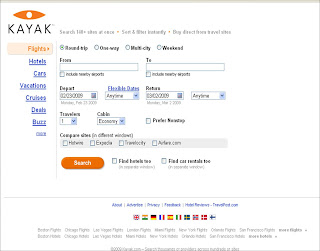
Kayak CEO Steve Hafner Interview: keep it simple, focus on search, stay out of Asia..oh...and get back into offline marketing

Enjoyed a chance to catch up with Kayak CEO Steve Hafner last week. I had planned the call to be about the challenges of a traffic arbitrage business model. I had hoped to draw out of Hafner that there was pressure in the Kayak model fuelled by rising paid search costs, being late to the review game with the Travelpost revamp and tremendous marketing and product pressure from the drop/elimination of booking fees by the big online travel agents (OTAs). Instead Hafner was relaxed, confident and ready to push ahead with millions of dollars in offline (yes offline) advertising planned.

We touched on two main areas. His focus and plans for the next twelve months (including plans for Travelpost and why the OTA fee cuts don't phase him) and his thoughts on expansion outside America (not in Asia and measured in Europe). On the former there is a lot to be worked on for Travelpost to catch TripAdvisor but there are plenty of flaws with the TripAdvisor product and an accompanying disquiet amongst users. On the latter, the potential risk I can see is that they may be under estimating the challenges of growing in Europe where they have more competitors and less compliant suppliers.

Here is our exchange in detail.

On plans for the next twelve months

Hafner says that Kayak is exclusively focused on three things:
  1. More focus on core search: The measures here are speed, accuracy and simplicity. Hafner is measuring his world in terms of milliseconds in response time. I asked if we was worried about price accuracy, database loads, hotel and switch look to book issues but none of these concerned him. For Kayak the true cost per query is falling to near zero through caching and the costs of bandwidth. This allows him to focus on the speed of search and the comprehensiveness of the results. His goals are big but simple - that the submit button results in a search in 15 milliseconds, that the results contain every bookable option and that the filtering and customer profiling gives the client the results they want. While this sounds obvious it was the simplicity and aggression in his focus that impressed me;
  2. Driving awareness: Hafner believes it is the perfect time to get back into offline marketing to take brand awareness to the next level and compete with the OTAs. He believes that Kayak is "fully penetrated online" and that the costs of offline has "come down by about a third". Critically he does not want to leave the offline channel as the exclusive domain of the big spending OTAs, especially because (as he puts it) "the fee cut [by the big OTAs] takes margin away from their P&L and out of their marketing budgets". New CMO Robert Birge has a $100mm to spend on marketing and a CEO keen to see the brand in lights on TV (example below of their "trip idea" commercials from back in 2006). Right now Hafner is claiming that 8% of online shoppers have heard of Kayak (cf he claims Orbtiz number is 60%). In two years he wants the number to be 20%. ; and
  3. Making Travelpost a viable competitor to TripAdvisor and Travelzoo: Kayak has followed the much smaller Uptake into the review meta-search model through a revamp of Travelpost. Prior to the revamp Travelpost (acquired by Sidestep) was a user generated hotel review site much like TripAdvisor. Now post revamp it aggregates reviews from around the web as well as allowing direct posting and commentating. He plans to go after both TripAdvisor and Travelzoo with this new product. He hopes within two years for Travelpost to be generating about half the revenue that Travelzoo is making from deals and to be 15% of the size of TripAdvisor's media revenue (up from 1% now).
On Expansion plans

An interview with Hafner is famously free from PR generated answer obfuscation. I asked a detailed question about the Asian market that started with a lead in on the challenges in the market, the earlier successes of Qunar in China and Wego in Singapore and Australia. Even made a reference to Sprice and Cheapflights. "So Steve," I concluded, "do you have your eyes on Asia too?". Two word answer - "absolutely not". In short he thinks the market is too small (in terms of search volume) and not mature enough (in terms of online advertising).

Europe is another matter. He admits that the change in MD "reflects a disconnect in aggressiveness" which I read to mean that the outgoing MD had a more aggressive plan than Hafner did (see the Travolution post on this for more details). This does not mean they are pulling out of Europe and he rejected any suggestion that Kayak had made a "false start" there. Instead they will keep on with the general three strategies above run by the two people in the London office. He conceded that there are product gaps in Europe (no Rayanair and some other low cost carriers) as well as higher costs from online marketing as Google is so much stronger but he is there for the long term even with no plans to replace the Managing Director role.

The competitors are coming fast at Kayak with big marketing budgets and constant model changes. Kayak's response is keep doing what we are doing only better and now on TV. What do you think. Good plan?

---------------------
Example of earlier offline advertising efforts by Kayak.

Wednesday, April 15, 2009

Triporati - Jim Hornthal interview

A new theme for the BOOT has been working on classifying and and analysing the different travel content, planning, community and search sites. Last month I started off this work through a review of Triporati (and drawing a comparison to my favourite non-travel web product Last.fm). This month I was able to continue my investigation into the sector via an interview with Triporati Chairman Jim Hornthal. We cover areas such as the business model, UGC vs editorial, the company and more.

Business Model

Hornthal was clear that Triporati's main distribution and monetisation push will be around working with partners. I have been hearing this again and again with content/planning/community sites. Most recently in my review of TripIt and before that in an interview with TripSay Board Member Alfonso Castellano. The rationale behind this is clear and makes sense to me. The battle for traffic from Google (either paid or organic) is either too expensive for a travel planning/inspiration site (in the case of paid) or not the core competency (in the case of organic). Better to take a great travel planning/inspiration product and add it to other high trafficked travel sites that are focused purely on booking or content (or both).

One of Triporati's first major deals here is with the triple A (Automotive club) network of sites. There are multiple link offs from the base AAA.com site and Triporati hosts the final landing page (here is the AAA Carolinas Example). There is lots of bespoke work for each deployment as it needs the media spaces from AAA, the booking widgets from AAA and trip options from Triporati are redefined for the partner. In effect AAA is the media partner and Triporati plays the content and technology role. Hornthal is particularly happy with AAA as a partner as AAA brings a offline presence as well as online. At the start 250 aaa travel agents are using Triporati to provide the expertise that is taken away from offline agents as the fam trip continues to disappear into the travel industry history books.

On the revenue side, because of the bespoke set up work Triporati is charging a set up fee, monthly fee tied to traffic as well as the obligatory ad share. I am impressed that Triporati is generating upfront payments from partners as this is not a normal practice in online travel where affiliates are used to a rev share only way of life.

[there is also a test version with TripAdvisor from a a email engagement plan]

On Editorial versus UGC

I have blogged before about how content companies need to find a balance between editorial content and UGC. Too much editorial and you risk not being up to date because editors cannot be in as many places as often as the masses out there. Too much UGC and you end up with the masses going off topic and insulting each other.

Hornthal's view on this balance is to have Triporati's technology and their editors as the discovery engine and then the crowd as a validation engine. Is clear to Triporati that you need to link the two parts but also need to keep them separate. I agree with this approach. Hornthal also put it like this "know where the right answer is not what the right answer is".

On the Triporati Company Background

I alluded in last month's post on Triporati to the pedigree behind Triporati - with Triporati founders Hornthal and Sharlene Wang being behind Preview Travel. The Triporati Board is also packed full of high profile names - Tim Draper (of Draper Fisher Jurvetson), Ted Leonsis (former Vice Chairman of AOL), David Patrick (Charles Schwab), Ron Conway (Google angle investor). Impressive.

My take

I get this space. I am very excited about this space. Triporati well placed to take the lead and own it. The product looks good, they have money and a Board stacked full of experience. The only but is that Triporati takes the Vacation Genome approach as the starting point (much like Pandora in music) rather than the user based recommendation editorial control (much like Last.fm in music - see earlier post if you want this explained further). This does not mean I will bet against Triporati as all the pieces are there, the approach is right and I don't see the genome over crowd approach as a fatal flaw. Triporati is the site and business that competitors TourDust, Geckogo, Joobili, TripBase, TravelMuse are behind and have to chase. [have already written a post on Joobili - more on the others soon].

Seems like I am being too nice. Second positive review in a row (TripIt earlier this week). Am determined to find someone to be nasty about next week.