Showing posts with label orbitz. Show all posts

Monday, August 17, 2009

Webjet to relaunch hotels with a GDS backed retail model. Three reasons why I don' think this is the best plan available

Webjet are having a great time selling domestic air in Australia. As we have discussed before their tech leadership in developing the Travel Services Aggregator back in 2004 enabled them to sell multi-carrier domestic air including low cost carriers before anyone else. Even though other sites now have similar functionality, Webjet continues to enjoy customer loyalty and growth (despite charging dramatically higher fees per booking).

The company has made a number of attempts at diversifying their
revenue with land product. In mid 2003 they launched Bookabed as a standalone hotel brand. In 2006 they revamped the product under the new name Lotsofhotels. Then in June 2008 they announced plans to take Lotsofhotels onto the eBay platform. Unfortunately none of these efforts have developed traction in a very competitive market.

In their recent results they announced the launch of new hotel product called "Stay and Pay" (Travel Weekly story here). This new product moves them away from merchant sales to the retail model (consumer pay at the hotel, Webjet collects commission from hotel). They are launching two twists on the retail models you see from big players like Booking.com and Venere. Firstly there is no negotiated inventory. The inventory is drawn from the publicly available rates distributed through a GDS feed from Travelport. Secondly there is a service fee of $10 per booking charged up front by Webjet.

I like the fact that Webjet are trying hotels again. Fees on air make up 97% of their operating revenue (just down from 98% last year). They need to have other revenue streams to compete with packaging experts Expedia and Zuji (Travelocity) and the Wotif group owned air intermediaries Travel.com.au and Lastminute.com.au (not to forget the Orbitz owned hotel only players HotelClub and RatesToGo) [disclosure]. That said there are three reasons why I don' think this is the best way to go about hotels for Webjet:

  1. Webjet will struggle for Rate Parity: The GDS companies (Travelport included) have done an admirable job working with the Chains and some independent properties to secure rate parity through GDS distribution. By that I mean working with hotels to have the rates that are loaded in the GDS be on par with the negotiated rates provided to the OTAs. However the rates in the GDS are never cheaper and by charging a $10 booking fee, Webjet will end up with pricing that is almost always more expensive than any other channel. There will be a convenience factor for consumers but this will be at the margins compared to the consumers who will be turned away by the higher price on Webjet;
  2. Webjet will not have access to important Inventory Types: Again the GDS companies have worked hard to expand the range of hotels and properties available. However there is still a bias towards chains and a bias towards geographies with a history of GDS distribution. This means Webjet will be missing important independent properties and have less coverage in the Asia Pacific, Latin American and Middle East regions than the negotiated hotel agencies and OTA competitors; and
  3. Webjet will miss out of the the best Specials and Promos: In this "year of the deal", hoteliers are providing deals and promos the likes of which have not been seen since 9/11. Most of these come with conditions, specifically a range of cancellation options ranging up to non-refundable. The GDS is not able to support this functionality as well as the negotiated inventory providers. Means that many of the great deals (especially last minute ones) will not be in the feed accessed by Webjet.
I can understand why Webjet went down this route. It would be very expensive for them to build a hotel contracting team from scratch. Impossible in fact if they wanted to gain coverage outside of Australia. Therefore they need to work with partners to access inventory. However my recommendation would be to work with an inventory provider with negotiated rates rather than the GDS. [disclosure - I work for a company that provides negotiated hotel rates]. It will provide them with a fix to each of the issues above.

The new Stay and Pay product is due for beta-launch today (18 Aug 2009). Will put in a functionality review post later.

Update - make sure you check out the comments where Richard Noon (Webjet CEO) puts his side of the story

Update 2 - I thought of one more reason why this product won't give consumers as good an experience as a negotiated provider will. The room type description and hotel content on the GDS is not as clear or attractive as those from a negotiated provider. Here is an example of a room type for a Sydney hotel in a GDS " PREMIER ROOM CITY VIEW 1 QUEEN OR 2 SGLSNON SMOKING LCD TV HI SPEED INTERNET FOR A FEE".

PS - last year at TRAVELtech Webjet CEO Richard Noon gave his estimates of the turnover of the various Austrlaia online air intemediaries.
Sunday, May 31, 2009

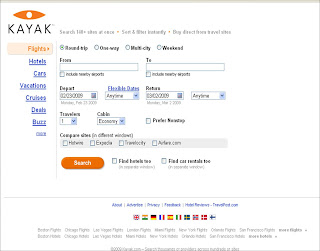
Kayak CEO Steve Hafner Interview: keep it simple, focus on search, stay out of Asia..oh...and get back into offline marketing

Enjoyed a chance to catch up with Kayak CEO Steve Hafner last week. I had planned the call to be about the challenges of a traffic arbitrage business model. I had hoped to draw out of Hafner that there was pressure in the Kayak model fuelled by rising paid search costs, being late to the review game with the Travelpost revamp and tremendous marketing and product pressure from the drop/elimination of booking fees by the big online travel agents (OTAs). Instead Hafner was relaxed, confident and ready to push ahead with millions of dollars in offline (yes offline) advertising planned.

We touched on two main areas. His focus and plans for the next twelve months (including plans for Travelpost and why the OTA fee cuts don't phase him) and his thoughts on expansion outside America (not in Asia and measured in Europe). On the former there is a lot to be worked on for Travelpost to catch TripAdvisor but there are plenty of flaws with the TripAdvisor product and an accompanying disquiet amongst users. On the latter, the potential risk I can see is that they may be under estimating the challenges of growing in Europe where they have more competitors and less compliant suppliers.

Here is our exchange in detail.

On plans for the next twelve months

Hafner says that Kayak is exclusively focused on three things:
  1. More focus on core search: The measures here are speed, accuracy and simplicity. Hafner is measuring his world in terms of milliseconds in response time. I asked if we was worried about price accuracy, database loads, hotel and switch look to book issues but none of these concerned him. For Kayak the true cost per query is falling to near zero through caching and the costs of bandwidth. This allows him to focus on the speed of search and the comprehensiveness of the results. His goals are big but simple - that the submit button results in a search in 15 milliseconds, that the results contain every bookable option and that the filtering and customer profiling gives the client the results they want. While this sounds obvious it was the simplicity and aggression in his focus that impressed me;
  2. Driving awareness: Hafner believes it is the perfect time to get back into offline marketing to take brand awareness to the next level and compete with the OTAs. He believes that Kayak is "fully penetrated online" and that the costs of offline has "come down by about a third". Critically he does not want to leave the offline channel as the exclusive domain of the big spending OTAs, especially because (as he puts it) "the fee cut [by the big OTAs] takes margin away from their P&L and out of their marketing budgets". New CMO Robert Birge has a $100mm to spend on marketing and a CEO keen to see the brand in lights on TV (example below of their "trip idea" commercials from back in 2006). Right now Hafner is claiming that 8% of online shoppers have heard of Kayak (cf he claims Orbtiz number is 60%). In two years he wants the number to be 20%. ; and
  3. Making Travelpost a viable competitor to TripAdvisor and Travelzoo: Kayak has followed the much smaller Uptake into the review meta-search model through a revamp of Travelpost. Prior to the revamp Travelpost (acquired by Sidestep) was a user generated hotel review site much like TripAdvisor. Now post revamp it aggregates reviews from around the web as well as allowing direct posting and commentating. He plans to go after both TripAdvisor and Travelzoo with this new product. He hopes within two years for Travelpost to be generating about half the revenue that Travelzoo is making from deals and to be 15% of the size of TripAdvisor's media revenue (up from 1% now).
On Expansion plans

An interview with Hafner is famously free from PR generated answer obfuscation. I asked a detailed question about the Asian market that started with a lead in on the challenges in the market, the earlier successes of Qunar in China and Wego in Singapore and Australia. Even made a reference to Sprice and Cheapflights. "So Steve," I concluded, "do you have your eyes on Asia too?". Two word answer - "absolutely not". In short he thinks the market is too small (in terms of search volume) and not mature enough (in terms of online advertising).

Europe is another matter. He admits that the change in MD "reflects a disconnect in aggressiveness" which I read to mean that the outgoing MD had a more aggressive plan than Hafner did (see the Travolution post on this for more details). This does not mean they are pulling out of Europe and he rejected any suggestion that Kayak had made a "false start" there. Instead they will keep on with the general three strategies above run by the two people in the London office. He conceded that there are product gaps in Europe (no Rayanair and some other low cost carriers) as well as higher costs from online marketing as Google is so much stronger but he is there for the long term even with no plans to replace the Managing Director role.

The competitors are coming fast at Kayak with big marketing budgets and constant model changes. Kayak's response is keep doing what we are doing only better and now on TV. What do you think. Good plan?

---------------------
Example of earlier offline advertising efforts by Kayak.

Tuesday, March 24, 2009

"The AsiaRooms of 2009 is not the AsiaRooms of 2005": Interview with John Fearon, AsiaRooms Head of Marketing

 Hotel -  Hotels AsiaRooms is one of the region's largest online hotel retailers. With 81, 908 hotels and counting (according to the site today) and a parent company that is the largest travel company in Europe (TUI), AsiaRooms is clearly a player that the BOOT should be paying attention to. Historically the company has made this hard as it has been very secretive with its numbers and plans and (to be frank) was not a company we wanted to pay attention to. Prior to TUI buying the company, AsiaRooms built up an unwanted reputation on online customer care forums for complaints and among the trade for scoffing at rate parity and associated price guarantees. Rumours of wholesale group rates being market up $5 and sold online became the standard trade fair post-session beer story when AsiaRooms came up in the conversation. The brand buzz was all bad. In fact the customer and industry complaint forums became the only source for profile information on the secretive company.

John Fearon the (relatively) new Head of Marketing for the Pattaya based AsiaRooms is determined to change all that. Determined to build on the TUI brand and infrastructure support to change the market perception of AsiaRooms and to bring the company out from behind the secrecy curtain. As John told me “we are not the AsiaRooms of 2005”. I had a chance this week to (virtually) sit down with Fearon and hear his plans for changing the reputation of AsiaRooms, overhauling their marketing plans, ditching meta-search and taking on all comers in a press to be number one in Asia.

In marketing, John's first target is to change the approach to paid search marketing. SEM and SEO is the frontier that John believes will sort out the winners from the losers in Asia (I agree). Is also the place he was happy to share numbers and metrics with me. After only three months of work Fearon is claiming to have doubled the amount of business coming form the search engines on the same level of spend. Not much of a metric to share but an indication of his marketing plans. He had a lot less praise for and desire to continue to invest in meta-search. Has pulled AsiaRooms out of Kayak and has no plans to go with hotelscombined. For the moment is sticking with Wego but as general rule does not believe that meta-search builds a brand or helps the business. Claims it forces you into “killing yourself” on pricing at the expense of the consumer experience. This is an interesting point. I am working on a separate post on my thoughts on the meta-search model but from what I am seeing the arbitrage gap (difference between price meta-search players buy traffic from Google and sell it to suppliers) is narrowing.

In supply the plan is to continue to gain access to cheap inventory - but with less (he did not say none) of the rate rule breaking.

Asia is a tough place to play but Fearon is not worried. AsiaRooms claims that profitability and support from the rest of the TUI nline Destination Services (ODS) group will prove another important factor. [FYI the TUI ODA group includes the UK based LateRooms and Spanish Hotelopia].

They will need more than good paid search plans and mothership support to make it in this market. Fearon says he is aware of this, especially with the Global F’n Crisis hitting Asia hard. He predicts the GFC will bring down a number of smaller brands (we off the record speculated which ones). But for Fearon this is the opportunity to bring AsiaRooms out and take competitors head-on. He has not been impressed by any of the marketing activities of competitors from the big four (Expedia, Orbitz, Travelocity and Priceline). "There is nothing they have done that made me say Wow".

Was interesting to finally hear a (confident) voice from AsiaRooms and one not afraid to admit to the reputation. He acknowledged that AsiaRooms broke a lot of the pricing rules in the past (and maybe that they still do) but is now looking to invest in brand and customer satisfaction (heck they even have a facebook fan page now!).

So what do you think? The consumer forums still don’t paint a pretty picture for AsiaRooms but the company is claiming a lot of changes since 2005. Either way the Asian online travel market war has moved to a different level.

Thursday, March 5, 2009

Q4 for Priceline, Expedia and Orbitz care of Seeking Alpha

Once again - if you are struggling to keep up with who made how much in online travel in Q4 Sramana Mitra at Seeking Alpha has done all the hard work for you. Her post "Online Travel: Priceline, Expedia, Orbitz" summarises the announcements and resulting share movements for each of EXPE, PCLN and OWW. Is this week's BOOT recommended read.

Photo from @jasoncalacanis

Tuesday, January 27, 2009

Alfonso Castellano Interview - current TripSay Board member, ex Travelocity and Lastminute (part 1)

Last week travel social network and planning site TripSay put out a press release announcing that former Travelocity Senior Vice President Alfonso Castellano (pictured) was joining the TripSay Board. Castellano spent nine years with lastminute/Travelocity and before than ten years with TUI. An impressive online travel resume.

I had a great chance to speak Alfonso last week about this new venture. This is the first in two posts from that discussion. In this post I will share with you the discussion we had around the online travel industry in general. In a later post will go through our discussions on TripSay and the travel content model.

Firstly to the OTAs

We started our conversation around the challenges facing the major online travel companies (OTAs). As Castellano said “Most [of the OTAs] are losing money in air” Castellano identified three themes/scenarios confronting OTAs today:

1. Complexity

The world is complex, the law, technology, fragmentation, environment, globalisation etc all ad complexity and with it costs to the big four OTAs (Expedia, Orbitz, Travelocity and Priceline).

According to Castellano, this globalisation investment bu the OTAs is not showing the benefits and gains in scale and volume and efficiency that were hoped. Instead this globalisation effort is bringing so much complexity that it is becoming a drag for the big four, placing increasing pressure on margins. Leading to theme 2…

2. Pressure on margin

Even in this economic demolition derby the OTAs are still under pressure from suppliers on margin. Castellano concedes that this pressure “might move a little now but underlying dynamic will remain. Car, air and even tour operators are becoming more and more discriminating in the on online channel.” This margin pressure is made worse due to the third theme…

3. Increasing cost of marketing

The global demand pressure will put pressure on margins but marketing costs will sill be there.

And….in a frightening prediction. Castellano is not surprised by the CEO changes recently “and am expecting more and more traumatic announcements out of the big four.”

Then to the Meta-search companies

He does not spare the bad news for other, newer players. Castellano also expressed views on the meta-search model. If we had talked months ago he would have said that the meta-search future was secured because meta-search supported the direct push by the suppliers.

Prior to this eco-madness (my words), the suppliers were able to be “discriminating about distribution”. Meta-search could play to this as “a marketing tool for supplier direct distribution rather than a complementary distribution” (ie unlike an agent). This meant suppliers could hold back from intermediaries. Today however, the “suppliers are running back to any player with distribution”. Castellano is expecting a shift “like the post 9/11 world”. Suppliers will be “desperate to pay for an extra bed to get back to profitability.” I found the discussion around the impacts on the industry of 9/11 versus this downturn very interesting. It was after the tragedy of 9/11 and resulting decimation in demand that the online merchant hotel business was born.

Finally to suppliers

I asked Castellano what advice he would give suppliers during this crisis to not repeat some of the mistakes of 2001 and 2002 where too much power was given to the intermediaries. He had even more grim news. This time for the suppliers (hoteliers). He sees a “fantastic future for hotel distribution for OTAs.” He goes on “If a hotel does not control big chunk of distribution today and is still dependent on high yield and hight cost distribution models [like agents]. It is too late, they have no room to maneuver. If they have not been building up distribution for the last 3 or 4 years, then the only option they [hoteliers] have is to keep ­ feeding the beast [online agents] then to come back and fight the bigger beast subsequently…Only a handful of hotel companies can get out of this.” Grim words indeed.

More from our discussion soon.

Wednesday, September 24, 2008

Financial Collapse. George Bush in charge. We're all doomed!

Lots of people are asking me about financial crisis. Two types of questions I get asked. The first is "how did this happen" and the second "is the travel industry doomed as a result"

On the question of "how" I have just read an article that gives the best explanation I have come across. In today's online version of the New York Times, Vikas Bajaj writes a great piece called "Plan’s Basic Mystery: What’s All This Stuff Worth?". In it he goes deep into the strange asset/securitisation products that were put together by Bear Stearns, Lehman etc and caused this whole mess. Worth a read (login required).

Despite the madness of these products and chaos that has resulted from their collapsed I am convinced that the Travel industry will not only survive this crisis but will come out the other end thriving. You might call me an optimist but my view is based on history.

The travel industry in America bounced back from 9/11 in a quarter. In fact the whole online merchant hotel business (and retail for that matter) was created out of the ashes of that tragedy. Hotels gave cheap rates to Expedia, Travelocity and Orbitz etc. Expedia completed its acquisition of Travelscape and soon after bought HRN/Hotels.com.

In Asia, the whole business ground to a halt during the SARs crisis. Hong Kong and the region around it could not pay travellers to come visit. Now Macau is the centre of the gaming and Asian hospitality market. Bali has suffered through two horrific attacks and proposals for bizarre religious laws. Yet manages to survive and fight back each time.

In Europe London and Madrid also suffered horrific attacks in recent years. Yet still the customers flock to Spain and UK the for holidays and breaks.

Travel has survived tragedy and shocks before and will do so because at the core humans love to travel. But the secret to survival is reinvention, not hiding and hoping to ride it out. Growing through 9/11 came from reinventing online hotel distribution. SARs from reinventing the Asian hospitality industry. To get out of this Wall Street induced melting Bull will require the industry to once again find efficiencies in distribution, marketing and supply management. Mobile anyone?

Note - an observant reader (ok my mother) has pointed out that my melting "bull" reference doesn't work given the obvious udder on our molten friend above.

thanks to my number one anonymous commentator for the photo

Sunday, August 10, 2008

Struggling to track EXPE, PCLN and OWW? Thankfully Seeking Alpha has a summary

Three big earning releases last week in the online travel industry. Made for a lot of material to listen to, read and digest. Thanks to Sramana Mitra at Seeking Alpha you don't have to fret. She has put together a one page summary of the highs and lows of the releases from each of Expedia (EXPE), Priceline (PCLN) and Orbitz Worldwide (OWW). Is this week's BOOT recommended read.

Friday, June 6, 2008

PhoCusWright and Viator Meetup in Sydney

Rod Cuthbert of Viator was kind enough to invite me to a drinks event with PhoCusWright CEO Phillip Wolf. Wolf was in Australia to attend the Tourism Futures conference on the Gold Coast. I talked all the attendees into joining in for a group photo. Rod had managed to put together a very influential group of attendees for this event - and I wanted to capture the moment. Not least of all because the photo includes local senior execs for each of Travelocity (Zuji), Expedia and Orbitz in the same room as well as me playing nice with people from Qantas.

Phillip gave an brief but interesting speech. Two things he said particularly stuck with me.

Firstly he put an new spin on how to think about the battle between the big OTAs and meta-search/content companies. Rather than defining sites such as Kayak and TripAdvisor by their business model and functionality (meta-search and user generated content) he described them with reference to their control over content. He calls them "zero percent sites". That is sites where zero (or near zero) percent of the site content is controlled or produced by the owner. I like that as a descriptor because it goes to the heart of the difference with online retail sites. In telling the story of the battle between the zero percent sites and the OTAs he mentioned a stat I had heard before by is worth repeating. Currently Kayak is generating more air fare searches than Travelocity. Not to say that Kayak is selling more air that Travelocity but more people are clicking the search button on Kayak and generating a search result. Why is that so amazing? Well says Wolf, "Kayak has 58 employees, Travelocity 5,000". Four of the top ten online travel sites by traffic are zero percent sites.

He then took this analysis a little further through taking us through PhoCusWright's current Perfect Storm thesis (The Perfect Storm: Search Shop Buy). It is one thing for us as an industry to have better means for classifying the models and categorisation for each competitor but do our customers care. We as an industry think about supplier sites, OTAs, Hotel Only, Meta/Zero, Affiliates, white-label, last minute, etc etc. But the consumers don't do any of this. All they think about is buying travel. On the whole the distinctions between the models and methodologies are meaningless to the consumer. Wolf encapsulated this through this comment "In our study of consumer behaviour a statistically significant number of consumers actually believe that they buy their travel from Google".

This resonated with me. No matter how much we want consumers to see the market segmented like with think it is and no matter how much with want to believe that brand and model distinctions are being understood by consumers, in the end the average customer types in what they want into Google and are not at all certain who they are booking on in the end. Frightening stuff.

Back to the photo. Here are the attendees from left to right: Fergus Kelly (Qantas Holidays), Rod Cuthbert (Viator), Grant Swinbourne (Qantas Holidays), Peter Smith (Zuji), Arthur Hoffman (Expedia), Me , Philip Wolf (Phocuswright) , Vicki Potts (Viator), Steve Sherlock (Oodles), Carol Hutzelman (Phocuswright) & Mike Thompson (Stella)

Monday, December 17, 2007

Meta search vs OTA: Should an OTA buy a meta-search company?

Was asked an interesting question about meta-search and online retail by a share analyst reader. Paraphrased, the question was
We get plenty of Private Equity calls relating to meta-search companies. Most want to know if these companies would work in Europe and who would be interested in buying them. Do you think that an online travel agency could/would buy a meta-search engine?
The main difference between a meta-search company (Sidestep, Kayak, Bezurk etc) and an online travel agency (Orbitz, Expedia, Travelocity etc) is that the first group are media companies and the second are retailers. The common element is that each is after the traveller - wants to attract travellers to the site to commit to a revenue generating activity. However the meta-search media business requires very different approaches to marketing, customer retention and business development than the OTA. This is because the activity the consumer is engaged in is different, the tools for retaining customers are different and the revenue model is different. Will quickly touch on each and then look at whether or not an OTA should buy one.

Customer Activity - You would think that since the activity on both meta-search and OTA is search that there would be little difference in customer activity. However the difference here is what is going on in the customer's mind. A consumer on an OTA is experience hunting. Is looking for advice, support, connection - all of the things a consumer desires from a retailer. In meta-search the consumer is singular in their focus - give me the cheapest price on the exact thing I want. This is why OTAs invest so much in brand and customer care. Meta-searchers are traffic arbitragers - they survive by buying traffic at a cheaper rate than advertisers will pay for referrals.

Customer Retention - Retailers can work to keep customers by offering discounts, exclusive deals and targeted promotions - ie product. Meta-search retention comes through bringing consumers into the search experience through reviews, social networking and new inventory connections - ie content.

Revenue Model - commission vs pay per click; cash from consumers vs bucks from media buyers; selling travel vs selling eyeballs.

OTAs therefore have the advantage in customer retention and breadth of marketing tools. But meta-search has the advantage in ease of access to supply and significantly reduced operational costs (no need for customer care and reduced supplier relations costs).

It is because meta-search is media rather than retailer that the biggest meta-search deal around was Farechase being bought by a media company - Yahoo!. However this does not cancel out an OTA as a potential buyer of meta-search. We have a very power example of success in an OTA buying, owning and running a media company through Expedia's ownership of TripAdvisor. Any acquiring OTA just has to embrace being a media company.

I am a fan of the meta-model but (as with all web companies) it is all about good product and execution. There is lots of success in travel so far for meta-search but comparison experts like Pricegrabber have already failed in moving to travel. The fit with a media company is stronger than that of an OTA. Of course - haunting the whole sector is whether or not the general untargeted search people (ie Google) develop the more targeted tools of meta-search.

Thursday, July 26, 2007

If you love a list of hotel sites, you'll like (and hate) TOP 100 HOTEL SITES

Found this site while surfing around. Claims to be a list of the "Top 100 Hotel Sites". List is generated using
The URL of every Hotel site was found in multiple internet searches and the amount of mentions of site's addresses is used to generate the rating. Hotel directory and travel guide. Includes information on tours attractions, restaurants, hotels reservations, travel jobs and more.
Whatever. There are some really bizarre rankings here. TripAdvisor is number one, Orbitz three, Booking.com four, Hotels.com five and Expedia six - all of which sounds find. However stuck at number two is myswitzerland.com, which undermines the whole list. Missing from the list are Wotif, HotelClub, RatesToGo, Rakuten and probably many more. Can't say either way if this is run by legitimate enthusiasts or just a link farm...and don't care. If you ignore the rankings and order, it provides a decent list a lot of the main (but also the minor) online hotel players.

Friday, June 29, 2007

Easy does it with online packaging and cross sell

easyJet announced today the launch of easyJet Holidays with the hotel section being powered by First Choice's Hotelopia. Here is the Travelmole article and the confirmation of Hotelopia's involvement.

An airline doing a deal with a hotel provider is nothing new. In fact we have seen great twists recently with Singapore airlines finally agreeing that they needed outside help with hotels by signing with GTA's Octopustravel and Ryanair signing up with the "undead" white label arm of Expedia (called World Wide Travel Exchange or WWTE). The difference here is the the quality of the integration.

I spoke recently in this post on what airlines need to do to stay on top in online travel. My number one suggestion was to focus on cross sell. Crucially to not treat hotel partners as a simple white label relationships or an ad sales deal where all the airline focused on was the size of the commission cheque at the expense of functionality, choice, price and all the other things that are important in building customer relationships. Pure white-label deals leave open a functionality and convenience gap that online agents (OTAs) with decent screen scraping/API connections and packaging technology can fill. Airlines that did not participate in the GDS had a presume insurmountable advantage over OTAs as the OTAs had no access to inventory. Now that aggregation technologies have found ways around the GDS non-participation, this advantage is disappearing. Now it is smart OTAs that can have the advantage as they can package and cross sell where airlines with dull white-label arrangements cannot.

The easyJet integration is a great step in maintaining the advantage over OTAs. I searched a random flight from Luton to Edinburgh (June 30 out, 7 Aug back) on both the easyjet.com site and the easyjetholiday site. Through the cross sell on the "regular" site after I searched for flights and the full holiday functionality of holiday site I received the same offers at the same prices. The process was seamless and matched the experience of booking through an Expedia or Orbitz (though I did not complete the booking so have to assume that all goes well once credit cards are entered).

This focus on product, experience and price is in contrast to Ryanair who have no cross sell and have done little to alter the look of their WWTE product other than header, footer and colours.

Congrats to easyJet on this launch.

Am not predicting the death of Ryanair.com, Qantas.com, Virgin-blue.com and other big traffic airlines sites that have not embraced product focused cross sell but will predict that for so long as these airlines take a casual attitude to complementary products they will be providing market opportunities for the online agents they hate so much.