The Innovation Index slides 9% in the first quarter of 2008 along with the broader market. The Innovation Index beats S & P 500 by 1%, beats NASDAQ by 5%, and lags Dow Jones by 1%. S & P 500 is down 10%, NASDAQ is down 14% and Dow Jones is down 8% in the first quarter of 2008.
Only 4 Innovators out of the Top 20 Innovators are in the green in 2008 and are showing modestly positive returns ranging from 1% to 7% gain. 16 out of the Top 20 Innovators are in the red in 2008, with wide-ranging negative returns with a maximum of 36% loss.
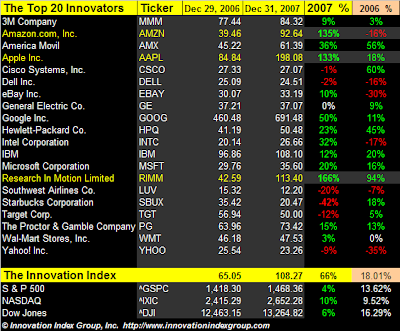
The Innovation Index had a banner 2007, and gained 66% in 2007.* The Innovation Index closed at 108.27 on December 31, 2007, up 66% from the closing price of 65.05 on December 29, 2006.*
Invest in The Innovation Index - Invest in the Innovation Index Fund
The Innovation Index
closed at 98.51 on March 31, 2008, down 9% from the closing price of 108.27 on December 31, 2007, and up 51% from the closing price of 65.05 on December 29, 2006. S & P 500 is down 7%, NASDAQ is down 6% and Dow Jones is down 2% since December 29, 2006.
The Innovation Index - 2007
Q1 2008 Leaders
Only 4 Innovators show a positive gain in first quarter of 2008. The early leader of 2008 is IBM (NYSE: IBM) with a gain of 7%. Why is IBM ahead? Great quarterly earnings performance, and an upbeat future earnings guidance aka outlook. IBM is poised to have a solid 2008, and if the broader market improves, watch out! IBM could easily gain 20% to 30% in 2008. Nike Inc. (NYSE: NKE) also leads with 6% gain for the year. Nike also had an amazing quarter, beat the revenue and earnings on the high estimates, and gave an upbeat outlook as well. If Nike continues to deliver on the announced innovations, Nike will have another breakout year on the heels of 2007. Who else is in the positive in 2008? How about America Movil (NYSE: AMX) and General Electric (NYSE: GE)? America Movil is on a three-peat: After a solid 2007 with 36% gain, and an impressive 2006 with 56% gain, America Movil is up 4% in 2008. It's core business is wireless which shows no signs of letdown in 2008. 2008 could be the year of GE. GE was even in 2007 (paid good dividend though). Investors are betting that GE can grow globally and show consistent growth in 2008. GE is a safer bet. GE is up 1% in 2008.
Q1 2008 Laggards
There is a sea of red. Everywhere you see, you see Innovators with negative performance in 2008. As a matter of fact, there are 16 of the 20 Innovators who are down in the first quarter of 2008. Who leads the pack in losses? Surprisingly, it is Google Inc. (NASDAQ: GOOG). Google is down 36% in 2008, after gaining 50% in 2007. So it is kind of bittersweet. Can Google rebound in 2008 with the earnings gains from recently completed Double Click acquisition? Google also announced new innovations with Team Apps. Google has plenty of distractions though - the biggest one being Microsoft's pending acquisition of Yahoo. Google must stay focused on increasing Search marketshare and increasing the higher performing clicks. A percent improvement in the effectiveness of clicks generates a factor of ten improvement in topline revenue. One of the newest Innovator for 2008 is down 34% after gaining 35% in 2007. Merck Inc. (NYSE: MRK) is down 34% in Q1, 2008. There are plenty of news around Merck's Vytorin and Zetia. "The drugmakers sold $5.2 billion of Vytorin and Zetia last year. The study showing the drugs work no better than a generic medicine at one-fifth the price may cost the two companies $1.3 billion in sales this year and $1 billion next year, said Jim Kelly, an analyst with Goldman Sachs & Co., in a research report today." - Bloomberg Merck has some rebounding to do from such a deep drop in 2008.
Why are shares of Apple Inc. (NASDAQ: AAPL) down 28% after gaining 133% in 2007? Apple was one of the star performers in 2007 Innovation Index. Apple kicked off 2008 with bold new innovations, introduced the new iPhone and new iPod touch, and created new technology with Nike for the gym. It has do with future earnings guidance, or rather a weak one by Apple. If Apple delivers on the earnings and shows growth in Mac, iPod and iPhone business, Apple will do just fine. Can Apple hit $250 in 2008? We will need to fast forward to December 2008.
There are 4 Innovators who have lost 20% or more in 2008. These include Amazon.com Inc. (NASDAQ: AMZN) down 23% after gaining a whopping 135% in 2007; Best Buy Inc. (NYSE: BBY) down 21% after gaining 6% in 2007; Intel (NASDAQ: INTC) down 20% after gaining 32% in 2007; and Microsoft Corporation (NASDAQ: MSFT) down 20% after gaining 20% in 2007. Can these Innovators rebound in 2008?
Which Innovators are safe bets for investors in 2008?
3M and PG are smart long-term buys in turbulent markets. We have three more quarters in 2008. And as we witnessed in 2007, one quarter can make a huge difference.
2007 Leaders
Research In Motion Limited - (NASDAQ: RIMM) was the 2007 leader in stock performance, with 166% gain for the year. Amazon.com, Inc. (NASDAQ: AMZN) was equally impressive with 135% gain for the year. Apple Inc. (NASDAQ: AAPL) had a great year with 133% appreciation for the year. There were eight other innovators with double-digit gains for the year. Among these innovators, Google Inc. (NASDAQ: GOOG) led with 50% gain. America Movil (NYSE: AMX) was next up with 36% gain in 2007, and Intel Corporation (NASDAQ: INTC) closed out 2007 with 32% gain. Overall, 13 innovators finished 2007 with positive gains.
2007 Laggards
Six innovators finished the year in the negative, led by Starbucks Corporation (NASDAQ: SBUX) declining 42% for the year. Southwest Airlines Co. (NYSE: LUV) was next, declining 20% for the year. Target Corp. (NYSE: TGT) rounded out the top three, declining 12% for the year. Yahoo Inc. (NASDAQ: YHOO) was down 9% in 2007.
2008 Top 20 Innovators
The Top 20 Innovators for 2008 were announced on December 31, 2007. Here is the alphabetical list of the Top 20 Innovators for 2008:
3M Company - (NYSE: MMM)
Amazon.com, Inc. - (NASDAQ: AMZN)
America Movil - (NYSE: AMX)
Apple Inc. - (NASDAQ: AAPL)
AT&T Inc. - (NYSE: T)
Best Buy Co., Inc. - (NYSE: BBY)
Cisco Systems, Inc. - (NASDAQ: CSCO)
Costco Wholesale Corporation - (NASDAQ: COST)
eBay Inc. - (NASDAQ: EBAY)
General Electric Co. - (NYSE: GE)
Google Inc. - (NASDAQ: GOOG)
Hewlett-Packard Co. - (NYSE: HPQ)
Intel Corporation - (NASDAQ: INTC)
International Business Machines Corp. - (NYSE: IBM)
Merck & Co., Inc. - (NYSE: MRK)
McDonald's Corporation (NYSE: MCD)
Microsoft Corporation - (NASDAQ: MSFT)
NIKE, Inc. - (NYSE: NKE)
Research In Motion Limited - (NASDAQ: RIMM)
The Proctor & Gamble Company - (NYSE: PG)
2008 Predictions (originally published January 17, 2008)
How will The Innovation Index perform in 2008? So far, the Innovators have been off to a rough start in 2008. The sub-prime mortgage crisis, rising oil prices, and early indications of slowing economy have contributed to negativity on the Wall Street. We believe this sentiment is short-lived, and will only last through the second quarter of 2008. The potential availability of an economic stimulus package will certainly help. The resilient Innovators of The Innovation Index will reward the patient, long-term investor. The key is to stay with these Innovators through the downturn, and wait until later in the year to realize the positive gains.* Innovation Index Group, Inc. announced the following BUY recommendations for the Top 20 Innovators of The Innovation Index.
Invest in the Innovation Index Fund
We launched the new Innovation Index Fund in December, 2007 that invests in the Innovation Index. Innovation Index would have returned 66% in 2007 based on our performance model, and 174% in the previous five years based on historical model. If you want to learn more about the Innovation Index Fund, fill out your contact information at the bottom of this form: http://www.innovationindexgroup.com/invest.html
The Innovation Index Reports:
Invest in The Innovation Index - Invest in the brand new Innovation Index Fund
Introducing The Innovation Index Fund - Invest into The Innovation Index
Top 50 Innovative Companies in the world - 2007 Report on Top 50 Companies
Annual Report - Chapter One - Total Innovation Activity - 2006 Annual Report One
Annual Report - Chapter Two - The Top Innovator - 2006 Annual Report Two
Annual Report - Chapter Three - The Innovation Insights - 2006 Annual Report Insights
Innovation and Stock Performance Correlation - The Innovation Index and Stock Performance
The Innovation Index gallops to 56% - Quarterly Report - Q3, 2007
About The Innovation Index
The Innovation Index introduced in December 2006 is a weighted stock price index of the top 20 Innovators in North America.
The Innovation Index returned 66% in 2007 according to performance model, and would have returned 174% over the previous five years (2002-2006) according to historical model. This assumes equal investment in each stock of The Innovation Index as of December 31, 2001. An average of $100 invested in The Innovation Index on December 31, 2001 returned $454 as of December 31, 2007. By comparison, $100 invested in S & P 500 returned 28% or $129, $100 invested in NASDAQ returned 34% or $136, and $100 invested in the Dow Jones Index returned 30% or $131 through December 31, 2007. The Innovation Index beats the S & P 500, NASDAQ and Dow Jones Index by more than seven times over the past six years.
Alphabetical list of the Top 20 Innovators of The Innovation Index for 2008 and their stock ticker symbols:
3M Company - (NYSE: MMM)
Amazon.com, Inc. - (NASDAQ: AMZN)
America Movil - (NYSE: AMX)
Apple Inc. - (NASDAQ: AAPL)
AT&T Inc. - (NYSE: T)
Best Buy Co., Inc. - (NYSE: BBY)
Cisco Systems, Inc. - (NASDAQ: CSCO)
Costco Wholesale Corporation - (NASDAQ: COST)
eBay Inc. - (NASDAQ: EBAY)
General Electric Co. - (NYSE: GE)
Google Inc. - (NASDAQ: GOOG)
Hewlett-Packard Co. - (NYSE: HPQ)
Intel Corporation - (NASDAQ: INTC)
International Business Machines Corp. - (NYSE: IBM)
Merck & Co., Inc. - (NYSE: MRK)
McDonald's Corporation (NYSE: MCD)
Microsoft Corporation - (NASDAQ: MSFT)
NIKE, Inc. - (NYSE: NKE)
Research In Motion Limited - (NASDAQ: RIMM)
The Proctor & Gamble Company - (NYSE: PG)
The Innovation Index will analyze the positions and standings of the Top 20 Innovators at the end of each year. For 2008, there will be no further changes in The Innovation Index.
Disclaimer: The Innovation Index Group, Inc. invests in the stocks comprising The Innovation Index.
* Past Performance Does Not Guarantee Future Results
 Anyone taking part in the conversation can hit the ad with their hand to immediately take advantage of the product or service being offered. With our new Teleportation Technology(TM), you'll be transported directly to the site where the service is available, or have the product appear instantaneously in your hands.


