Showing posts with label babies useful info. Show all posts

Tuesday, September 15, 2009

Teach your kids not to pick foods off the floor and eat it


While being parents, have you watched how your kid tries to pick their food off the floor and pop it into their mouth innocently?

I guess as parents we do teach our kids not to pick food off the floor and eat it because as we all know that bacteria gets attached to food making it harmful for us to consume but sometimes parents might think that if we pick up the food as quick as possible, say in an instant of five seconds, it might have less changes of getting contaminated with bacteria. That's not right and not a good idea at all and the best choice would be to throw away foods slipped out of ones grasp no matter how tantalizing it can be!

Foods can get contaminated with bacteria as soon as it hits the floor(especially if the conditions are right) This is because no matter how clean your surface looks it might still have bacteria. Though floors that look dirty will very obviously be likely to grow bacteria but even floors that are cleaned well can house bacteria that can survive for a long time.


Foods that have wet surfaces like cut fruits etc.. can attach more bacteria and the longer the food remains of the floor, the more bacteria will accumulate on the food. Remember while some bacteria are not harmful but some are likely to cause diarrhea and some can make you more sicker. One will never be able to determine the germs on the floor without a powerful microscope so its advisable to banish your dropped delicious butter cookie as i guess you wouldn't want to get your child ill, not even at the cost of a 3 or 5 second rule, right?

Teach your kids to play safe from his/her earliest possible age :-)

Monday, June 15, 2009

Friday, March 14, 2008

Baby Alisha was down with fever resulting in a fever convulsion.


Being a mother to 17 month, pretty baby Alisha, was always so enjoyable.I dont remember a terrifying moment before, but just a few days a ago, baby was down with fever since the morning.Later in the evening due to a high temperature rise, she suffered a fever convulsion.. I did not know what to do then because i hadn't seen anything like that in my entire life.. And to see it happening to my baby, almost killed me.She was rushed her to hospital but till then the convulsion ceased and the doctor said everything was fine, so not to worry.I know you're curious to know what happened.. so read below, please...

Alisha was playing on my lap when all of a sudden i felt her muscles pull and her head began to drop, she was like shaking and jerking uncontrollably.Then i saw her eyes turn up too.She wasn't even breathing properly.. Oh my god! I was trembling all the while, i couldn't see her in that state.. Those moments were very disturbing and i will have to care for her even much more to ensure she doesn't develop a high temperature in the future since the convulsion occurred due to the rise of high temperature and is quite a common thing in toddlers aged 6 months to kids aged 6 years.During this period we parents have to be on high alert for the slightest symptoms of fever, to prevent its recurring to a child who had it before.

I wish no parent should experience anything like this ever.. Its not an uncommon thing and theres no risk as such to the child but when you see your child suffering something, like a fit.. It feels so devastating and horrifying!! Now baby is doing quite fine and under medications and sooon she will be fit and fine.

This post was mainly to create awareness and provide information to parents around the world.. i hope i could do my part on this:)

Time for tips and advice..
Some very important notes i would like to put here for parents who dont have an idea about what is a convulsion, its symptoms and how to prevent it from happening to your baby.

WHAT IS A CONVULSION?
Its a kind of fit or seizure which happens without warning mostly due to a temperature rise.But a number of cases are due to digestive disturbances, by over-feeding.Many cases result from the suppression of skin eruptions.If someone in your family has already been through it, then history could repeat itself.

WHAT ARE THE SYMPTOMS?
Read the whole of the above to know my experience with it.The child will become unconscious or unaware of their surroundings.There will be movements in their arms in a twitching manner.Their eyes may roll back and have difficulty breathing.The child will fall, if standing, and may pass urine.May vomit and may bite his tongue.The child may not be breathing, and may begin to turn blue.

WHAT TO DO WHEN IT OCCURS?
Firstly try your best not to panic and stay with your child, as the child needs your whole attention now.Note of how long the convulsion lasts.Dont put anything in its mouth or try to stop the convulsion by pressing the baby.Place them on their side with a rolled towel behind them for support.Loosen tight clothing especially from around the neck.Now focus your attention on bringing the fever down by applying cool washcloths to the forehead and neck and sponge the rest of the body with lukewarm(not cold) water.After one to three minutes the child will begin breathing normally again.Seek medical attention at its earliest, please dont take for granted.

I would love to read your comments, so please feel free to share anything that comes to your mind after you read this post..

Saturday, December 29, 2007

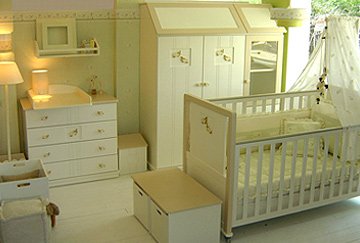
Tips for Decorating Your Baby’s Nursery


The birth of a baby is always an exciting and exhausting time. There is a lot of preparation involved in many ways – from the mother preparing physically and mentally, to the practical side of things, such as ensuring any adjustments are made in the house before baby comes home for the first time.

One of the key things on your to do list if you are expecting a baby is to create a nursery for them to sleep in. This is best done some time before the birth rather than at the last minute, especially if the baby decides to arrive early. You don’t want to be halfway through painting a wall when it’s time to go to the hospital.

Of course it’s not always easy to choose a colour scheme, especially if you don’t know what sex the baby is going to be. If you cannot or do not want to find out beforehand however, there is another alternative: you can choose a more neutral colour for the walls, and then buy accessories in either pink or blue, if desired, once the baby is born.


If budget is a concern, the cheapest way to decorate is by painting the walls rather than wallpapering them. If they are particularly uneven you can sand them down before painting. If you opt for this solution, make sure the work is done well in advance of baby’s arrival, and ensure the room is well ventilated during and after the sanding. Alternatively you could buy lining paper and paint directly onto that, while plain walls can easily be spruced up by using a nursery border. You can then match your accessories to this.

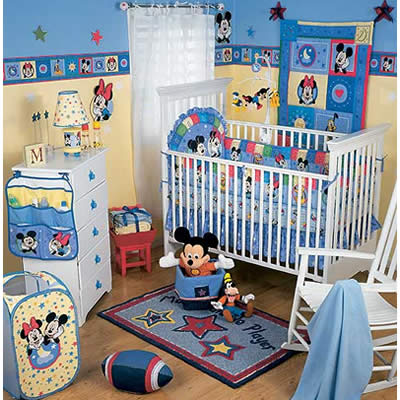
Of course decorating isn’t the only thing you need to think about. Buying essentials to finish the room off is equally important. Baby bedding is available in many designs and colours, so you should be able to find the perfect selection to match the colour scheme you have chosen. If you buy a complete set of matching bedding you will often find you can also buy matching accessories such as lampshades and even soft toys to complete the look of the room.

If you would like a particular set of blue or pink bedding and you don’t know the sex of your baby, the best thing to do is to decide which set you would like and ask a friend or relative if they would go out and buy the appropriate set when the time comes. That way you don’t have to worry about rushing out to buy bedding when the new arrival comes home.


Decorating a nursery can seem like a major job, but with proper thought and planning it doesn’t have to be very difficult. Before you know it you’ll be welcoming your new baby into their freshly decorated nursery.

Sunday, August 26, 2007

step by step guide to baby and child massage

Babies And Children usually enjoy being massaged as much as adults, but will often only keep still for a short space of time.The strokes you have learned can be used on babies and children - just adapt them to allow for their size and the fact that their little bodies will not have built up the same chronic tensions that adults can suffer from.Just explore and discover what your child likes best.

Front Of The Body:

Massage Steps:
1.Starting with the child on their back, gently stroke their face, starting in the middle of the forehead and working out to the temples.
2.Stroke across the cheeks from nose to the ears and then from the cheeks down to the chin.Gently stroke across the eyebrows, and back around under the eye.Make gentle circles around the temples.
3.Stroke up the front of the body and out along the arms.
4.Make clockwise circles around the navel using both hands.Do gentle wringing strokes across the abdomen and up the body.
5.Lift arms one at a time and stroke the length of the arm from shoulder to the hand.Use one hand to squeeze the arm, starting from the shoulder and moving down the arm.
6.Massage the hand and squeeze and rotate each of the fingers in turn.
7.Repeat for the other arm.Gently drain up the leg.Wring or squeeze up the leg.
8.Stroke down the leg using a light, feathering stroke.

Back Of The Body:
Massage Steps:
1.Turn the child on their front and gently stroke their back.Stroke up and over the back and along the arms.
2.Gently knead the child's shoulders.
3.Make a gentle wringing stroke up over the body.If your child is a baby, massage their rear using a gentle kneading or pinching strokes.
4.Smooth down the spine using alternating hands, starting at the base of the neck and working down to the base of the spine.Use gliding strokes down the legs.Bend the knee up and work on the foot.
5.Work around the anklebone with your fingertips.Sandwich foot between heels of hand and massage, moving both hands in a circular motion.
6.Gently squeeze the heel with one hand and massage up the sole of the child's foot using the thumbs of your other hand.
7.Massage the toes, gently squeezing, rotating and pulling each one in turn.Sandwich the foot between your hands and hold it firmly for a few seconds.Turn the baby over.
8.Stroke from one foot up the leg, across the sacrum(base of the spine), and back down the other leg.Use light strokes down the body, starting from the top of head right down to the feet.

Massage Caution:

Be very gentle when working with babies and children.Do not pursue the session if the child begins to fidget.

Massage Tip:

As a general rule, the strokes you use will need to be much lighter on children.The younger the child, the smaller and more delicate the strokes will need to be.If the child you are working on is very young, then you can sit on the floor and massage him or her on your lap.Otherwise spread a towel on the floor or any safe, raised surface.

Sunday, August 19, 2007

remember, your babys diet is important!


After months of pureeing, mashing and carefully introducing new foods, making baby food now become a little easier.baby is probably enjoying more textured foods... and along with that moms are able to understand the likes and dislikes of baby!but we've got to keep introducing new and tasty foods so that baby can feast on a great number of nutritional as well as different flavoured foods...

read below for more info on baby diet:

At this stage, your baby needs about 750-900 calories a day. He also needs about twice as much calcium as he did at birth. Calcium is necessary for strong bones and teeth - it helps the teeth resist decay and maintains healthy gums

Iron is another essential part of his diet, supporting both growth and development. It plays a major role in forming haemoglobin, the part of the red blood cells that carries oxygen to the body's tissues. Iron is particularly crucial in brain development.

A baby at this stage may sometimes seem to be eating less food than he was before.

DON'T PANIC - this could be one reason -

A baby's growth naturally slows down at this time, so he may simply feel less hungry than before. Continue to offer a wide variety of foods and be patient, he'll let you know when he's hungry.

read my next articles on baby.. for new recipes.

Thursday, August 9, 2007

My Baby's Growing So Fast!


They’re no longer newborns, but they’re definitely still babies... they seem so small and fragile and parents often find themselves concerned about the effects of the world on their baby... is this medication safe? should he have this vaccine? is she sick or just hungry? is he supposed to do that? feeds? toys? the world seems so fast when you have a baby in your arms!!!

my baby alisha, my cutie pie.. shes on her 9th month and theres no time turning back the clock to the past.we are just moving on at full speed and her growth is that speedy too... shes begum to know wheres her eyes and says eyesh! haha and pokes her little finger at my eyes or hers.

can crawl so quickly.. even a train cant beat her! shes my express(train) i always catch in time saving her from dangers around...

yesterday she said one of her first words.. "papa" and so excitedly kept repeating it.. i love and care for her so much.. am sure all mothers do.. a little comment below to protect your baby on her/his 9th

It has been nine months since you first held your bundle of joy in your hands! However the once squirming bundle has undergone a dramatic change. For one, it is no longer squirming but almost running! Welcome to your baby's ninth month.

Look mamma I can stand

In baby's ninth month, he is getting closer to walking all by himself. He can crawl up the stairs (dangerous!) and is cruising too. Your baby at this stage is trying to learn how to stand up from a sitting position. You might be amused to see your nine month-old baby standing for a long time, tiring himself out but unable to sit from this position. A few babies might even start walking at nine months. Mobile walkers are not very safe for baby. You might want to consider exersaucers or stationary walkers instead.

One, two, buckle my shoe?

Not yet. Walking bare foot helps your baby get a better grip of the ground. Besides, it gives her first hand information on the texture of various surfaces and helps the learning process. Baby shoes look cute and you want to go out and buy every pair for your nine month-old baby, but resist the temptation to do so until she starts walking outdoors.

Play with me!

In baby's ninth month, he loves to play interactive games with you. He is now an expert at reaching out and grabbing things. He hates it when something is taken away from his hands. Roll a toy car towards him, stack rings or build block towers with him and watch his eyes light up.

"Da-da Ma-ma"

How soon your baby talks, depends on a number of factors including her environment and her general predisposition. A great majority of babies who start talking as late as three years have normal intelligence. So don't worry if your nine month-old baby seems quieter than his peers. (Babies must not be compared anyway). Keep talking a lot to your baby and sooner or later, she will talk to you too.


Watch out, here I come

Your nine month-old baby is naturally curious about his surroundings and this is a crucial time to avoid accidents. Supervise your baby all the time especially if she is very resourceful. If you have not childproofed your house already, now is the time to act. Do pay special attention to avoid drowning hazards and electrical accidents. Protect your baby from being injured by sharp corners and remove all unstable furniture from the room. Install childproof locks on cabinets and doors and put up barrier gates at the stairs. Keep an emergency rescue number handy just in case.

Who is that?

Baby's ninth month is a time when she develops preferences for toys.and people. She does not like strangers handling her and wants mamma around her all the time. Never force your baby to interact with strangers. Give her a little time to warm up and she will surprise you by eventually getting over her stranger anxiety all by herself.

Visit the doctor regularly for well-baby exams and keep baby's immunization record up to date. A healthy baby is a happy baby.

Tuesday, July 17, 2007

caring for new born babies1


people people envy a babys blissful existance coz they are gifted as bubbly and giggly playmates for siblings and parents, who cant resist a minute from hugging,kissing or even pinching them on their soft tender skin.parenthood takes us into a whole new world of loving and caring for a new born... caring, one of the most important part of a daily rountine and as we go about it we need to take very extra cautions in order to lessen risks around us!

our baby will face some problems for the first few days out of the womb.mothers generally get tensed and start worrying that the baby might be sick and get panicked.i went through the same thing and new moms should also be careful and alert.probems to look out for:

First Bowel Movements:
Your baby's first bowel movements are generally green and sticky as they are composed of mostly merconium and full of digested mucus. Hence don't worry if you see green sticky stool. Breastfed babies usually produce soft, yellowish stools, sometimes tinged light green with little odour. A bottlefed baby often produces stools that are firmer, brown and smellier.

Fussing during Feedings:
This is the common problem faced by most of the mothers. Your baby may be crying because of many reasons. Usually there is something they are not happy about. It could be a burp ready to come up, it might be that the milk flow is too fast, your baby may be full, or if you are breastfeeding, your breast may be empty. These moments of fussiness usually occur around six weeks and again at eight to twelve weeks. When your baby fusses, stop the feed to release wind. Then resume the feed on the second breast. When your baby fusses again, stop the feed and return it for the last time to the first breast. If your baby is bottle fed, follow the same process. Burp your baby, check to see that the teat is not blocked, and also check that the teat hole is the correct size for your baby's age. You can tell if your baby is getting enough by the number of soiled and wet nappies you are changing and by your baby's weight gain.

Releasing Wind:
Air can be swallowed while suckling, when your baby is crying, or if the flow of milk is too fast. Correct positioning of your baby before and after feeding can help prevent excessive wind and provide relief. The release of air may bring up regurgitated milk. Keeping your baby's back reasonably straight with its lower back supported upright will help your baby expel excessive air more easily. After a feed you can help your baby to release wind. Sit your child on your knees, leaning forward and supported by one of your hands across the upper chest. With your other hand, stroke your baby's back from the base of the spine upwards. Then pat gently between your baby's shoulder blades. Baby massage on the back and stomach will help disperse trapped wind.

Vomiting:
When a baby vomits, it is usually a sign that your baby is full or needs to get rid of mucus in the stomach. The best thing to do is change your baby's nappy and put it to bed. Even if your baby has just regurgitated most of the feed, there is no immediate need for more food. A sleep will do wonders though your baby may wake a little earlier than usual for the next feed. If your baby is repeatedly vomiting, is not gaining weight, has blood or green-tinged bile in the vomit or has a constantly high fever, call your doctor. Repeated vomiting is dehydrating for a little one.

Snuffles and Hiccups:
Young baby get lots of hiccups and snuffle a lot causing lot of concern to you. But you need not worry because this is due to the respiratory system developing. Many babies born by Caesarean have more mucus in their system and thus have problems during breathing. This is because babies born vaginally are squeezed through the birth canal, an action that often forces a lot of mucus out of the baby's system.

Weight Loss:
Often babies lose weight the first few days out of the womb. This is quite normal because prior to birth babies retain fluid and nutrients and these are shed in the days following. Weight is regained and usually surpassed within the first week or so. However if your baby is continuing to lose weight, seek medical advice.

Twitching, Blisters and Dry Skin:
Young babies also tend to twitch and jerk in their sleep as their nervous system continues to develop. Young babies often develop suckling blisters in the first few weeks. These will disappear without treatment. Dry and peeling skin on the hands and feet is common with young babies and it tends to disappear without treatment. It is not usually eczema. But if the condition is bad then do seek your Doctor's advice.

Sticky Eyes:
Babies often are affected by thick, sticky, yellow mucus around the eyes. This is usually a result of a blockage in the tear duct called the lacrimal duct. In babies the duct is very narrow and is easily blocked by debris from the eye. A sticky eye needs to be cleaned frequently with cotton buds or a muslin facecloth and warm water.

Digestion Problems:
Most babies experience some degree of digestive upset due to their still-developing system. Mild constipation can be alleviated through regular massage, particularly of the tummy, back and buttocks. Abnormal bowel movements can be distressing. If your baby has sudden vomiting or diarrhoea, severe or long-lasting swelling of the belly or blood in the bowel motions, call your doctor immediately. Repetitive diarrhoea is dehydrating for a baby's system.

Insomnia:
During the first few weeks of a life, a newborn finds itself in a strange environment. If your baby is having difficulty sleeping, check that the environment is suitable and the room temperature is proper. A warm bath followed by a baby massage is the ultimate preparation for bedtime.