
Selected references:
Leading Business Innovation eBook & Resource Kit
Creativity and Innovation Best Practices
Creativity and Innovation Case Studies
The Innovation Index
Top 50 innovative companies in the world

Senator Barack Obama and his team created these key innovations along the four innovation pillars for this historical campaign that won him the U.S. presidency:
Product - www.BarackObama.com, My.BarackObama.com
Senator Obama's website www.BarackObama.com catered to all citizens of the United States - all states, all nationalities, all age groups, all religions, all
business types, all parties, all ethnicities e.g. People of Faith, Latinos, Rural Americans, Women, Kids, Students, Veterans, Military, Seniors, Sportsmen, Environmentalists, Disabled, Republicans and more.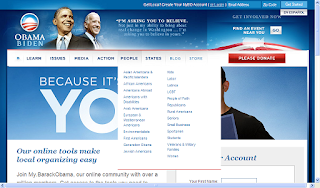 The website clearly stated Senator Obama's stand, challenges, and opportunities on key issues such as Economy, Civil Rights, Defense, Iraq, Homeland Security, Education, Energy, Healthcare and more - total of 26 different issues wherein Senator Obama communicated on regularly. The website also provided adequate learning about Senator Obama's background, his wife Michelle Obama, Senator Joe Biden and his wife Jill Biden, and section devoted to In the News, latest Press Releases and Speeches of Senator Obama.
After a person donated to President Obama's campaign or signed up at BarackObama.com, the service automatically created a My.BarackObama.com page wherein the person can personalize his/her interests, create a profile, and participate in fundraising goals;  find and attend local events, search for groups and group activities, and find and meet local people using My Neighborhood; create and find groups all over the nation and by categories, and connect with group members using My Groups; communicate with friends, find friends with like-minded interests, and invite new friends using My Friends; search for events, create and manage events using Events; write emails and messages to your groups and friends using the built-in messaging system, create, associate and publish blogs using the Blog tool; contact undecided voters and participate in callout campaigns using Contact voters; leverage other resources and tools to proactively collaborate in Senatar Obama's campaign. In short, the latest Web 2.0 and social networking tools and technologies were used wherein the person can interact at My.BarackObama.com and also use the latest social networking services such as Facebook, Myspace, YouTube, Flickr, Digg, Twitter, LinkedIn, and more.
www.BarackObama.com and My.BarackObama.com acted as the central communication place for all of Senator Obama's communications to the voters all over the U.S., and citizens all over the world. The combination of relevant and timely information e.g. response to smears, personalization through My.BarackOabama.com, participation through many of the groups, networks and voter callouts, and social networking through events, blogs and the latest web products and services made this a top innovation of Senator Obama's campaign.
Customer Experience - Focus on "You", i.e. "We the people" It is important to note that in late 2006, Time voted the person of the year as "You", i.e. "We the people". Senator Obama and his team understood this national trend very well in light of the developing Internet social networking technologies and behavior, and capitalized on this. The entire campaign was focused on "You". From the website that carried this theme of "You" everywhere, to Senator Obama's writings and speeches that addressed "You", "Us" and "We the people", and also the personalized communications that were emailed to every member who signed up every few days asking proactively "You" to donate, participate, and recruit voters. This focus on "You" reverberated with the central theme of Hope and Change. The results were fascinating and historic: About 4 million people registered through www.BarackObama.com, donated more than $700 million dollars to the campaign, more than the combined fundraising for the 2004 election by President George W. Bush and Sen. John Kerry of Massachusetts, and helped recruit countless of new unregistered supporters and voters. In particular, the Obama campaign won over support from the young voters, students, minorities, first-time voters and Latinos. The total contributions for his campaign, national convention, transition and upcoming inauguration are nearing $1 billion dollars.
Processes - Nearly flawless campaign
Senator Obama had to run the campaign of his life to first overcome Senator Clinton's insurmountable lead, second win over Senator Clinton and her supporters, and third to win against Senator McCain. Each stage of the campaign tested him and his team. His campaign will go down in the history of U.S. Presidential races as probably the best run campaign of all times. In order to make this happen, Senator Obama embarked on the central theme of Change and Hope. His website captured this message prominently at the top:
"I'M ASKING YOU TO BELIEVE. Not just in my ability to bring about real change in Washington... I'm asking you to believe in yours."
Voters were ready for Change owing to current President Bush's eight year term; Voters confidence, hopes and aspirations were declining rapidly with the decline of the economy. And Senator Obama captured this sentiment with the central theme of Hope and asking voters to believe in him. Senator Obama assembled the brightest people to help him advise and run this campaign, both online and in the media, from the very first day. These people included political advisers, economists, technologists, internet gurus, entrepreneurs, businessmen and more. And he stayed with this exceptional team with few changes until the very end. Key processes and leadership provided Senator Obama the vision and ability towards winning at key junctures along the campaign: Canavassing and getting the votes of super Delegates, getting the Kennedys proactive support and approval, recruiting Senator Joe Biden as his running mate, winning over Senator Clinton and President Clinton and their supporters, and obtaining the support of key Republicans including General Colin Powell. The icing on the cake: Senator Obama bought half-hour of prime-time network television to make a final argument to ask the people of the United States to vote for him using the money that his voters overwhelmingly donated.
Business Model - Donations from "We the people"
Inspiring "We the people" i.e. "You" to donate generously and frequently.  This was the hallmark of Senator Obama's campaign. Senator Obama made a key observation: If he was going to win the White House, the long road had to be through the majority of the people helping him get there. And in order to achieve that, he had to have a huge campaign budget i.e. an abundant supply of money. Senator Obama understood technology, growth of online non-profit organizations, and the Internet e-Commerce trends wherein people would donate online for a good cause. He made three key decisions towards creating the largest campaign contribution in the history of U.S. presidency: 1. No donations from lobbyists and interests. This clearly broke the political tradition, and importantly freed him from strict spending limits imposed by the government. Also, this would make more individuals to donate more money because of the resulting image created that "I am like you". 2. Inspire "You" i.e. "We the people" to join his movement for Change and Hope by using the Internet and traditional media, and register "You" online through his website.
 3. Ask "We the people" to donate frequently to his campaign any amount of money by interspersing messages of Change and Hope and asking to donate simultaneously. The campaign frequently sent messages asking your friends to donate by simply entering their emails, recruiting equal donations from registered members by pledging simultaneous contributions, creating fundraising goals and asking everyone you know for help and even more creative ways to raise money for the campaign by offering campaign stickers, campaign posters and banners, campaign shirts, campaign mugs and all types of memorabilia, and invitations to join Senator Obama for lunch, dinner or key events to make "We the people" spend more money on the campaign. Big donors contributing more than $1,000 only totaled 47% of all donors. The business model of only asking the people to donate, not taking any money from lobbyists and matching contributions from government, and inspiring everyone to donate frequently through clever messages worked brillantly and helped Senator Obama create that never-empty pot of gold to spend on his campaign.
My personal story
I was inspired by Senator Obama's book "Audacity of Hope" and his campaign promise of Change and Hope. I became a U.S. citizen in 2008 to Vote, registered as a Democrat and registered to Vote, and voted for Senator Barack Obama in the general elections. I wrote about his book and experiences on this blog in November 2006 - Senator Barack Obama, Bold Innovations and Opportunities. Here is the starting paragraph from this article:
"If we act boldly, then our economy will be less vulnerable to economic disruption, our trade balance will improve, the pace of U.S. technological innovation will accelerate, and the American worker will be in a stronger position to adapt to the global economy," states Barack Obama, the Democratic U.S. Senator of Illinois, in his new book "The Audacity of Hope". Senator Obama lays out a vision for reclaiming the American Dream aided by a government built on our best traditions, representing our everyday lives, uniting our common hopes and dreams, and creating an unbreakable bond.
In summary, President-Elect Barack Obama and his campaign team are the Innovators of the year, and www.BarackObama.com and My.BarackObama.com are the Innovations of the year 2008.
About Sanjay Dalal
About Creativity And Innovation Driving Business
The mission of Creativity and Innovation Driving Business is to provide no-nonsense insights, strategy and solutions with proven processes that drive Creativity and Innovation at your business, create real market growth and success for your products and services, and achieve market leadership. We have considerable experience and expertise in working with small, growing and established companies, various departments and distributed teams.
Creativity And Innovation Driving Business is the leading Business Innovation Strategy, Consulting and Services organization.
We offer our industry leading Innovation eBook on Creativity And Innovation in Business that contains over 55 best practices, case studies and insights on the current state of Innovation in Business at Top Innovators.
We launched the Innovation Bootcamp to help would-be innovators and entrepreneurs jumpstart innovations at their business. By leveraging online web conferencing technology, we are able to share our insights and best practices to business professionals wherever they are in real-time. Signup for bootcamps today.
References:
http://www.barackobama.com/
Barack Obama: The Audacity of Hope. Thoughts On Reclaiming The American Dream
Chicago Tribune


Senator Obama was (has recently been) picked to represent the Health, Education, Labor and Pensions committee, along with the Homeland Security and Governmental Affairs committee. He says keeping the American people safe should always be our top priority. He will also work for the Foreign Relations committee, and the Veterans' Affairs committee. Working simultaneously in four different committees is an honor, a measure of respect, and a remarkable feat for any U.S. Senator. (He was also on the cover of Time Magazine hinting of a run for the presidency in 2008.)
Three Innovation Opportunities
Senator Obama is not only focused on promoting economic growth and bringing good paying jobs to Illinois, but also creating substantial innovative opportunities in education, science and technology, and energy for America. In his book, he talks about how "investments in all these three key areas (education, science and technology, and energy) would go a long way in making America more competitive." He agrees that none of these investments will produce immediate results; these investments will actually cost money and resources in the near term. However, he believes that such investments in R & D and education, increasing fuel efficiency of American cars (e.g. Tesla, Toyota, Honda, Ford, and future electric cars by GM), instituting performance pay for public-school teachers, understanding the feasibility of school vouchers and evaluating the viability of hydrogen fuel cells are necessary.
"But while the means we use to accomplish these ends should be subject to vigorous and open debate, the ends themselves shouldn't be in dispute," states Senator Obama in a prose reminiscent of President Abraham Lincoln. He emphasizes that "like those before us, we should be asking ourselves what mix of policies will lead to a dynamic free market and widespread economic security, entrepreneurial innovation and upwards mobility." He even asks us to be guided by President Lincoln's simple maxim: "that we will do collectively, through our government, only those things that we cannot do well or at all individually and privately."
Globalization
Whereas Senator Obama observes that globalization has brought significant benefits to American consumers such as lowered prices on goods including big-screen TVs and winter fruits, increased the purchasing power, kept inflation in check, boosted stock returns, created new markets for U.S. companies overseas, and even reduced poverty in foreign countries; however, globalization has also increased economic instability for millions of ordinary Americans as more U.S. companies have automated, downsized, outsourced, and offshored. Obama believes the effects of globalization create a so-called "winner-take-all" economy where a rising tide doesn't lift all the boats. Knowledge workers such as engineers, lawyers, consultants, doctors, marketers are doing well now; however, blue-collared workers whose skills can be automated, digitized, outsourced or offshored for less are clearly hurting.
Senator Obama asserts that "our greatest asset has been our system of social organization, a system that for generations has encouraged constant innovation, individual initiative, and the efficient allocation of resources." The classic paradox is whether we should consider our free-market system as a given and let it ride naturally - "laissez-faire", or whether our government should take action to open up opportunity, encourage competition, and make the market work better. In the past government has been called upon to build the infrastructure, train the workforce, and lay foundations necessary for economic growth. For President Lincoln, the essence of America was opportunity, the ability of "free labor" to advance in life.
Government Innovations
Senator Obama provides several examples on how our government has provided individuals the tools to adapt and innovate in a climate of constant technological change. From the GI Bill that made college education available to millions, to the creation of public schools, universities and institutions of higher education, formation of National Academy of Sciences, Homestead Act, Hoover Dam, interstate highway system, Tennessee Valley Authority, Darpa, Internet, Human Genome Project, Federal Reserve Bank, Food and Drug Act, Meat Inspection Act, FDR's New Deal, Securities and Exchange Commission, FDIC insurance, tax cuts, Social Security, forty-hour workweek, child labor laws, minimum wage act, National Labor Relations Act, and the Great Society programs including Medicare, Medicaid, Welfare, EPA and Occupational Health and Safety Administration -- countless innovations through out the history led by our great leaders.
Senator Obama makes a fundamental point that "capitalism is not standing still." The unavoidable globalization, competition, and technological revolution stifle our economy and frustrate our people. He makes a strong case for investments that can make America more competitive in the global economy: investments in education, science and technology, and energy independence. He provides examples of schools in Chicago where students only get a few hours of school each day: the number one issue being the school district cannot afford to pay the teachers for one whole day. He talks about workers who have lost their jobs because companies want more profits or can't compete. He discusses the rising gas prices and our dependence on oil to the tune of $800 million dollars every day.
Education Innovations
It is evident that Senator Obama deeply cares about education. He emphasizes innovation and bold reforms in education. He recommends that we should "identify those reforms that have the highest impact on student achievement, fund them adequately, and eliminate those programs that don't produce results." He provides some examples of education reform and suggests that we have many good ideas, but we don't do a great job of executing on them. For instance, challenging and rigorous curriculum with emphasis on math, science and literacy skills; longer hours and more days to give children the time and sustained attention they need to learn; early childhood education for every child, so they're not already behind on their first day of school; meaningful, performance-based assessments that can provide a fuller picture of how a student is doing; and the recruitment and training of transformative principals and more effective teachers. He believes that teachers should be held accountable, and at the same time rewarded for their effectiveness -- even salaries of $100,000 a year based on experience, performance and qualification. Obama also emphasizes need for higher education reform, especially for science, engineering and technology, and management of rising cost of public college tuition that has risen 40 percent over the last five years. Finally, direct help in meeting college expenses in the form of grants, low-interest loans, tax-free educational savings accounts, or full tax deductibility of tuition and fees.
Science And Technology Innovations
Senator Obama has a concrete plan for maintaining our scientific and technological edge that will spearhead future innovations: the plan will cost $42 billion over five years. He recommends that "if we want an innovation economy, one that generates more Googles each year, then we have to invest in our future innovators -- by doubling federal funding of basic research over the next five years, training one hundred thousand more engineers and scientists over the next four years, or providing new research grants to the most outstanding early-career researchers in the country." He believes this is necessary to maintain America's competitive edge. He refers to the Morrill Act signed by President Lincoln that created the system of land grant colleges, institutions of higher learning, and nation's primary research and development laboratories. He asserts that these institutions have inspired and created nation's innovators, and applied research from such institutions has resulted in commercial applications.
Energy Innovations
Finally, Senator Obama calls for energy independence. He believes that if we are to become more competitive, we have to build an energy infrastructure. U.S. demand for oil will jump 40 percent over the next twenty years; further our dependence on foreign oil only serves the interests of volatile regimes. Oil erodes the environment. When U.S. has only 3 percent of the world's oil reserves, and uses 25 percent of the world's oil, alternatives must be sought: create renewable, cleaner energy sources for the twenty-first century. He proposes that "we should end every single tax break the industry currently receives and demand that 1 percent of the revenues from oil companies with over $1 billion in quarterly profits go toward financing alternative energy research and the necessary infrastructure." Obama touts Brazil as a good example where a mix of regulation and direct government investment has developed a highly efficient biofuel industry and 70 percent of new vehicles run on sugar-based ethanol instead of gasoline. Obama believes that regulation when applied with flexibility and sensitivity to market forces can actually spur private sector innovation and investment in the energy sector. Fuel-efficient cars and alternative fuels are the future of the auto industry. Obama proposed legislation called "Health Care for Hybrids" that makes a deal with U.S. automakers: "In exchange for federal assistance in meeting the health-care costs of retired autoworkers, the Big Three would reinvest these savings into developing more fuel-efficient vehicles." Obama thinks that investments in alternative fuel sources will lead to creation of thousands of new jobs.
Uncommon Insights
Senator Obama shares with us insights from Robert Rubin, the former U.S. Treasury secretary under President Bill Clinton, and Warren Buffet. Rubin suggests that "there's no limit to human ingenuity." The insight gained from Rubin is that we can slow globalization, but can't stop it. For instance, when one buys an American good, it could be developed by overseas software programmers and packaged outside our borders. Billionaire Buffet shares an uncommon insight that he will be paying a lower effective tax rate than his receptionist. Not only that, he is paying a lower rate of tax than the average American. Buffet believes that "some of that wealth (rich people) has to be plowed back into education, so that the next generation has a fair chance, and to maintain our infrastructure, and provide some sort of safety net for those who lose out in a market economy." What Buffet is essentially reverberating is a "change in spirit, a willingness to put our common interests and the interests of future generations ahead of short-term expediency."
Bottomline:
Senator Barack Obama is a visionary, a real leader, an innovator who can bridge the nation whole, analytical yet convincing, grounded in history and tradition, and progressive in his prescription for change. He is a creative innovator who believes in a proactive government creating an environment that facilitates reforms in education, science and technology, and energy. He believes that strategic investments in these three key areas will empower America to create a stronger economy that will create countless new opportunities for innovators and workers alike.
References:
Barack Obama: The Audacity of Hope. Thoughts On Reclaiming The American Dream.