Showing posts with label Innovation process. Show all posts

Monday, March 15, 2010

Apple Innovation eBook - Innovation Strategy, Innovation Process, Innovation Model

Apple Innovation Strategy - Apple Innovation eBookHow does Apple, the #1 innovative company in the world, innovate and create game-changing innovations such as the iPod, iTunes, iPhone, iPad and more? What is Apple's secret recipe for innovation success?

What is Apple's Innovation Strategy? Download these Apple Innovation eBook insights and learn to be like Apple... like Steve Jobs, the innovator and CEO of Apple.


― "There's an old Wayne Gretzky quote
that I love. 'I skate to where the puck
is going to be, not where it has been.'
And we've always tried to do that at
Apple. Since the very very beginning.
And we always will.
" —Steve Jobs

Apple innovates through:
• Creativity and Innovation
• Innovation in Products
• Innovation in Business Model
• Innovation in Customer Experience
• Innovation and Leadership
• Steve Jobs


This Apple Innovation Strategy ebook provides insights, strategy, best practices, facts and much more...

Apple has built an Innovation Factory – one that harnesses creativity in its people, stimulating new ideas, and launching successful, profitable new innovations... Apple leverages its diverse culture, innovation processes, partners and networks to seize the new opportunities in the marketplace and grow its business...exponentially…

How did Apple do it?
• Increase revenue more than 400% in 8 years…
• Increase net profit more than 650% in 8 years…
• Increase market cap more than twenty times to over $170 billion and
counting…

Download Apple's Innovation Strategy and learn to innovate, like Apple, today!!

Download Now

If you are having download issues, send us an email at: info at innovationmain dot com

About the author:
Sanjay Dalal is an innovator and entrepreneur with over fifteen years of leadership experience in Silicon Valley and High Tech companies. Dalal authored and launched the Innovation Faculty eBook and Definitive Guide on Creativity and Innovation in business in 2008, used by over 550 leading organizations and professionals all over the world including HP, Hallmark, Cleveland Clinic, Pepsi, EDS, and major universities. Dalal published over 200 articles in the last two years on the real-time state of innovation in business at this blog on Creativity and Innovation Driving Business, and introduced the Innovation Index in December 2006 that correlates business, innovation and stock performance. Dalal filed joint U.S. Patent on "Hands-On Labs" for delivering live, hands-on training over Web Meetings by simulating a training lab environment. Dalal has launched innovative products such as WebEx Training Center and WebEx Sales Center to market, and grown product line revenue to tens of million dollars in annual revenue. Dalal holds executive certification on Leading Management Teams from Cornell University, and is an engineering scholar graduate in Computer Engineering from The University of Texas at Austin. Dalal attended Arizona State University for graduate education in Computer Science.

Innovation eBook is brought to you by Creativity And Innovation Driving Business based in Irvine, CA.

Friday, February 12, 2010

Apple's Innovation Strategy - Learn How Apple Innovates

Apple Innovation Strategy - Apple Innovation eBookHow does Apple, the #1 innovative company in the world, innovate and create game-changing innovations such as the iPod, iTunes, iPhone, iPad and more? What is Apple's secret recipe for innovation success? How does Steve Jobs innovate?


What is Apple's Innovation Strategy? Download these Apple Innovation eBook insights and learn to be like Apple... like Steve Jobs, the innovator and CEO of Apple.


― "There's an old Wayne Gretzky quote
that I love. 'I skate to where the puck
is going to be, not where it has been.'
And we've always tried to do that at
Apple. Since the very very beginning.
And we always will.
" —Steve Jobs, CEO, Apple Inc.

Apple innovates through:
• Creativity and Innovation
• Innovation in Products
• Innovation in Business Model
• Innovation in Customer Experience
• Innovation and Leadership
• Steve Jobs
Legendary Leadership

This Apple Innovation Strategy ebook provides insights, strategy, best practices, facts and much more...

Business Innovation FactoryApple has built an Innovation Factory – one that harnesses unbridled creativity from its people, stimulating bold & enterprising new ideas, and launching successful, profitable new innovations... time and again! Apple leverages its diverse ecosystem of employees, customers, suppliers, partners & global networks, proven innovation process, and a winning culture that doesn't accept second place - to seize the new opportunities in the marketplace and grow its business... exponentially…


How did Apple do it?
• Increase revenue more than 1,200% since 2000
• Increase net profit more than 3,000% since 2000
• Increase market cap more than thirty five times to over $300 billion and
counting…

Download the all new, revised Apple's Innovation Strategy and learn to innovate like Apple and Steve Jobs, today!! (latest edition released in April 2011, and includes iPad innovation, iPhone 4, new insights, and excerpts from Steve Jobs interview)

Download Now

Apple Innovation Strategy eBook details invaluable tools to unlock:
Creativity -> Ideas -> Innovations -> Success -> Profits

BONUS Download Included:

WOW! Product Guide launched in February, 2011! Insights for planning, designing and creating Amazing, Innovative Products that WOW! your Customers NOW!

Who should download?

If you are a product manager, marketer, product marketer, sales operations manager, sales director, sales consultant, business consultant, product designer, brand manager, marketing manager, VP of products, VP of marketing, VP of technology, research & development director, product director, marketing manager, marketing consultant, brand consultant, innovation consultant, chief innovation officer, design engineer, business school professor, business school student, consultant, trainer, management consultant or entrepreneur - this definitive guide is for you! If you are one of the key executives of the company or the CEO, buy this guide for your company!

Download Now

If you are having download issues, send us an email at: info at innovationmain dot com

About the author:
Sanjay Dalal is an innovator and entrepreneur with over fifteen years of leadership experience in Silicon Valley and High Tech companies. Dalal authored and launched the Innovation Faculty eBook and Definitive Guide on Creativity and Innovation in business in 2008, used by over 650 leading organizations and professionals all over the world including HP, Hallmark, Cleveland Clinic, Pepsi, EDS, J&J, LG, TATA and major universities. Dalal published over 300 articles in the last two years on the real-time state of innovation in business at this blog on Creativity and Innovation Driving Business, and introduced the Innovation Index in December 2006 that correlates business, innovation and stock performance. Dalal filed joint U.S. Patent on "Hands-On Labs" for delivering live, hands-on training over Web Meetings by simulating a training lab environment. Dalal has launched innovative products such as WebEx Training Center and WebEx Sales Center to market, and grown product line revenue to tens of million dollars in annual revenue. Dalal holds executive certification on Leading Management Teams from Cornell University, and is an engineering scholar graduate in Computer Engineering from The University of Texas at Austin. Dalal attended Arizona State University for graduate education in Computer Science. Dalal is the current CEO & Founder of OGoing Inc., exclusive business community for social networking.

Apple Innovation eBook is brought to you by Creativity And Innovation Driving Business based in Irvine, CA, an Irvine Chamber of Commerce member.

Address: 111 Academy Way, Suite 100, Irvine, CA 92617
Main Phone #: 1-949-288-6880

Monday, May 7, 2007

Ten Questions with Erich Joachimsthaler - Hidden In Plain Sight - Demand-first Innovation And Growth

What do Allianz Group, Apple Inc. (NASDAQ: AAPL), Axe, GE Healthcare (NYSE: GE), bmw, Proctor & Gamble (NYSE: PG), Starbucks (NASDAQ: SBUX), and Netflix have in common? These innovators consistently and successfully bring to market winning innovations, achieve profitable new growth, and reinvent their business for the future.

Erich Joachimsthaler, founder and CEO of Vivaldi Partners, a strategy, innovation and marketing consulting company, in his newly published book - Hidden In Plain Sight : How to find and execute your company's next big growth strategy - provides us insightful answers to real questions facing businesses today: on creating successful innovations and driving profitable growth - by introducing a new methodology “demand-first innovation and growth” (DIG). Joachimsthaler purports a poignant view of the misplaced state of innovation in the broader market.

I was able to obtain a copy of Hidden In Plain Sight from Harvard Business School Press publicist Michelle Morgan. Michelle also introduced me to Joachimsthaler. Rather than indulge you with my analysis and thoughts on this must-read innovation book and the three-part method of the DIG model, I wanted to share with you something even better: Top Ten Answers from Erich Joachimsthaler himself on my most pressing questions.

One lucky person will win a FREE hardcover book in an “Innovation Raffle” on behalf of HBS Press (ended)

Without further ado:

Top Ten Questions and Answers on Hidden In Plain Sight with Erich Joachimsthaler:

Question #1: Why are key opportunities for innovation and growth hidden in plain sight? Do companies even know about this?

Erich Joachimsthaler: In the book, I discuss four reasons why opportunities are hidden in plain sight. First, is the fact that growing a company requires establishing processes, systems, and procedures. Growth requires that work is divided into divisions or business units which fragments a company’s view of the customer. Second, are strategic considerations. Company often follow mantra’s like: stick to the knitting and therefore continue to invest into a direction that has proven to be right in the past. Third, and this is the most important reason is that American companies today live comfortably in the world of either the product perspective or the customer perspective. That is, there is either a mentality of looking at the world from the product perspective or the customer perspective. Both of the perspectives have one central tenet that underlies them. It is the need-fulfillment paradigm. Find a need and fill it. The problem is that this model is not only obsolete, it is generic and geriatric – time to retire it and send it to Florida. We are facing a dilemma in mammoth proportion in America. Companies need to learn and accept that we are in a world of product proliferation where we already have served nearly every need several times over, where there are over 50 varieties of bottled water, over 78 different Lay’s chip varieties, over 29 varieties of Pop Tarts and over 20 different milk types – no longer the company is in charge, but the customer. Fourth, success begets success. Success also infuses a company with an inside-out perspective. Often times, companies not only don’t see the opportunities, they often don’t know about them in the first place.

Question #2: "We are differentiating our products from competitors' offerings, segmenting the marketplace to identify new customers or consumers, growing through mergers and acquisitions, developing brand new products and extending brands, and actively listening to customers or consumers. We have everything in place to be successful." Is this a fallacy?

Erich Joachimsthaler: Yes, this is exactly and precisely the problem. These practices are the practices that have worked in the past – they have worked during the years where consumers were in search of products and services, where consumers found the station breaks on TV a form of entertainment. Companies are wrong in thinking that listening to consumers is equal to understanding. The problem of huge proportions that American businesses are facing is the fact that our fundamental paradigm of business, the very essence and foundation of what creates the success for business until today is now in question. You have to abandon the simplistic notion of the need-fulfillment paradigm. The complexities of today’s consumers can no longer be measured in terms of a set of attributes, product or brand attributes, that need to be fulfilled or exceeded and that ensures commercial success. You follow this paradigm and you are more likely competing based on features in commodity hell than building a profitable growth business. We have got to retire the outdated notions that the need-fulfillment paradigm serves any useful purpose today in the day and age where over 95 percent of all new products fail within the first year. You have also got to retire the basic notion that consumers can tell you what they want. I am of the opinion that consumers can not know what they have not experienced. It is important that we are not consumer-led, not marketing-led and not product or technology led – we have got to find a new approach to growth which is described in my book.

Question #3: Why is it important for a company to look from the outside in and let go of existing processes and models?

Erich Joachimsthaler: It is a natural human tendency to pursue patterns that have worked and that have made us successful. It is only natural, therefore, that Sony looks at the world in terms of finding more customers for the Walkman. After all, the Walkman has been a huge success and why would hundreds of millions of Walkmans sold be wrong. But this very success can blind executives in not seeing the biggest opportunities in plain sight.

And outside-in perspective, and be mindful, I do not mean a customer perspective, can provide an unbiased and untainted view of the opportunities that a company has. It is a hard thing to do, though.

Question #4: What is Customer Advantage? Is it the same as profitably serving the needs and want of my customers - aka maximizing gains from customers?

Erich Joachimsthaler: Precisely not! Profitably serving the needs and wants of customers is a notion that is reminiscent of the need-fulfillment paradigm. The corollary is that one can profitably serve consumers needs and wants if one has something that is different from competitors and competitors can not right away copy it. Today, the notions of competitive advantage, of differentiation for the sake of differentiation and of serving customers to delight them need to be questioned. Remember the highly differentiated Iridium phone service, a brick-size phone that had an antenna the size of a base ball bat. It came with a 3,000 dollars basic plan plus 7 dollars per minute of calling. Calling of course required that one needed to step outside a building as it would not work inside, and one needed to be clear of buildings after all. Motorola spent billions of dollars in it and there was an enormous conviction that there will be a big market. And it was extremely differentiated. Or do you remember and equally highly touted and buzzed up, hyped up new product, the Segway Personal Transporter, it was highly differentiated and was to change the way we walk and stroll or transport ourselves from point A to point B. There was also a conviction from study after study with consumers that there was a big market. Right? Now, we live in an age where the iPod has become the big success. Now, if differentiation is so important? Can you tell me what the No. 2 MP3 player is? Or No. 3? Then, iPod is differentiated from what? How about the so important iTunes downloadable service? If iTunes is the No. 1 downloading service for music? What is the No. 2 or 3? Have you ever bothered comparing any of the services? That’s my point. I bet you can’t give the answers, because when you achieve customer advantage, the comparison is irrelevant. People have absorbed and assimilated the iPod into their lives. We live many more minutes of our 1,440 minutes we all live from midnight to midnight with our iPods – and that is customer advantageit is how your product fits into the everyday life of consumers. It is not the simplistic notion of how much my product or brand is different from competitors.

Question #5: What is the changing ecosystem of demand? How do Procter & Gamble and GE address this?

Erich Joachimsthaler: The ecosystem of demand paradigm changes the simplistic need-fulfillment paradigm. It maps the complexities of the everyday lives. Importantly, is the mapping process itself. It does not start with identifying needs and wants using some sort of ganglion marketing research procedure. Instead, it begins with mapping the everyday life of consumers in the case of P&G or customers for GE. The starting point is the GAP or Goals, Activities and Priorities of people. This is the gap that the current product perspectives and the current dominant consumer perspectives totally miss. The GAP is what really matters, here and now, today in the everyday life of consumers. The GAP is however only the starting point. It is only useful if one sees the GAP in the context, the social-cultural context in which one lives. Context is everything! The GAP then focuses on behaviors and we study the behaviors in the context in which they occur. This is a crucial aspect of our model. We believe that the best predictor of behavior is behavior, not attitudes and not opinions or brand reputations. It is as simple as this and it is as complex as this. Starting with this behavioral perspective – what really matters to consumers in their everyday life, we explore unarticulated needs and wants, but also urges, passions, fantasies and desires. As you progress with putting layer and layer of complexity on understanding the demand landscape from this perspective, the contours of the ecosystem of demand emerge. It is powerful rendition of where the opportunities for the business lie. So, you think this is a bit too complex, everything has to be simple. Frankly speaking, I disagree. Remember, we are talking about your wife or your husband or your next door neighbor, would you agree with me that we do not live around simple people? We have got to abandon the simplistic notions of consumer demand that exists today.

How did GE or P&G do it? To begin with, both companies began observing their consumers without the biases of their own products and brands. This has been a near revolution at these companies. Both stories are well described in the book. GE Healthcare for example studied anesthesiologists and their behaviors during key surgical procedures in the operating room. P&G studied people around their everyday lives around their home, not simply when they were scrubbing the bathroom floors. These companies also learned that they needed to reframe their existing businesses and categories and pursue entire new thinking routines in order to really understand their businesses better. An important aspect of their success has been that the new insights from the research led to an entire new search of helping consumers or anesthesiologists that involved multiple businesses inside the company and even communities from outside the company. And even more importantly the entire strategic blueprint for action – in the case of P&G, its marketing model has changed. Today, P&G seeks one to one relationships with over 60 million households in America (more than every second household), it has established their own presence on Second Life, it has established their own social networking sites, it is revamping the entire marketing success model that it itself developed and perfected over the last fifty years.

Question #6: What is DIG, and how is it different from my company's innovation model?

Erich Joachimsthaler: The DIG model is a systematic, systemic and repeatable process to identify and executive innovation and growth strategies. It replaces the existing model of SAV or screwing around vigorously, sometimes also called the fuzzy front end of existing innovation models. In the fuzzy front end, one searches wildly for ideas that then can be put through the classic stage-gate process of new product development. In the DIG model, the focus is not on the product, it is on finding ways of creating a transformational change in consumers’ everyday life. Therefore, the innovation can be a product, a solution, a new technology, a business model, or no product at all. And because it is a process, there is a chance of winning again and again, of repeating the success. It does not rely on the occasional brilliance of one particular executive.

Question #7: Can a company still succeed if it cannot create a complete demand landscape? How did Frito-Lay stay on top of high-profile customer trends by creating a complete demand landscape?

Erich Joachimsthaler: Yes, in reality, we cannot completely map the entire ecosystem of consumer demand – it is an evolving process. We prefer to get a very good rendition of the contours of the demand landscape, then dig deep – hence the acronym DIG. We do always focus on a specific component of it first – what we call the demand landscape. At Frito-Lay we identified the moments around which Lays is currently consumed during the 1,440 minutes we all live. We then identified other moments in everyday life that are relevant. We then analyzed the trends in each of the moments. For example, a moment in the office is impacted by different trends than a moment at home or on the go. And mind you, we did not begin with deep dive of people’s psychology around snacking and studying product attribute configuration or emotional drivers of the Lays’ consumption experience.

Question #8: How and why did Allianz reframe the opportunity space? Was this needed? Was Allianz successful?

Erich Joachimsthaler: In the case of Allianz, the emphasis was on reframing the opportunity space. This was so because in the insurance business, particularly the personal liability insurance business, there was the feeling that there were no innovations possible. It is an old and very traditional business. It is a business that matured and consumers simply buy based on the lowest price or annual fee.

At Allianz, the personal liability business was important to the company. Allianz was by far the leader in the market with a significant price premium. Where do you go from here? The feeling was that new competitors only force the market into the wrong direction - lower prices and cheapened services through telephone trees and outsourcing arrangements in low-cost countries.

Allianz was able to rethink the entire personal liability business and it was done not simply based on largely visionary ideas but forty concrete innovations that the executives in part themselves came up with, by looking at the demand landscape in totally new ways – using the 12 BIG (breakthrough innovation and growth) lenses that are described in the book.

Question #9: How does BMW create sustainable Customer Advantage? What could BMW do differently?

Erich Joachimsthaler: The BMW story in the book describes how this company has understood their demand landscape and how it has developed a portfolio of cars ranging from the BMW brand, the MINI brand to the Rolls Royce brand – a premium car manufacturer that sells over a million automobiles! The chapter in the book describes how the company has developed a strategic blueprint for action (the third component of the DIG model), that captures a relevant part of the ecosystem of demand. In this example, the component of the blueprint described is the company’s world-class brand management system. You will learn how the company adopted an entire new model of branding for the MINI than the success model it used for the bmw brand. And hence, they have drawn in different consumers for the MINI brand than for the bmw brands. The chapter illustrates how the DIG model opens up strategic options for building profitable growth that one would not otherwise see from a traditional business as usual perspective. At bmw, the innovation, the breakthrough was not another technology, but the innovation was about the brand management approach and how it created a deeper affiliation and hence customer advantage.

BMW has done a lot of things right and what they can do differently now is never ever forget and be mindful that innovation – even at BMW where innovation has such a strong technology core – goes far beyond its habitual technology domain and into brand management, design, and new business models. I think the story in the chapter vividly describes this BMW difference.

Question #10: What drives Apple's innovation and growth? Is Apple better at connecting with and engaging consumers?

Erich Joachimsthaler: Apple’s innovation and growth is first and foremost driven by inner conviction about the outer world – a conviction that is manifested by Steve Jobs and largely led by him and people around him.

This conviction is about changing how consumers live around music or entertainment. It is not merely a product focus, although it might appear this way. Apple has created the transformational change that I talk about in the book, it has created the customer advantage as I define it. It has changed the way we find out about music, the way we select music, buy music, listen to music, store music and discard music – in short, it has changed how we manage music in our lives (something that is fairly important to all of us), it also has changed how we manage video, etc.

It is not merely a better experience from competitor X, but it is a transformation of our lives, a part of our lives and Apple moves on doing the same with our entire digital lives, watch the launches of iTV and iPhone.

If Apple merely would define a set of needs and wants and then seek to fulfill it, they would ask consumers what they like or dislike about the Walkman and then create a better Walkman. I think that model of need-fulfillment paradigm is NOT at the core of the Apple process. Instead, Apple develops a notion of the changing consumer landscape. Think about around 2000 or 2001, there were already some consumers who downloaded songs from Napster and Kazaa. They see how the demand landscape is changing and they develop their own thinking, what I call structured thinking, around how to create a transformative experience for consumers. They don’t rely solely on consumer input and focus groups. In the process, Steve Jobs reframes the entire opportunity space for Apple – from a computer company, to a music company (Apple happens to be now one of the largest music retailers), to be an entertainment company. You ask about connecting with consumers? What would Madison Avenue recommend you? They would say: you need to find an emotional message that creates a connection with the consumers – touting functional and emotional benefits and achieve a clear positioning relative to competitors. How would that look like? Most likely a message, communicated over TV that clearly explains the principal benefits and the reasons to believe this benefits to targeted consumers. What would a marketer recommend? He or she would recommend that Apple segments the market into those who like more noisy music versus the sophisticated music lover who perhaps listen to classic music. And if you look at what Apple did, it seems they have followed little of the standard advice from marketers or advertising professionals. Connection and engagement does not happen on the small screen, the TV set or the large screen, but it happens in the 1,440 minutes where consumers live and work and play. Engagement and connection for Apple has nothing to do with emotionalizing the difference of iPod over the Walkman or touting superior product attributes. Look at their advertisements. Their marketing program or advertising program cannot be printed on paper or shown in little films called TV or cinema spots. Their program of connecting with consumers is about the 2,000 accessories that they have licensed to Bose and other companies so that we can absorb and assimilate the iPod into our 1,400 minutes we all live every day.

All Important Question: What are the top three takeaways from Hidden in Plain Sight that help companies internalize the DIG agenda?

Erich Joachimsthaler: The important takeaways are:
1) Innovation and growth is not a fuzzy process of screwing around vigorously (SAV) but can be a systematic process,
2) Innovation and growth is not something that happens in a department like R&D or product development – innovation and growth is a company-wide activity and only if you have a process can you also engage the entire organization,
3) Innovation and growth is not about products or solutions – it is about creating a transformational change in the way people live, work and play – and in order to achieve that, the innovation can be a product, a solution, a technology and new business model like at Netflix or no product at all. It could even just be a management innovation like brand management at BMW or a better supply chain management process.

If you follow these three takeaways, there is a chance to win again and again and to achieve a larger transformation of your company, and reinvention of the business for the future.

Selected references:
Top 50 innovative companies in the world

References:

Erich Joachimsthaler: Hidden In Plain Sight - How to find and execute your company's next big growth strategy

HBR IdeaCast with Erich Joachimsthaler

Apple, GE, P&G and Starbucks are 4 of the Top 20 innovators of The Innovation Index

Thursday, May 3, 2007

Innovation Treasure Hunt by Michael J. Silverstein

Michael J. Silverstein in "Trading Up" conceptualized the "new luxury" paradigm shift driving today's consumer shopping habits - paying high prices for goods and services that are appealing, cool and emotionally satisfying including shoes, golf clubs, music, home, food at fancy restaurants, beauty products and more.

In his new book, "Treasure Hunt", Silverstein with John Butman shows that the same consumers are not only buying at Victoria's Secret and Panera, but also are going to Costco and Home Depot and getting the same emotional satisfaction. In essence, shopping has become fun and rewarding, an adventure, a "Treasure Hunt". One reason for this: the growth of both low-end and high-end consumer categories and innovations in goods, services, designs, marketing and selling.

Silverstein notes that on the one hand a consumer buys a venti latte at Starbucks (NASDAQ: SBUX) for $5, on the other brews coffee at home for 40 cents, and uses the savings to buy an Apple Nano (NASDAQ: AAPL). How can a business target both the high-end and low-end consumer? How do innovators such as eBay Inc. (NASDAQ: EBAY), Dollar General, H. E. Butt (H.E.B stores), Commerce Bank, Tchibo, Aldi, Bath and Body Works, McDonalds, and more cater to the "bifurcated consumer market"? It's a double-edged sword - the offering has to be exciting enough for "trading up", or enough of an emotional bargain to go "treasure hunt." Anything in the middle is a treacherous fall.

Silverstein provides a detailed process for continued consumer-driven innovation. The process requires a detailed prework that includes mapping the competitive landscape, determining the consumer dreams, dissatisfactions and anomalies, global patterning, cost structure breakdown, and moment of truth diagnostic. If this sounds too complex, Silverstein provides a simple yet ingenuous checklist of five questions whenever he is out shopping and looking for new products:

1. Does the product clearly have technical, functional and emotional benefits?

2. Is there a clear consumer target?

3. Is the product displayed in a store in such a way that consumer would describe it as "stunning"?

4. Is there a pattern of continuous innovation?

5. Is the consumer fundamentally engaged in such a way that she wants to say "Yes"?

Silverstein observes several changes contributing to the growth in bifurcation of consumer market – high-end and low-end – over the next decade. Finally, the author provides a six-step call to action for the innovators to lead, innovate and grow:

1. Don't wait for the market to move. Be ahead of the curve.

2. Engineer out dissatisfactions in your product.

3. Hunt for value in the trade-up and trade-down segments of your market.

4. Inspire a continuous search for cheaper, better, more value...and better, better, better.

5. Attack the category like an outsider who is looking at a blank sheet.

6. Pursue the market with energy and relentlessness.

Apple, Starbucks and eBay are 3 of the top 20 innovators of The Innovation Index.

References:

Treasure Hunt - Inside the Mind of the New Consumer - Michael J. Silverstein with John Butman

Tuesday, October 10, 2006

China and India driving Innovation

Chinese Vice Premier Zeng Peiyan, in a key address at the 14th World Productivity Congress (WPC) held in Shenyang, capital of northeast China's Liaoning Province, emphasized the role of technology and innovation in China towards developing productivity and realizing sustainable development.

Selected references:
Leading eBook on Creativity and Innovation in Business
Creativity and Innovation Best Practices
Creativity and Innovation Case Studies
The Innovation Index
Top 50 innovative companies in the world

Zeng proposed that in order to "realize sustainable development, China should institute an advanced system of productivity which considers new technology industries as the pioneers, basic and manufacturing industries as supporting players, all of which will help the service sector develop to its fullest". Zeng even called for implementing the strategy of reinvigorating the country through science, education and trained personnel and building a system of innovation. Zeng proclaimed that such innovative systems will "ensure scientific development which help transform the mode of economic growth to achieve harmonious and sustainable development." Zeng also wants to reduce pollution and energy consumption so as to create a safer and cleaner environment for productivity to thrive.

The China drive towards innovation and productivity is consistent with Friedman's assessment in "The World is Flat."

In a separate news story, The Confederation of Indian Industry (CII) is planning to create a National Innovation Grid in India. CII in a partnership with Centre for Entrepreneurial Learning (CFEL) of Cambridge University is proposing to set up a virtual network of information to drive innovation in Indian Small and Medium Enterprises (SMEs). The National Innovation Grid would act as a facilitator and driver for SMEs who can leverage the knowledge gained from CFEL and infrastructure capital from CII to create innovative new businesses. This has the potential to accelerate growth in the Indian SMEs.

"CII`s alliance with East of England International, a hi-tech cluster with Cambridge is focused at developing a model for linking small entrepreneurs and individual innovators with linking academia, research and development institutions, businesses as well as the government to facilitate innovation in the SME sector in India", CII President R Seshasayee said.

CII also launched a new program: "Towards 100 Indian `Billion $' MNCs" in partnership with Infosys. The program has a lofty goal of helping 100 new Indian Multi-National Companies achieve One Billion Dollars in revenue within the next ten years through an "ecosystem" of partners.

Bottomline

China and India are driving Innovation to develop productivity, create sustainable development, and achieve new business growth. Both countries are realizing the strategic importance of Innovation as they seek to create new economic growth in the future. New technology industries, SMEs and even Billion Dollar MNCs are on the horizon.

Selected references:
Leading eBook on Creativity and Innovation in Business
Creativity and Innovation Best Practices
Creativity and Innovation Case Studies
The Innovation Index
Top 50 innovative companies in the world

References:
Xinhua online
Zee News
Hindu

Wednesday, October 4, 2006

Can Leadership create Innovation?

In a story on "Connecting the Dots between Innovation and Leadership" published by Knowledge@Wharton, Wharton management professor Michael Useem asked an important question at the roundtable: "How are Innovation and Leadership linked?", "How do we lead in a way that generates Innovation?" The panelists were asked to describe a single factor that is critical to innovation.

Here were the ten answers by the panelists on what drives Innovation at their companies:

1. Marketing

According to C. Robert Henrikson, chairman and CEO of global insurer MetLife, the focus is on marketing. According to Henrikson, Innovation happens because of true marketing, not merely sales support; for example, executives beyond the sales team, such as lawyers and financial officers, need to meet with customers regularly. "All parts of the organization must have a sense of the customers' business to anticipate their needs and reach out with innovative ideas," he said. Henrikson observed that most insurance companies have no marketing and are simply followers of innovation established by competitors. He further emphasized that: "I can't wake up and say, 'It's good to be a fast follower.' You have to get out in front of consumer behavior. That is what will be the differentiator in our industry."

2. Size

Alex Gorsky, head of Pharma North America and CEO of Novartis North America, indicated that "It's really important not to confuse size with true innovation. Research shows big is not necessarily better." Gorsky noted that all the mergers have made drug companies big in size, but not big on innovation. Rather, the smaller biotech companies or divisions are causing real innovations according to Gorsky.

3. Culture

According to Seth Waugh, CEO of Deutsche Bank Americas, culture is a critical factor in promoting innovation. Business leaders stimulate innovation by offering incentives to workers, creating an environment, and setting expectations. Waugh noted: "You must have people with that hunger to always learn, who are always open and who think about things in a different way. You always have to reinvent yourself tomorrow."

4. Technology

Retired partner and managing director at Goldman Sachs, Connie K. Duckworth talked about the important role of technology driving innovation. "The advent of desktop information technology transformed the financial services industry on Wall Street in the 1980s and 1990s," she noted. Duckworth observed that "new computer technology allowed companies to analyze the role of risk and to track risk in financial services, which changed the dynamics of the business."

5. Passion

Patricia Danzon, Wharton professor of health care systems and a consummate researcher on pharmaceutical industry mergers, identified passion as critical to innovation. Although passion is difficult to quantify, Danzon elaborated that passion may be linked to workers who have a stake in the business, either financially or in small firms where there is clear authority and little bureaucracy. Danzon stated, "So much innovation in the pharmaceutical industry is coming from the small firms ... and it seems to come from the passion and the involvement of being master of your own destiny."

6. Active Participation

Jeffrey Katz, CEO of Sherwood Equities, a New York City developer, and a major investor in Times Square, said business leaders must remain open and receptive to what comes their way in the form of new deals in order to capitalize on opportunities, and then seize these opportunities. He observed that "the marketplace, at least in New York, is extremely [fast-changing]. Unless you are sensitized and able to react right away, you will be reading about a deal next week rather than doing it."

7. Hard Work

Peter Linneman, Wharton finance professor and founding chairman of Wharton's real estate department, had a more real world perspective. He said there is no magic "Aha!" moment in most innovation. According to Linneman, "It's just all hard work -- showing up everyday in the morning, studying plans, walking around seeing what other people are doing. If you wait for 'eureka,' you are never going to have innovation."

8. Internal Development

Seth Waugh observed that it is preferable to create new businesses within the company first, because a homegrown enterprise is likely to fit better in the existing corporate culture. And he noted that this has the advantage of keeping the organization flat. Henrikson also believes in internal development as the passport to innovation. Henrickson emphasized, it’s talented managers -- not necessarily acquisitions -- that drive innovation. Katz is in the build-from-within camp. In order to grow, he encourages contrarian thinking. He noted that "if a developer waits to see what the crowd is doing, it's too late."

9. Targeted Acquisitions

Waugh believes that highly targeted "rifle-shot" acquisition, when an opportunity integrates well with the parent company's overall portfolio, is a strategic approach to stay ahead of the competition. Henrikson believes otherwise. Gorsky observes, "The area where it (acquisition) does make sense is in complementary technology with new technology partners." For example, Novartis' acquisition of Chiron Corp., a biotech firm with a specialty in vaccine development and production, as an example of an acquisition that fits well with Novartis' broader strengths.

10. Agility

Katz emphasizes the importance of agility to reshape development plans. He believes agility can create new ways of efficient and effective development that can span over months and years for completion.

Some of the panelists observed that leaders remain intently fixed on customers to uncover clues to innovation, realize and achieve the need for balance in quantitative skills and people skills, possess emotional intelligence and sensitivity to multi-cultural and multi-generational issues, demonstrate persistence in sticking with a goal although with flexibility, and execute on great ideas.

Selected references:
Leading eBook on Creativity and Innovation in Business
Creativity and Innovation Best Practices
Creativity and Innovation Case Studies
The Innovation Index
Top 50 innovative companies in the world

If you enjoyed reading this Innovation best practice, I recommend the complete list of Creativity Innovation Best Practices.

Acknowledgements:

"Connecting the Dots between Innovation and Leadership", Knowledge@Wharton. Click here for the complete story.

Monday, September 25, 2006

The Disruptive Innovation Gap

When does a Business become a dominant business in its market, achieve outright market leadership, and continue the market growth onwards and upwards.

Answer: Innovation.

Innovation driven by creativity and excellence in products, operations, and distribution.

Christensen's Hypothesis

According to Clayton Christensen, author of "Innovator's Dilemma: When New Technologies Cause Great Firms to Fall", companies that become attached to "Sustaining Innovation" eventually disappear or lose their market leadership position. "Sustaining Innovation" is innovation derived from evolving the current product, serving profitable customers' needs, and focusing on investments driven by profit margins. On the other hand, companies that drive "Disruptive Innovation" create new markets with opportunistic and creative Innovation, take away market shares from existing players of "Sustaining Innovation", and eventually become market share leaders. "Disruptive Innovation" is derived from creating simple, easy to use products that appeal to the low-end of the market, or a new, untapped market. Frequently "Sustaining Innovation" companies are driven up-market in a response to the low-end "Disrupting Innovation" players thus relegating them to a smaller segment of the market.
Christensen observes that as the market need evolves from early market to market maturity, the performance requirement associated with use and adoption of products by the broader market changes, and companies that are only focused on "Sustaining Innovation" typically do not react to this change. These companies are serving the needs of their current customers (profits), and frequently, these customers are not representative of the broader market. Even though these companies know about this change in customer habits and needs, they are not in any position to re-define themselves to embrace this changing market environment. On the other hand, companies driving "Disruptive Innovation" frequently observe this change in customer adoption, and create innovative products for the low-end market or a particular untapped market that allow them to achieve leadership.

Further, Disruption and Commoditization happen in parallel - so for the companies attached to "Sustaining Innovation", it is a double whammy - lose market to Disruption and lose profits to Commoditization. What ends up happening is the "Sustaining Innovation" company creating a product that is too good for the broader market and hence cannot command the premium price any more. On the other hand, the Disruptor, who is not worried about price margins, provides a product that is initially focused on the low-end market need or a particular unserved market segment, and begins capturing market share.

Some Questions

What happens to the "Disruptive Innovator" as we travel in time and as the markets evolve?

When and how does the "Disruptive Innovator" overtake the "Sustaining Innovator" ?

How does the market share for the "Disruptive Innovator" grow beyond the market share of the "Sustaining Innovator"?

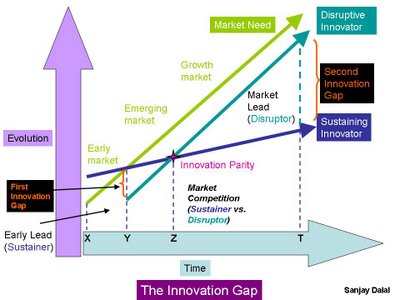
To understand this further, let us look at the chart below titled "The Innovation Gap". (This is a variation from the model discussed by Christensen; I have tried to piece together the underlying concept)


The X axis is the "Time" axis, the Y axis is the "Evolution" axis.
The chart showcases Market Need, Sustaining Innovator, and Disruptive Innovator. For chart simplicity, the Market Need and associated Market Growth is demonstrated on a straight line (a bell curve, or variable curve could be used instead).

Early Lead

The "Sustaining Innovator" or the Sustainer has the Early Lead in the Early Market. It has launched its product at point in time "X" as shown in the chart, a product that not only meets the current need of the customers in the Early Market, but also exceeds it. As a matter of fact, the Sustainer continues meeting this need of the Early Market customers, and some of the need of the Emerging Market customers as the market evolves.

The Disruptive Innovator or the Disruptor is not even present when the Sustainer began marketing its product to the Early Market customers at a point in time "X" on the chart. The Sustainer has this Early Lead on the Disruptor, both in terms of Market and Innovation, until the Disruptor launches its own product at point in time "Y" as shown in the chart.

First Innovation Gap

The Gap exists wherein the Sustainer has simply better Innovation than the Disruptor at the "Y" point of time in the Market evolution, has better understanding of the customer and has greater market share. We call this Gap, the "First Innovation Gap". The Sustainer has the lead on the Disruptor. It is precisely this Gap that drives the Disruptor to create new Innovation that is simple, easy to use and at relatively better price points. The Disruptor targets the low-end of the market or an untapped market. The Disruptor remains "under the radar" for some time as it starts building up this market that the Sustainer largely ignores (for the Sustainer is focused elsewhere, on the larger profitable customers, and meeting their needs).

Of course, this type of "First Innovation Gap" is not simply associated in the Early Market. It could happen at any stage of the Market. The Sustainer will have this Early Lead on the Disruptor always at some point in time.

While the Sustainer is Innovating at a different pace and trajectory serving the needs of its profitable and larger customers, and focused on profitable investments, the Disrupter is Innovating at a faster pace and trajectory serving the needs of the broader market, and creating new market share. The Disruptor has created Innovation that has a broader market appeal, owing to the simplicity and ease of use, and relatively better price points.

Innovation Parity

At point in time "Z" of the market evolution, the Disruptor has caught up with the Sustainer in Innovation, albeit on separate trajectories. We call this intersection as the "Innovation Parity". As is evident, it took the Disruptor less time to get to "Innovation Parity". The "Innovation Parity" is a significant milestone for both the Disruptor and the Sustainer - for the Sustainer has larger market share and profits at this point in time of the market evolution. The Disruptor has a growing share of the market and is also seeing some profits. And both the Disruptor and Sustainer are now matched up in terms of Innovation. The Sustainer's Innovation and market growth is tapered as it crosses the "Innovation Parity". The Sustainer has lost its market pulse and eye on the market, and is now losing head to head versus the Disruptor in its current market and customer base. The Sustainer has seen the growth of the Disruptor and growth of the broader market. However, the Sustainer has not changed with the changing environment and changing customer need. On the other hand, the Disruptor's Innovation and market growth is aligned and even faster than the pace of the market as it crosses the "Innovation Parity". The Disruptor is gaining significant market share, competing and winning head-on versus the Sustainer, and is beginning to create a Market Lead over the Sustainer.

Second Innovation Gap

What begins to emerge after the "Innovation Parity" is the "Second Innovation Gap". The Disruptor continues its Innovation momentum, is in tune with the market need, is winning consistently against the Sustainer, and has increased the market share. The Disruptor becomes the new market share leader at point in time "T" as shown in the chart. The Sustainer has fallen behind in Innovation, lost the momentum, is losing consistently against the Disruptor and lost the market leadership. The "Second Innovation Gap" is much wider than the "First Innovation Gap". For most Sustainers, the "Second Innovation Gap" is Game, Set, Match for the Disruptor that caused the Second Gap in the first place. The Disruptor is the newly crowned market leader and will remain the market leader for the longest time. This is not to say that the Sustainer cannot turn its Innovation and Growth trajectory and has the potential to itself become the Disruptor. However, as with the laws of probability, the probability for the same Sustainer to turn around and become a Disruptor again is minimal at best. Rather it is likely that the newly crowned Disruptor and market leader will at some point in time become complacent, become a Sustainer and leave the door open for a new Disruptor to come from behind. This could happen with a shift in the market, shift in customer need, significant market events, and significant new Innovation. And the Innovation Cycle continues.

How easy is it to cause Disruptive Innovation?

According to Christensen, Disruptive Innovation necessitates a disparate strategy process - not on what is already known to work, and incremental improvements. The process is driven by Creativity, unconventional and out-of-the-box thought, and without any anticipation. Further, the process design does not begin with addressing the needs of current customers (this is what the Sustainer does); rather the process design targets what's underneath the need. What drives customers to do what they do. Where is the unanticipated need? And finally, Disruptive Innovators are not profit driven - at least not initially. Their focus is on creating something of intrinsic value that will apppeal to a much larger market, yet is intuitive, easy to use and simple.

Selected references:
Leading eBook on Creativity and Innovation in Business
Creativity and Innovation Best Practices
Creativity and Innovation Case Studies
The Innovation Index
Top 50 innovative companies in the world

If you enjoyed reading this Creativity best practice, I recommend the complete list of Creativity Innovation Best Practices.

Acknowledgements

Clayton M. Christensen - The Innovator's Dilemma, The Innovator's Solution, Seeing What's Next