Friday, May 5, 2006

‘Dear Inside AdWords…’ – referrals, local business ads, and finding a Professional

It’s been a while since we’ve answered some of your questions, so today, we’re happy to share a few more of our readers’ emails.

When will AdWords referrals be available in the US? – Anne R.

Dear Anne: Good news! We introduced AdWords referrals in the US a few of weeks ago. You can find out more about the program in our past post, or at the AdSense Help Center.

How do we add an image to a local business ad? – TMP

Dear TMP: Once you’re in the Ad Group that you want to edit, you can create a local business ad by clicking the Create Local Business Ad link. Follow the instructions until you get to screen shown below, where you will be given the option to upload a graphic to your ad. (I’ve outlined it in red in the example below for your reference.) Note: the dimensions of the image must be no larger than 125 X 125 pixels, and 20K or under in file size. More guidelines for the images in local business ads can be found here. You can also read more about local business ads in one of our prior posts.


How do I find Google Advertising Professionals in my area that I can interview to purchase services from them? – Marianne E.

Dear Marianne: The easiest way to locate Google Advertising Professionals in your area would be to search for them on Google Maps. Simply go to Google Maps, and type in “google advertising professionals” (we recommend using the the plural form, with quotes around the entire search term) and your city or zip code, and press the Search button. You should then be given a list of local business listings of Google Advertising Professionals in your area. When interviewing service providers, be sure to ask them if they have Qualified Individuals in their firm, or if the company itself has attained Qualified Company status. You can also read more about the Google Advertising Professionals program in our blog post on this subject.

That’s all for this edition. We love getting your questions, so be sure to send them our way. You never know—yours may be answered here next time!


John Gage's Ad-Hoc Keynote - WCIT2006

Senator Kay Bailey Hutchinson (R. Texas) was not able to make it to Austin's WCIT2006 for her Friday Keynote Address (due to a late Senate vote), so John Gage (Chief Researcher and Vice President of the Science Office for Sun Microsystems) pitched in with a delightful Ad-Hoc presentation.

John had spoken at earlier sessions, and given that he has a lot to say he took full advantage of the opportunity to engage a larger audience (the hall was packed in anticipation of a speech by former US Secretary of State Colin Powell)... John easily filled his alloted time, and had to be gently ushered away from the microphone by WCIT2006 CEO Glyn Meek.

John took us on a journey to many of the countries represented at the convention by enlisting Google Earth. As he flew between continents, he pointed out and zoomed in on the homes of fellow presenters and on the future site of 2008's WCIT in Kuala Lampur... and then he demonstrated how the tool could be used to visualize important data... for example the locations of reported Avian Flu incidents.

If Avian Flu spreads as many fear, the first signs are going to be from the undeveloped nations, from the mostly remote rural areas where people live in closer proximity to animals... For our own sakes we need to build out the world's networking infrastructure - starting with the poorest countries first - to insure that we know what is going on in those locales... We need to hear the news of disease outbreaks as soon as possible to prevent the feared pandemic (a compelling argument).

John went on to demonstrate another wonderful tool from www.gapminder.org that can be used to visualize Human Development Trends from around the world over the last four decades. Words Cannot Begin To Describe This Tool --- VISIT THE SITE AND SPEND A FEW HOURS EXPLORING ON YOUR OWN!


Pardon the dramatic all caps of the previous sentence... but you really ought to check this tool out... By graphing Child Survival Rates and GDP per capita income for regions (and individual countries), you can visualize dramatic trends that have taken place over the last several years. You can see countries that were once poor with high child mortality rates blossom in both wealth and health... and you can also see countries where wealth has increased, but health has not.

John makes a compelling point that tools like this can be used to strip away deciet and expose the truth... it is painfully clear which countries have successful health/wealth policies, and which do not. Knowledge (not raw information) is power, and gapminder's tools help transform raw information into knowledge that people and governments can use to the benefit of all...

John's passion for ICT (Information and Communication Technology) as a tool for a better world is contagious, and nobody seemed to mind that he over-ran his allotted time slot... We all wish he could have spoken longer, and with respect to Senator Hutchinson... I was kind of glad that she missed her plane.

Thanks John... You've helped rekindle hope that ICT really can make a difference.

(cross-posted at my java.net blog)

Referral buttons get a makeover

Every once in a while we like to give AdSense features a new look. This time, we're excited to announce the new and improved referral buttons for AdSense, Firefox with Google Toolbar, AdWords, Google Pack and Picasa. With the sleeker design comes a more web-friendly GIF image and several additional colors to choose from -- all to help the button feel more at home on your site.

The new buttons are currently available to US English publishers, and we hope to roll this out for all countries and languages supported by AdSense for content. To try out the new buttons, choose Referrals on your AdSense setup tab and follow the instructions to start displaying the button of your choice.


UPDATED pictures and for accuracy

Thursday, May 4, 2006

Miscellaneous Exterior Detailing Products

Miscellaneous Exterior Detailing Products

Exterior Plastic Trim
- Plastic Polish
- Plastic Restorative Agents
- Plastic Protectant

Windows
- Glass Cleaner
- Liquid Glass Polish
- RainX Exterior Glass Wax
- Microfiber Towels

Headlights and Taillights Plastic
- Plastic Polish
- Polishing Pad

Regards,
Michael Kralj

Security and Privacy - WCIT2006


One of the three focuses of Austin's WCIT2006 is Privacy & Security, and quite by coincidence I spent Thursday volunteering with the Conference Security Team.

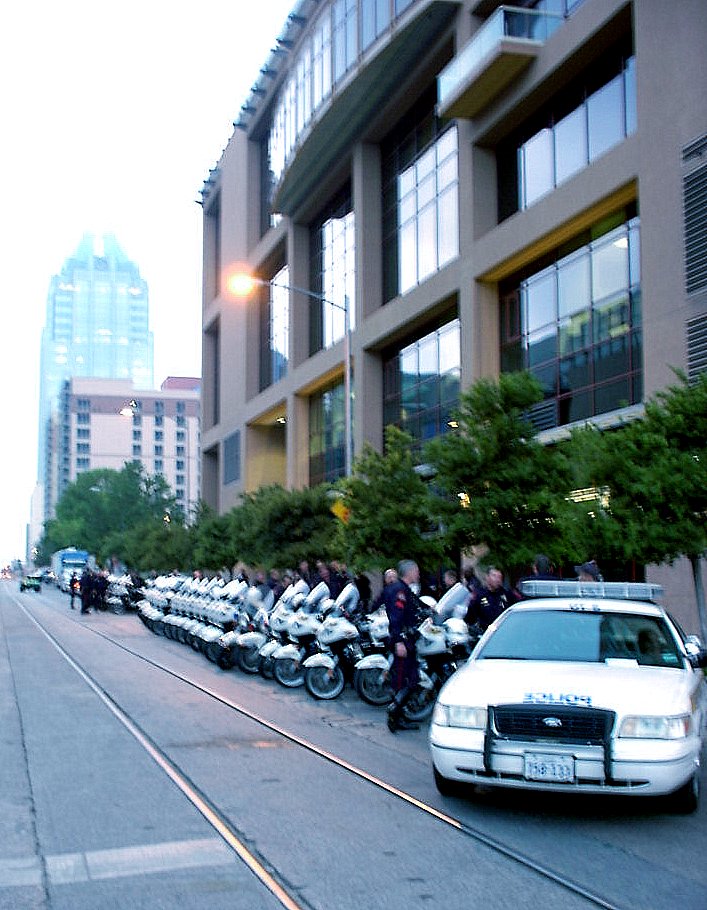
I snapped this picture on the way into the Austin Convention Center this morning: The row of police motorcycles stretching down 4th Street was quite impressive... and it is indicative of the heightened sense of security at events in the US since 9/11.

All of the volunteers for this year's event had to undergo background checks by the FBI... No exceptions. That's a really harsh requirement when you are so reliant on volunteers to conduct business... it was impossible to accept any of the many last minute offers to help.

Privacy and Security are inextricably linked. You cannot have true security unless you know who you are dealing with, and that makes it impossible for anyone to be truly anonymous.

My sense is that we in the US are alone in our stubborn insistence on anonymity. In Malaysia all citizens have been required to carry identification papers since the nation's independence, and as technology improves they have constantly upgraded these ID cards. I was told that the Malaysian smart-ID card has been adopted by nations across the globe.

Our US forms of ID are getting better, but we still fight the establishment of a National ID card. Instead, we complicate the task of identity documents by mandating that each State upgrade their own driver's licenses (the Real ID act). To me, this seems like a lot of smoke and mirrors to preserve a fictional concept instead of meeting our real ID needs.

Security at the conference is pretty tight (we have many dignitaries attending), but it is still dependent on a lot of people standing around and looking at badges. I believe there were plans at one time to set up RFID readers for the badges, but it was impractical for some reason... so we rely on people.

I must say that the reliance on people to check badges was a boon for me: I love to watch people, and standing at the escalator in my "official" staff T-shirt (black, of course) gave me a legitimate excuse to stare at individuals as they walked by. I did not get to hear any of the great keynote sessions, but I did get to have conversations with several interesting attendees.

Of course, this points out why people should not do the task that I was performing. I was diligent in my efforts to check badges, but I was also easily distracted by interesting people (and as my wife knows... I am guilty of looking at pretty women). Perhaps one of the biggest distractions was the incredibly cute bomb-sniffing dog that was working the floor. Wherever the dog went, a crowd gathered... all focused on the dog (including members of our police department).

Even when I was truly focused on the badges, I was relying on color coding... if the color was right I let it pass. I could not check the biometric information on the badges (the picture) to verify that the badge really belonged to the person who was wearing it, and truth be told someone could have easily used a colored piece of paper to deceive me.

Obviously for real security at our conference we would need something like the technology in the Tom Cruise movie "Minority Report" (retinal scanners are pervasive, and identify you wherever you go). We would have to sacrifice privacy for security: Is the price of real security worth the benefit?

Maybe security is worth the loss of privacy, maybe it isn't... and that is one of the topics that the World Congress of IT is discussing in Austin this week.

(cross-posted at my java.net blog)